Senescence Bypass Mechanism Analysis Service
At Creative Biolabs, we recognize that the "bypass" of cellular senescence is a sophisticated survival strategy employed by premalignant and drug-treated cancer cells. Our service is designed to deconstruct these escape routes, providing you with the molecular evidence needed to ensure therapeutic efficacy. By utilizing our proprietary analysis platforms, we help you determine the durability of the senescence response induced by your candidate compounds. This prevents the progression of "persister" cells that could otherwise re-enter the cell cycle, acquire stemness-like characteristics, and drive tumor recurrence.
Introduction of Senescence Bypass Analysis
Cellular senescence serves as a robust barrier against oncogenic transformation, characterized by terminal proliferative arrest. However, senescent cells evolve dynamically, and specific populations can execute a "bypass," re-entering the cell cycle and driving tumor progression or therapeutic resistance. While traditionally governed by p53-p21-CDK and p16-CDK4/6 signaling axes, modern insights reveal complex regulatory layers including METTL1-WDR4 mediated tRNA m7G methylation, acting as a molecular "stopwatch", and metabolic rewiring. Characterizing these escape mechanisms is paramount for developing stable pro-senescence therapies and effective senolytic strategies to eradicate persister cells and optimize clinical outcomes in oncology.
Comprehensive Analytical Capabilities for Senescence Bypass
Creative Biolabs provides an exhaustive suite of analytical tools to monitor and manipulate the senescence arrest. Our offerings include:
High-Throughput Genome-Wide Bypass Screening
We identify specific genetic drivers that, when suppressed or overexpressed, allow cells to ignore physiological growth-arrest signals. Our large-scale CRISPR/Cas9 libraries pinpoint essential regulators that facilitate the transition from stable senescence back into an active, proliferative cell cycle state.
Advanced Epitranscriptomic Modification Profiling
We map the METTL1-WDR4 complex and tRNA m7G46 methylation levels to decode the "RNA stopwatch" governing arrest. This analysis reveals how post-transcriptional modifications influence mRNA translation efficiency and ribosomal biogenesis, providing a unique perspective on the translational control of bypass.
Quantitative Metabolic Flux and Bioenergetic Analysis
We quantify profound bioenergetic shifts, including altered lipid metabolism and mitochondrial ROS feedback loops, that fuel cell cycle re-entry. By measuring oxygen consumption and extracellular acidification rates, we identify the metabolic adaptations required for cells to overcome the senescence barrier.
Dynamic SASP Switch Characterization
Our platform distinguishes between pro-inflammatory and immunosuppressive secretomes to predict the efficiency of immune-mediated clearance. By characterizing signaling shifts, such as the NOTCH1-mediated switch, we help you determine if bypassed cells will successfully evade surveillance or trigger chronic inflammatory responses.
Explore Our Full Suite of Multi-Omic Analytical Tools - Inquire for a Customized Project Plan
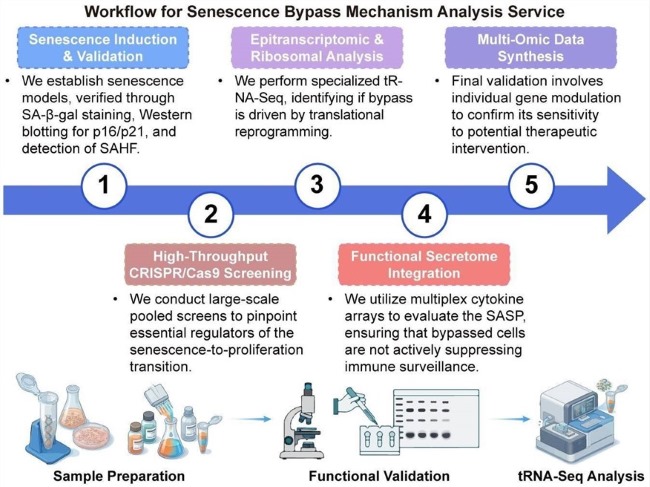
Workflow
Our workflow is a meticulously structured process designed to transition from initial cellular characterization to the identification of actionable therapeutic targets.
Publication
This comprehensive review explores the mechanisms and regulation of cellular senescence, a state of irreversible proliferative arrest critical in cancer and aging. The authors detail key signaling pathways, including p53/p21 and p16/RB, that enforce cell cycle exit, and examine the complex senescence-associated secretory phenotype (SASP). They discuss how DNA damage, mitochondrial dysfunction, and epigenetic changes establish and maintain senescence, highlighting its dual role in tumor suppression through permanent growth arrest versus promoting age-related inflammation and disease, with implications for senolytic therapies.
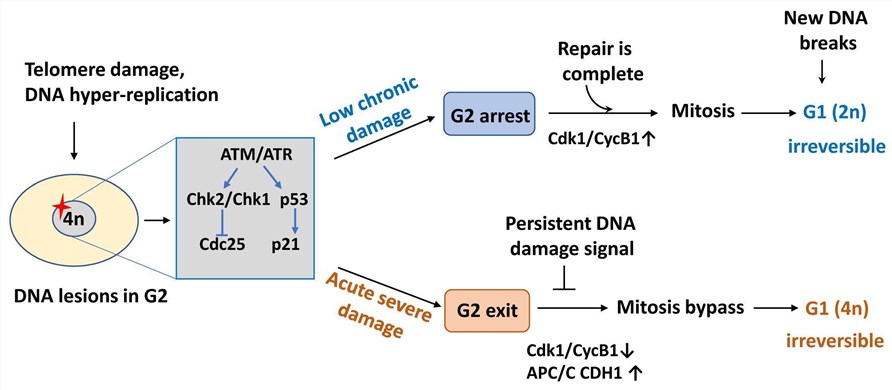 Fig.1 A schematic depiction of molecular mechanisms driving cell cycle arrest in senescence. 1
Why Choose Us?
Creative Biolabs stands at the forefront of senescence biology by integrating the latest breakthroughs into a commercial service. While other providers focus solely on traditional cell cycle markers, we offer a multi-dimensional perspective that includes the tRNA "stopwatch" mechanism and G2-phase arrest analysis. Our platform leverages the human cellular senescence gene database (HCSGD) to provide unparalleled context, ensuring that your results are compared against thousands of validated senescence-related data points. Our unique advantage lies in our ability to decouple growth arrest from the senescence-associated secretory phenotype (SASP). This allows for the discovery of "clean bypass" mechanisms that are essential for regenerative medicine and the development of next-generation senomorphics. With a proven track record of supporting high-impact research, Creative Biolabs is your partner in de-risking the drug development pipeline.
Experience the Creative Biolabs Advantage in Cellular Engineering - Get an Immediate Quote Today
FAQs
How does your bypass analysis handle the heterogeneity of senescent cells?
Creative Biolabs utilizes single-cell resolution where possible and multi-marker validation (SA-β-gal, p16, and SAHF) to ensure that the analysis accounts for the diversity of the senescent state across different tissues.
Can you identify targets for 'clean' bypass in regenerative medicine?
Yes. We can specifically screen for pathways that allow cell proliferation while neutralizing the deleterious pro-inflammatory SASP, which is a major goal in anti-aging research.
How do you validate that the 'bypass' is not just a sub-population of non-senescent cells?
We use rigorous baseline characterization and time-lapse imaging to ensure that the cells re-entering the cycle were definitively in a senescent state before the bypass event.
Customer Review
-
Unmatched Precision in Genomic Screening
Using Creative Biolabs' senescence bypass analysis in our research has significantly facilitated our understanding of how G2-phase arrest is circumvented in p53-deficient models. The precision of their CRISPR screening is unmatched. - Dr. Alen** S -
Unparalleled Clarity in Metabolic Adaptations
The integration of Seahorse flux analysis with genomic data allowed us to see how bypassed cells fuel their re-entry into the cycle. Creative Biolabs provided insights that standard RNA-seq missed entirely. - Sarah P*n
Related Services
Cell Death-mediated Cancer Resistance Analysis Services
Creative Biolabs analyzes apoptosis, necrosis, and autophagy resistance. We identify Bcl-2/Mcl-1 upregulation and p53 mutations to deconstruct survival-promoting pathways and overcome therapeutic resistance.
Learn More →Ferroptosis Tumor-related Pathway Solutions
Creative Biolabs provides ferroptosis-mediated pathway analysis and translational oncology research. We target System Xc-, GPX4, and FSP1 to overcome drug resistance and reveal novel therapy opportunities in cancer immunotherapy.
Learn More →How to Contact Creative Biolabs
Creative Biolabs provides the most advanced senescence bypass mechanism analysis service available, moving beyond simple cell cycle counts to explore the deep metabolic and epitranscriptomic roots of cellular arrest stability. Whether you are aiming to stabilize anti-tumor senescence or harness the "clean bypass" for regeneration, our team of senior scientists is ready to assist you in achieving your research goals.
Contact Creative Biolabs today to discuss your senescence bypass project with a senior scientist.
Reference
- Roger, Lauréline, Fanny Tomas, and Véronique Gire. "Mechanisms and regulation of cellular senescence." International journal of molecular sciences 22.23 (2021): 13173. Distributed under Open Access license CC BY 4.0, without modification. https://doi.org/10.3390/ijms222313173
 Download our brochure