Senescence associated Secretory Phenotype (SASP) Analysis Service
Creative Biolabs provides the analytical precision required to distinguish between beneficial acute senescence and detrimental chronic "inflamm-aging." Our service is specifically designed to navigate the complexity of the DDR–SASP–ImmR axis, a critical framework where DNA damage response (DDR) triggers an Immunomodulatory (ImmR) secretome that can paradoxically promote tumor evasion or tissue fibrosis. By partnering with us, you gain access to high-resolution mapping of cytokines, proteases, and exosomal cargo that drive age-related pathologies and therapy resistance.
Scientific Background: Mechanistic Drivers of SASP
Cellular senescence is a sophisticated stress response characterized by irreversible cell cycle arrest and the subsequent development of a highly bioactive secretome known as the SASP. Peer-reviewed research demonstrates that the SASP is far more heterogeneous than previously understood, functioning as a "double-edged sword" in tissue homeostasis. While transient SASP secretion can assist in wound healing and tumor suppression, its chronic accumulation is a primary driver of systemic aging and chronic pathologies, including fibrosis and immunosuppression. Recent technical analyses have highlighted the role of the DDR–SASP–ImmR axis, where DNA damage triggers the release of factors that recruit myeloid-derived suppressor cells (MDSCs) to the tumor microenvironment.
Comprehensive Solutions
Our platform provides specialized analytical breadth to capture every facet of the senescent secretome, ensuring your research is supported by multi-dimensional data and high-resolution molecular mapping.
Deep Proteomic Profiling
Utilizing TMT-labeling and high-resolution LC-MS/MS, we provide unbiased quantification of hundreds of secreted proteins. This allows for the discovery of novel biomarkers and the characterization of inducer-specific secretome signatures.
High-Sensitivity Multiplexing
We offer MSD-based assays to quantify low-abundance cytokines and chemokines. This targeted approach ensures picogram-level sensitivity for critical "core" SASP factors, even in small-volume research samples.
Exosomal Cargo Characterization
Our team specializes in isolating and analyzing the extracellular vesicle SASP (eSASP). We profile protein and lipid contents to reveal how these vesicles mediate paracrine signaling and bystander effects.
Pathway Integration & Mapping
We deliver sophisticated bioinformatic analyses that map your secretome data onto biological networks. This elucidates the functional impact of SASP on immune recruitment, tissue remodeling, and the tumor microenvironment.
Inquire Now to Explore Our Custom Analytical Packages and Tiered Service Options
Workflow
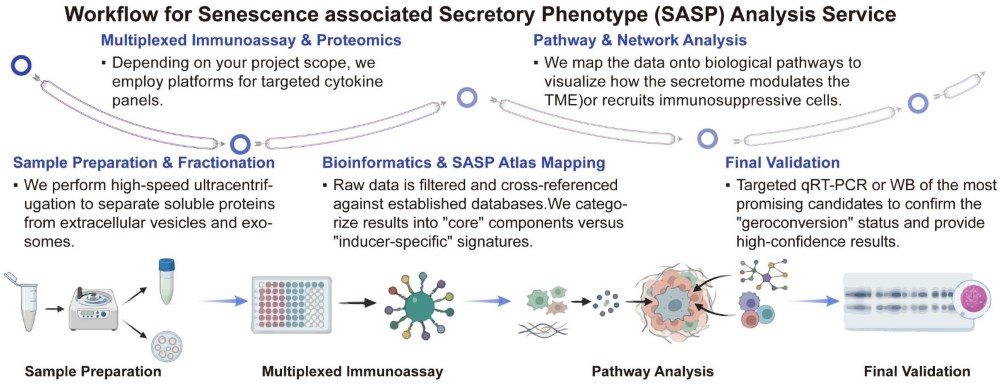
To ensure the highest data fidelity, Creative Biolabs has developed a standardized yet flexible workflow that accounts for the extreme sensitivity and transient nature of the senescent secretome.
Publication
This review examines the dual role of the SASP in head and neck cancers (HNCs), where it can both suppress tumors via immune surveillance and promote progression through chronic inflammation, angiogenesis, and therapy resistance. The authors detail SASP generation mechanisms, its impact on the tumor microenvironment, and emerging therapeutic strategies, including senolytics and senomorphics. Targeting SASP components offers potential to overcome treatment resistance and improve outcomes in HNC patients.
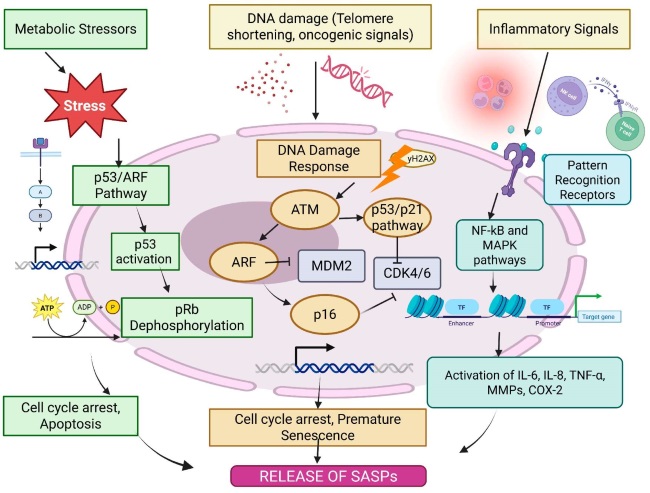 Fig.1 Mechanisms driving SASP generation. 1
Why Choose Us?
Creative Biolabs stands at the forefront of longevity research by offering an integrated SASP Analysis platform that transcends basic cytokine detection. While many providers rely on limited antibody arrays, we utilize high-resolution TMT-based mass spectrometry and multiplexed immunoassays to capture the full proteomic landscape. Our unique advantage lies in our deep integration with the SASP Atlas methodology, allowing us to differentiate between core markers like GDF15 and stimulus-specific factors. Furthermore, we provide specialized analysis of the eSASP, which contains distinct bioactive lipids and proteins that drive paracrine senescence. This comprehensive approach ensures that your senotherapeutic candidates are validated against a holistic secretome profile, significantly reducing the risk of off-target effects and increasing translational success in complex disease models.
Experience the Creative Biolabs Advantage – Get a Technical Quote Today
FAQs
How does Creative Biolabs distinguish SASP from general inflammatory responses?
We use a multi-marker approach, pairing secretome data with intracellular markers like p16INK4a and p21CIP1, and cross-referencing your samples against the "core" signatures identified in the SASP atlas.
Can you analyze SASP from small-volume research samples?
Yes, our MSD platforms are optimized for low-volume samples (as little as 25 μL), making them ideal for murine plasma or precious tissue biopsies.
Do you offer assistance in choosing the right senescence inducer for our cell line?
Absolutely. Our scientific team consults on various induction methods (X-ray, oncogenic stress, or genotoxic drugs) to ensure the model reflects the research conditions you are targeting.
Customer Review
-
Unbiased Discovery
Using Creative Biolabs' SASP analysis in our research has significantly facilitated the discovery of non-canonical markers in our chemotherapy-induced senescence models. The separation of exosomal vs. soluble fractions was critical for identifying the bioactive drivers of our phenotype. - Dr. A***n L -
Superior Sensitivity
The multiplex platform provided by Creative Biolabs improved our ability to detect low-abundance cytokines like IL-1α in senescent keratinocytes, which we previously struggled to quantify using standard ELISA techniques. The data was exceptionally clean. - Prof. M***o R
Related Services
To further your longevity and oncology research, Creative Biolabs recommends these complementary offerings:
Type-I Interferon (IFNα) Engineering Services
Creative Biolabs provides IFNα engineering, quantifying receptor-biased agonism and TME-activation. We utilize protease-cleavable prodrugs and fusion constructs to evaluate kinetic bias and half-life extension for an optimized therapeutic index.
Learn More →Longevity Targeted Genetic Modulation Service
Creative Biolabs provides longevity-targeted genetic modulation, quantifying gene regulatory networks and epigenetic drift. We utilize synthetic gene circuits and AAV delivery to evaluate transient reprogramming and metabolic restoration for therapeutic rejuvenation.
Learn More →How to Contact Creative Biolabs
Creative Biolabs offers a world-class SASP analysis service that bridges the gap between basic geroscience and research applications. By leveraging the SASP atlas, advanced mass spectrometry, and multiplex immunoassays, we provide the most comprehensive secretome profiling available to the biopharmaceutical industry.
Contact Our Team for More Information and to Discuss Your Project
Reference
- Alam, M. T., et al. "The Impact of Senescence-Associated Secretory Phenotype (SASP) on Head and Neck Cancers: From Biology to Therapy." Cancers (Basel) 17.24 (2025). Distributed under Open Access license CC BY 4.0, without modification. https://doi.org/10.3390/cancers17244024
 Download our brochure