T Lymphocyte (T Cell) Immunophenotyping Service
Background Service Highlights FAQs Contact Us
Introduction: Unraveling the Complexity of T Lymphocytes
T lymphocytes, or T cells, represent a pivotal component of the adaptive immune system, orchestrating potent defenses against a diverse array of threats, ranging from extrinsic pathogens to intrinsic dangers such as malignant cells. Concurrently, specialized subsets of T cells meticulously regulate immune responses, preventing detrimental autoimmunity and maintaining systemic homeostasis. The remarkable functional diversity of T cells is intrinsically linked to their intricate differentiation and maturation states. Understanding this heterogeneity is paramount for advancing immunological research, developing targeted therapies, and refining diagnostic approaches in various disease contexts, including infectious diseases, autoimmune disorders, and cancer.
Immunophenotyping, a sophisticated technique employing multi-parameter flow cytometry, stands as the gold standard for comprehensively identifying and characterizing distinct T cell populations. This method relies on the differential expression of specific cell surface markers, intracellular transcription factors, and cytokine secretion profiles, allowing for precise delineation of functionally diverse T cell subsets. At Creative Biolabs, with over two decades of specialized experience in the biological industry, we leverage cutting-edge technologies and deep scientific expertise to provide unparalleled T lymphocyte immunophenotyping services.
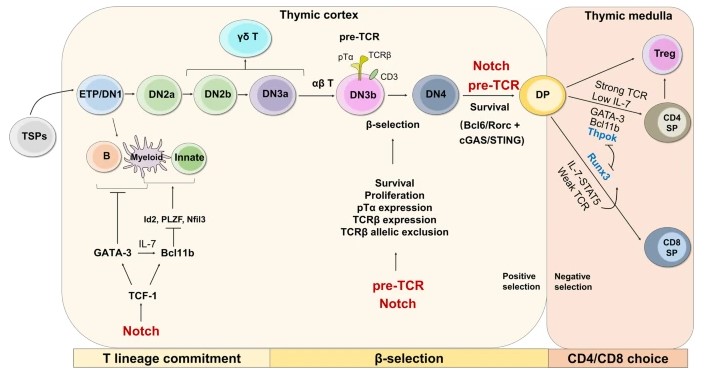 Fig.1 T cell development.1
T Lymphocyte (T Cell) Immunophenotyping Service at Creative Biolabs
Creative Biolabs offers a robust and comprehensive T lymphocyte immunophenotyping service designed to meet the rigorous demands of both fundamental research and clinical translation. Our service focuses on the precise identification and quantification of T cell populations, critical for monitoring immune responses, tracking disease progression, and evaluating therapeutic efficacy. Utilizing state-of-the-art multi-parameter flow cytometry, Creative Biolabs delivers high-resolution analysis, essential for deciphering the nuanced roles of T cells in health and disease. This capability is particularly vital in the era of advanced immunotherapies, where accurate T cell characterization directly informs patient stratification and treatment monitoring.
Our Comprehensive Service Contents
Our T Lymphocyte Immunophenotyping Service encompasses a broad spectrum of analytical capabilities, providing granular detail on the T cell compartment:
Discerning T Cell Subsets and Functional Phenotypes
Our advanced panels are meticulously designed to delineate the diverse T cell subsets, crucial for understanding their specialized functions:
CD4+T Helper (Th) Cells:
We rigorously identify and quantify major helper T cell subsets including:
-
Th1 cells: Characterized by extracellular markers such as CD183 (CXCR3) and intracellular expression of T-bet, producing key cytokines like IFN-y and IL2, central to cellular immunity against intracellular pathogens.
-
Th2 cells: Identified by markers like CD194 (CCR4) and CD294 (CRTH2), expressing GATA3, and secreting IL4 and IL5, pivotal in allergic responses and anti-helminth immunity.
-
Th9 cells: Distinguished by intracellular PU.1 expression and IL9 secretion.
-
Th17 cells: Marked by CD196 (CCR6) or CD161 (KLRB1) expression, ROR transcription factor, and production of IL17, implicated in autoimmune diseases and host defense against extracellular bacteria and fungi.
-
Th22 cells: Characterized by CCR10 expression, AHR and/or FOXO4 transcription factors, and IL22 secretion.
-
CD4+ Regulatory T Cells (Tregs): Identified by key suppressive markers such as CD25 (IL2R-alpha) and CD152 (CTLA4), alongside the master transcription factor FoxP3, critical for maintaining immune tolerance and preventing autoimmunity.
CD8+T Cytotoxic T Lymphocytes (Tc):
Mirroring the functional diversity of CD4+ cells, we characterize CD8+ subsets including:
-
Tc1, Tc2, Tc9, Tc17 cells: Defined by analogous extracellular markers, transcription factors, and cytokine profiles (e.g., CD183/CXCR3 and T-bet for Tc1 producing IFN-y; GATA3 for Tc2 secreting IL4/IL5; RORt for Tc17 producing IL17), executing direct cytotoxic functions.
-
CD8+ Regulatory T Cells: Analogous to CD4+ Tregs, expressing CD25, CD152, and FoxP3, contributing to immune suppression.
Characterization of Effector Memory Differentiation States
Beyond functional subsets, Creative Biolabs meticulously analyzes the differentiation status of T-αβ cells, which dictates their migratory capacity, longevity, and immediate effector functions:
-
Naïve (TN) T cells: Representing unprimed cells.
-
Stem Cell Memory (TSCM) T cells: Exhibiting high proliferative capacity and self-renewal.
-
Central Memory (TCM) T cells: Recirculating in lymphoid organs, poised for rapid recall responses.
-
Effector Memory (TEM) T cells: Circulating in peripheral tissues, capable of immediate effector functions upon antigen re-encounter.
-
Effector T cells (TEFF): Terminally differentiated cells with potent immediate effector functions.
These populations are discriminated using combinations of extracellular markers such as CD45RA or CD45RO, CD197 (CCR7), CD95, CD62L, CD27, CD28, CD122 (IL2R-beta), and CD127 (IL7R-alpha). We also assess the expression of co-stimulatory and co-inhibitory receptors (e.g., CTLA-4, PD-1, TIGIT, TIM-3), which are vital indicators of T cell activation and exhaustion.
Identification of Antigen-Specific T Cells
For highly specialized research, Creative Biolabs offers advanced capabilities for identifying antigen-specific T-αβ cells. Utilizing highly specific tetramer or pentamer staining, which are biotinylated peptide–MHC complexes linked to fluorescent labels, we can directly visualize and quantify T cells recognizing specific epitopes. The application of combinatorial tetramer staining with multiple fluorochromes significantly enhances specificity, allowing for the simultaneous identification of numerous different antigen specificities, even for very small, low-frequency populations.
Distinct Advantages
At Creative Biolabs, our distinction in T lymphocyte immunophenotyping is forged by a confluence of factors:
-
Unparalleled Expertise
-
Cutting-Edge Technological Infrastructure
-
Comprehensive and Validated Panels
-
Robust Quality Control and Data Reliability
FAQs
Q1: What types of samples can Creative Biolabs analyze for T cell immunophenotyping?
A1: Creative Biolabs can analyze a variety of sample types, including freshly isolated peripheral blood mononuclear cells (PBMCs), whole blood, and other relevant biological specimens. Specific sample preparation requirements will be discussed upon consultation.
Q2: Can Creative Biolabs develop custom T cell immunophenotyping panels for specific research needs?
A2: Absolutely. Creative Biolabs specializes in developing and validating custom multi-parameter panels tailored to the unique requirements of your research project, leveraging our extensive expertise and comprehensive antibody library.
Q3: What are the typical applications for T cell immunophenotyping service?
A3: Our service is widely applicable across various fields, including basic immunology research, cancer immunotherapy monitoring, vaccine development and efficacy studies, autoimmune disease characterization, infectious disease diagnostics, and biomarker discovery.
Q4: How does Creative Biolabs ensure the accuracy and reliability of its results?
A4: Creative Biolabs adheres to rigorous quality control protocols, including detailed gating strategies, viability staining, and the use of appropriate controls. Our instruments are regularly calibrated, and our methods are validated against established industry standards to ensure high accuracy and reproducibility.
Contact Us
To discuss your specific T lymphocyte immunophenotyping needs or to request a quote, please contact Creative Biolabs’ expert team. We are committed to providing tailored solutions and exceptional scientific support to accelerate your research breakthroughs.
Reference
-
Sun, Lina et al. "T cells in health and disease." Signal transduction and targeted therapy vol. 8,1 235. 19 Jun. 2023, doi:10.1038/s41392-023-01471-y. Distributed under Open Access License CC BY 4.0, without modification.
 Download our brochure