Our workflow enables a seamless transition from deep NGS genotyping and RNA-Seq to high-resolution mass spectrometry and spatial proteomics. This unified approach provides a holistic view of the antigen presentation landscape within a single, streamlined process.
Tumor Antigen Presentation Defect Analysis Service
Creative Biolabs provides a thorough molecular investigation into the pathways that render research models "invisible" to the immune system. We provide an integrated assessment of the antigen lifecycle - from intracellular processing to surface display. By partnering with Creative Biolabs, researchers gain a deeper understanding of resistance mechanisms, enabling the identification of novel targets and the optimization of experimental therapeutic combinations. Our clients gain the clarity needed to de-risk discovery pipelines and validate therapeutic hypotheses with high-resolution evidence.
Introduction What We Can Offer How We Can Help Why Choose Us Customer Reviews FAQs Related Services Contact Us
Mechanisms of Tumor Antigen Presentation and Immune Escape
Tumor Antigen Presentation Defects (TAPD) represent a sophisticated escape mechanism where neoplastic cells silence the "master switches" of immunity, such as NLRC5 and CIITA, or physically alter the MHC-I/II groove structure. Research indicates that a high proportion of solid tumors across various experimental models utilize these complex pathways to achieve immune invisibility. Creative Biolabs' service provides a high-resolution analysis of the entire antigen life cycle - from intracellular ERAP-mediated trimming to MHC-II CLIP displacement - ensuring your research targets are rigorously evaluated for visibility to the immune system.
Request a Consultation →
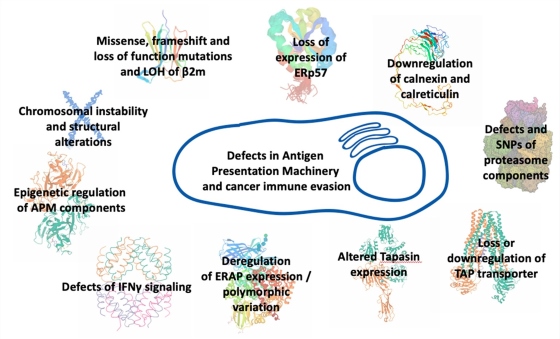 Fig.1 Defects in different components of the antigen processing and presentation machinery. 1
What We Can Offer
Integrated Multi-Omic Platforms
Rigorous Quality Control
Every analysis is conducted within a well-established research quality system. By following Quality-by-Design (QbD) principles and utilizing advanced analytical techniques, we ensure that your data meets the highest standards of reliability and scientific reproducibility.
Scalable Throughput
Our facilities are equipped to handle diverse project scales, ranging from single-sample exploratory pilot studies to large-scale longitudinal cohorts. We ensure consistent data quality and timely delivery regardless of the complexity or volume of your research.
Technical Documentation
Clients receive detailed analytical reports reviewed by our internal team of experts. These documents are designed to be suitable for supporting high-impact research publications, internal decision-making processes, and technical presentations to key stakeholders.
How Creative Biolabs Can Assist Your Project
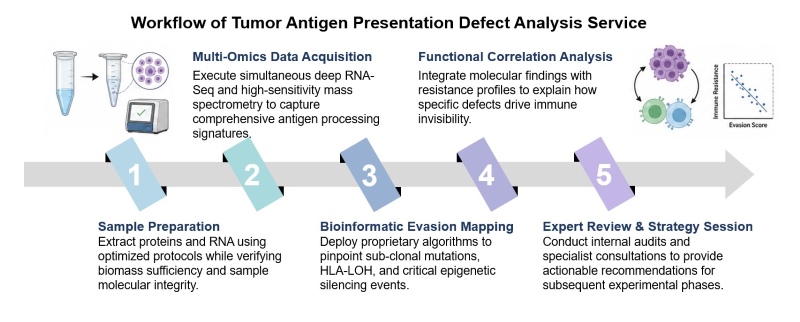
Highlights
Unified Analytical Platform
Creative Biolabs leads the field by integrating complex findings in MHC-II-CLIP dynamics and NLRC5 regulation. Our single platform approach ensures a streamlined workflow for investigating diverse immune evasion mechanisms across research models.
Dual-Pathway Capture
Our service uniquely covers both CD8+ and CD4+ evasion mechanism. By analyzing MHC Class I and Class II pathways simultaneously, we provide researchers with a complete view of immune resistance profiles.

High-Sensitivity Detection
We utilize proprietary algorithms for HLA-LOH detection in heterogeneous research samples. These tools deliver superior sensitivity compared to standard open-source alternatives, ensuring that even minor sub-clonal escape mechanisms are identified.
Contextual Biological Insights
Beyond delivering raw data, we provide a biological narrative of immune escape. Our reports correlate identified defects with non-responsiveness, offering the mechanistic evidence required to validate your experimental therapeutic hypotheses.
Experience the Creative Biolabs Advantage and secure a competitive edge in your immunotherapy programs - Get a Quote Today.
Customer Reviews
-
Accurate HLA-LOH Detection
Partnering with Creative Biolabs allowed us to distinguish between genomic antigen loss and processing defects in our lead program. Their high-sensitivity algorithms successfully identified sub-clonal escape mechanisms that standard tools missed. - S**h. Z. -
Pathway Mapping
The inclusion of ERAP1/2 enzymatic analysis facilitated our neoantigen discovery efforts by identifying over-trimmed peptides. This insight prevented us from pursuing several targets that the model could not physically display. - Prof. M***o. K.
FAQs
How does your service differ from standard Whole Exome Sequencing?
Unlike WES which focus only on mutations, we provide functional analysis of processing machinery. We evaluate surface presentation, enzymatic trimming, and epigenetic silencing that standard sequencing often misses.
What is the minimum purity required for results?
We accept diverse research samples. Our advanced bioinformatic deconvolution techniques allow us to adjust for varying purity levels, ensuring high-resolution results even in complex or heterogeneous tissue.
Related Services
Integrated Multi-Omics & Metastasis Risk Stratification Service
This service combines genomic and proteomic profiling to identify specific molecular signatures associated with metastatic potential in preclinical models, facilitating the categorization of high-risk research cohorts.
Learn More →Tumor Microenvironment Immune Escape Signature Identification Service
We utilize multi-omic spatial profiling to identify distinct molecular signatures that drive immune exclusion and suppressive microenvironments in your specific research models.
Learn More →How to Contact Us
Creative Biolabs provides a high-resolution molecular lens for deconstructing the complexities of antigen presentation defects in laboratory research. By seamlessly combining genomic analysis with transcriptomic profiling and functional proteomic assays, we empower research teams to investigate the fundamental drivers of immune resistance.
Our integrated approach facilitates the optimization of experimental therapies and helps validate candidate neoantigens by ensuring they are effectively processed and displayed by the research model's immune machinery - Get Started Today.
Reference
- Mpakali, Anastasia, and Efstratios Stratikos. "The Role of Antigen Processing and Presentation in Cancer and the Efficacy of Immune Checkpoint Inhibitor Immunotherapy." Cancers vol. 13,1 134. 4 Jan. 2021. Distributed under an Open Access license CC BY 4.0, without modification. https://doi.org/10.3390/cancers13010134
 Download our brochure
Loading case studies...
Online Inquiry