Ubiquitin-Specific Protease (USP) Panel Screening Service
Introduction: The Critical Role of Ubiquitin-Specific Proteases in Cellular Homeostasis
Ubiquitin-Specific Proteases (USPs) constitute the largest and most diverse family within the broader class of deubiquitinating enzymes (DUBs). These enzymes play an indispensable role in maintaining cellular homeostasis by precisely regulating protein ubiquitination, a reversible post-translational modification critical for a myriad of cellular processes. USPs achieve this by cleaving ubiquitin moieties from target proteins, thereby influencing protein stability, localization, and activity. Their regulatory functions extend across fundamental biological pathways, including but not limited to cell cycle progression, DNA damage response, gene expression, signal transduction, protein degradation, mitochondrial function, and immune responses.
Dysregulation of USP activity is frequently observed in various pathological conditions, underscoring their profound involvement in disease pathogenesis. Consequently, the accurate assessment and comprehensive profiling of USP activity are paramount for deciphering their specific functional contributions in both health and disease, and for identifying novel therapeutic targets. At Creative Biolabs, with over two decades of specialized experience in advanced biological analyses, we recognize the critical need for robust and precise tools to investigate this complex enzymatic family.
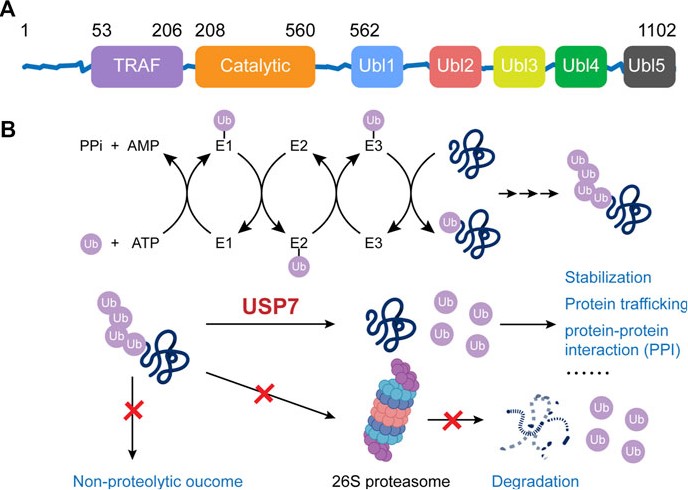 Fig.1 Structure and function of USP7.1
Our Ubiquitin-Specific Protease (USP) Panel Screening Service
Creative Biolabs' Ubiquitin-Specific Protease (USP) Panel Screening Service represents a cornerstone of our commitment to advancing biological research and drug discovery. Leveraging our extensive expertise and state-of-the-art technological platforms, this service is meticulously designed to provide a comprehensive and quantitative assessment of multiple USP activities within diverse biological samples.
Our service goes beyond mere detection; it aims to provide deep insights into the dynamic landscape of USP activity. By identifying which specific USPs are active, quantifying their relative activity levels, and observing how these profiles shift under varying physiological or pathological conditions, Creative Biolabs empowers researchers to gain unprecedented clarity into the intricate roles of these enzymes. This understanding is invaluable for pinpointing key regulatory nodes in cellular pathways, identifying potential disease biomarkers, and, crucially, discovering novel therapeutic targets that can be modulated for clinical benefit. Our commitment at Creative Biolabs is to deliver data of the highest scientific rigor, ensuring precision and accuracy in every analysis.
Comprehensive Service Content: Methodologies, Insights, and Applications
Creative Biolabs' USP Panel Screening Service is built upon a foundation of advanced methodologies, designed to yield detailed insights into USP function and specificity.
- Core Methodologies
The primary purpose of our USP panel assay is to meticulously characterize the activity and substrate specificity of a broad spectrum of USP enzymes. To achieve this, we employ a multi-faceted approach:
- Activity-Based Probes: Our service utilizes highly specific activity-based probes, often conjugated with reporter tags such as HA or FLAG. These probes covalently bind to the active site of catalytically active USPs, allowing for the simultaneous detection, enrichment, and identification of multiple active USPs directly from complex biological matrices like cell extracts or tissue homogenates. This methodology provides a snapshot of the active USP landscape within a given sample.
- Substrate-Based Assays: We employ a panel of carefully selected substrate-based assays. These assays typically involve fluorogenic substrates, such as Ubiquitin-AMC, or specific peptide/protein substrates that are tagged with ubiquitin. Upon cleavage by an active USP, these substrates release a detectable signal (e.g., fluorescence). By testing a range of substrates against purified USP proteins or cell lysates, we can precisely measure the deubiquitinating capacity of individual USPs and elucidate their preferred substrate specificities.
- High-Throughput Screening (HTS): For applications in drug discovery, our platform is optimized for high-throughput screening. This enables the rapid and efficient evaluation of large libraries of compounds to identify potential inhibitors or activators of specific USPs, accelerating the lead discovery process.
- Mass Spectrometry (MS/MS) Analysis: In conjunction with activity-based probes, advanced MS/MS analysis is routinely performed. This powerful proteomic technique allows for the unambiguous identification and quantification of the specific USPs that are active in a given sample, providing unparalleled molecular detail.
Our service accommodates a variety of sample types, including purified USP proteins, cell lysates from diverse cell lines, and tissue extracts, ensuring broad applicability across research paradigms.
- Information Gained and Key Insights
Through our comprehensive approach, Creative Biolabs' USP Panel Screening Service provides critical information, including:
- Identification of Active USPs: Pinpointing which specific USPs are catalytically active in your sample.
- Relative Activity Levels: Quantifying the relative enzymatic activity of identified USPs.
- Dynamic Activity Profiles: Revealing how USP activity profiles change in response to different conditions (e.g., disease states, drug treatments, genetic manipulations).
- Substrate Preferences: Providing insights into the substrate specificities of individual USPs, crucial for understanding their precise biological roles.
Diverse Applications Across Research and Drug Discovery
The insights generated by Creative Biolabs' USP Panel Screening Service have profound implications across various scientific disciplines:
- Basic Biological Research: Our service is instrumental in fundamental investigations aimed at deciphering the specific functions of individual USPs within intricate cellular processes. For instance, researchers can explore the roles of USPs in cell cycle regulation, understanding how they control progression through different phases, or their involvement in DNA damage response pathways, where they are critical for maintaining genomic integrity. Furthermore, USPs are key players in signal transduction cascades, and our assays can illuminate their contributions to cellular communication.
-
Disease Research and Biomarker Discovery: Altered USP activity is a hallmark of numerous diseases, making our service invaluable for disease research:
- Cancer Research: USPs are frequently dysregulated in cancer, influencing protein stability, cell cycle progression, and apoptosis, all critical for tumorigenesis and metastasis. Creative Biolabs' analyses have consistently revealed distinct USP activity patterns in tumor cell lines of varying histological origins, providing crucial insights into cancer-specific USP vulnerabilities. For example, studies have shown that USP21 regulates STAT3 activation, mitochondrial function, and cell proliferation in cancer cells, while USP2 is implicated in cell migration and STAT3 phosphorylation. USP36, for instance, deubiquitinates and stabilizes the oncogenic protein c-Myc in the nucleolus, highlighting its potential as a therapeutic target.
- Neurodegenerative Diseases: USPs play significant roles in neuronal function and are increasingly implicated in the pathogenesis of neurodegenerative conditions such as Alzheimer's and Parkinson's diseases. Our screening can help identify specific USPs whose dysregulation contributes to these complex disorders.
- Inflammatory Diseases: By regulating key inflammatory pathways, USPs represent promising targets for the treatment of chronic inflammatory conditions. Our service can identify USPs that modulate these pathways.
- Metabolic Disorders: Emerging evidence links USPs to metabolic dysregulation, including obesity and diabetes. Profiling USP activity can uncover novel targets for metabolic disease intervention.
- Infectious Diseases: Certain viruses have evolved mechanisms to manipulate host USP activity to facilitate their replication and evade immune responses. Our service can help characterize these host-pathogen interactions.
- Drug Discovery and Therapeutic Target Identification: Given their enzymatic nature and critical roles in disease, USPs are considered highly promising therapeutic targets. Creative Biolabs' USP Panel Screening Service is a pivotal tool in the drug discovery pipeline:
- Inhibitor/Activator Screening: Our high-throughput capabilities enable rapid screening of compound libraries to identify novel small molecule inhibitors or activators of specific USPs.
- Lead Characterization: Once potential hits are identified, our assays can be used to thoroughly characterize their potency, selectivity, and mechanism of action. For instance, virtual screening approaches, followed by experimental validation, have successfully identified promising USP5 inhibitors targeting its zinc finger ubiquitin-binding domain, demonstrating the power of targeted drug discovery efforts. The development of several USP inhibitors as potential cancer therapeutics is a testament to the translational impact of this research.
Our Advantages
At Creative Biolabs, our distinct advantages stem from our unwavering commitment to scientific excellence and client success:
- Cutting-Edge Technology
- Comprehensive Analytical Depth
- Customization and Flexibility
- Unparalleled Expertise
FAQs
Q1: What types of samples can be submitted for Creative Biolabs' USP Panel Screening Service?
A1: Our service is versatile and can accommodate a variety of sample types, including purified USP proteins, cell lysates from diverse cell lines, and tissue extracts. Please contact us to discuss specific sample preparation requirements.
Q2: What kind of information will I receive from the USP Panel Screening Service?
A2: You will receive comprehensive data identifying the specific USPs active in your sample, their relative activity levels, and how these profiles change under different experimental conditions. We also provide insights into the substrate preferences of the USPs analyzed.
Q3: How can Creative Biolabs' USP Panel Screening Service benefit my drug discovery efforts?
A3: This service is invaluable for drug discovery. It enables the identification of dysregulated USPs as potential therapeutic targets, facilitates the high-throughput screening of compound libraries to find novel inhibitors or activators, and aids in the detailed characterization of lead compounds.
Q4: Is the USP Panel Screening Service suitable for high-throughput applications?
A4: Yes, our platform is optimized for high-throughput screening, particularly for the identification of USP inhibitors or activators from large compound libraries.
Q5: Does Creative Biolabs provide assistance with data interpretation?
A5: Absolutely. Our team of experienced biological specialists provides expert data analysis and interpretation, helping you understand the significance of your results and guiding your subsequent research strategies.
Contact Us
To learn more about how Creative Biolabs' Ubiquitin-Specific Protease (USP) Panel Screening Service can accelerate your research and drug discovery initiatives, or to discuss your specific project requirements, please do not hesitate to contact us. Our dedicated team is ready to assist you.
Reference
- Lu, Jiabin et al. "Targeting Ubiquitin-Specific Protease 7 (USP7) in Cancer: A New Insight to Overcome Drug Resistance." Frontiers in pharmacology vol. 12 648491. 22 Apr. 2021, doi:10.3389/fphar.2021.648491. Distributed under Open Access License CC BY 4.0, without modification.
 Download our brochure