ALT-like Immortalization Pathway Characterization Service
Creative Biolabs provides a specialized analytical suite designed to identify and quantify the alternative lengthening of telomeres (ALT) phenotype across diverse cell lines and patient-derived tumor tissues. In the current oncology landscape, approximately 15% of cancers, particularly high-grade sarcomas and glioblastomas, bypass telomerase inhibitors by utilizing ALT. By identifying these hallmarks, we enable you to discover synthetic lethal vulnerabilities and predict drug responses with high precision, ensuring your lead compounds are tested in the most relevant biological contexts.
Comprehensive Overview of the ALT Immortalization Pathway
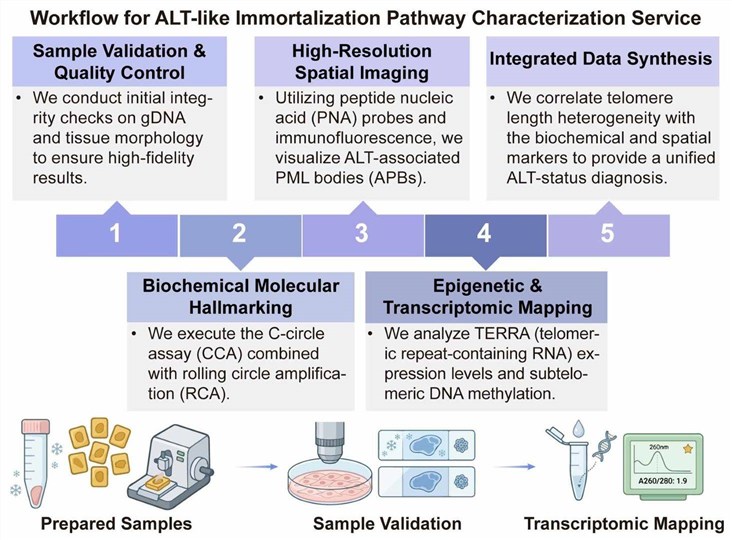
The ALT pathway is a homologous recombination-mediated DNA replication strategy utilized by approximately 15% of human malignancies to achieve replicative immortality. Unlike telomerase-positive cells, ALT cells exhibit extreme telomere length heterogeneity and produce extrachromosomal telomeric repeats (ECTRs). Recent literature identifies the loss of chromatin remodelers ATRX and DAXX, along with the subsequent recruitment of the SLX4-nuclease complex, as the primary triggers for this pathway. Characterizing these recombination events is vital for overcoming resistance to telomerase-targeted therapies and identifying new therapeutic windows in aggressive sarcomas and central nervous system tumors.
Precise Molecular Solutions and Deliverables
Our service delivers more than raw data; we provide a roadmap for therapeutic intervention. We specialize in detecting the transition from telomerase-dependency to ALT-dependency, a common resistance mechanism in clinical settings.
Comprehensive ALT Mechanistic Profiling
Creative Biolabs delivers an in-depth analysis of the SLX4-dependent recombination pathway. We identify pathological nuclease recruitment and telomere trimming events, providing essential data for validating small-molecule inhibitors that target the DNA damage response machinery specifically within ALT-positive tumor environments.
Spatial Co-localization & APB Analysis
Our platform visualizes ALT-associated PML bodies (APBs) using high-resolution immunofluorescence. By tracking the recruitment of the MRN complex and RAD52 to telomeric foci, we provide spatial evidence of active recombination, which is critical for supporting regulatory dossiers.
Epigenetic Plasticity & TERRA Mapping
We evaluate the transcriptomic landscape of telomeres by quantifying TERRA expression and subtelomeric methylation patterns. This assists in identifying R-loop-mediated vulnerabilities, offering a holistic view of the epigenetic factors that drive replicative immortality and influence overall drug sensitivity.
Unlock the Full Potential of Your Oncology Pipeline — Request a Specialist Consultation Today
Workflow
Creative Biolabs employs a systematic and multi-disciplinary workflow to ensure the accurate identification of telomere maintenance mechanisms.
Publication
This study reveals that ATRX loss in human pluripotent stem cells, combined with p53/Rb pathway disruption, creates a deterministic system for ALT induction upon differentiation. Contrary to current models, ALT activation occurs independently of telomere crisis and is driven by differentiation-triggered telomere instability. The findings demonstrate that a non-genetic switch, cellular differentiation, initiates telomere recombination in ATRX-deficient cells, leading to immortalization and providing mechanistic insights into ALT-positive cancers.
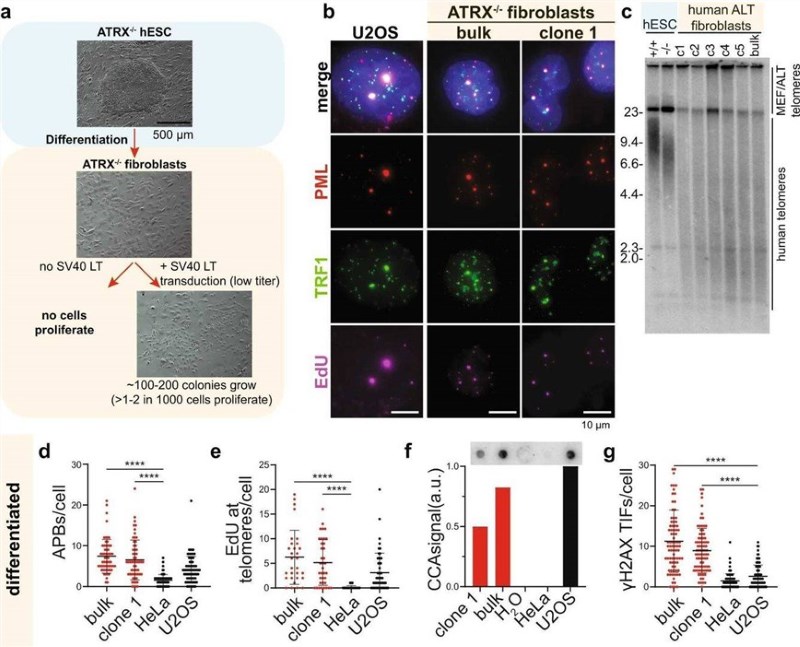 Fig.1 ATRX loss induces alternative lengthening of telomeres. 1
Why Choose Us?
Creative Biolabs stands at the intersection of expertise and innovation, offering a platform optimized for detecting "low-level" or "emergent" ALT activity that standard assays often overlook. Our advantage lies in our deep understanding of the SLX4-SLX1-ERCC4 axis, allowing us to provide insights into telomere trimming and trimming-mediated generation. We leverage Published Data and proprietary assay optimizations to ensure every result is a definitive step toward your project milestones. Our commitment to accuracy helps reduce the risk of false negatives in complex, heterogeneous tumor samples.
Harness Over 20 Years of Scientific Leadership — Experience the Creative Biolabs Advantage and Get a Quote Today
FAQs
How does your service distinguish between ALT and low-level telomerase activity?
We utilize a dual-verification system combining the TRAP assay for telomerase. This ensures that even in "TMM-switch" scenarios, the dominant maintenance mechanism is correctly identified.
Is the service compatible with archived FFPE tumor samples?
Yes, Creative Biolabs has developed optimized DNA extraction protocols that recover high-quality gDNA from FFPE sections, though fresh-frozen samples are recommended for TERRA RNA quantification.
Are there specific precautions for shipping samples for TERRA analysis?
Because TERRA is a non-coding RNA, samples must be flash-frozen and shipped on dry ice. We also offer stabilization buffers to ensure transcript integrity during transit.
Customer Review
-
Exceptional Precision in Telomere Mapping
Using Creative Biolabs' ALT characterization in our research has significantly facilitated the differentiation of heterogeneous cell populations in our glioblastoma models. The assay sensitivity was far superior to our previous qPCR-based methods. - Dr. Ama** S -
Crucial Epigenetic Insights
The analysis of DNMT3B isoforms and TERRA levels provided by Creative Biolabs was instrumental in explaining the resistance profile of our sarcoma lines. A very thorough approach to epigenetic plasticity. - Prof. Mar** L
Related Services
Agonist/Antagonist Assay Services
Creative Biolabs provides neurite outgrowth, [3H]-2-DG glucose uptake, and cell-based antagonist assays. We quantify potency and selectivity to characterize pharmacological profiles for metabolic and neurological drug discovery.
Learn More →Immunophenotyping based T Cell Exhaustion Service
Creative Biolabs provides high-dimensional immunophenotyping to map T-cell exhaustion gradients. We utilize multi-color flow cytometry to quantify proliferative loss and cytotoxic dysfunction, identifying terminal exhaustion states for immuno-oncology research.
Learn More →How to Contact Creative Biolabs
Creative Biolabs offers a world-class platform for the characterization of ALT-like immortalization, providing the data depth required for modern oncology research. From mechanistic SLX4 profiling to epigenetic TERRA analysis, we are your partner in navigating the complexities of telomere maintenance and achieving your drug discovery milestones.
For detailed information or to discuss the specifics of your project, please reach out to our team of specialists.
Reference
- Turkalo, T. K., et al. "A non-genetic switch triggers alternative telomere lengthening and cellular immortalization in ATRX deficient cells." Nat Commun 14.1 (2023): 939. Distributed under Open Access license CC BY 4.0, without modification. https://doi.org/10.1038/s41467-023-36294-6
 Download our brochure