This assay provides a detailed analysis of the mass and purity of antibodies and antigens, ensuring the quality of your starting materials before more complex assays.
Learn More →B Cell based Hydrogen/Deuterium Exchange Footprinting Assay Service
Creative Biolabs' hydrogen-deuterium exchange mass spectrometry (HDX-MS) is a powerful biophysical technique used to probe protein structure and dynamics. As acknowledged in published data, HDX-MS can serve as a complementary method to traditional structural biology approaches like X-ray crystallography and Cryo-EM. Its ability to provide information on proteins in solution, including conformational changes upon ligand binding, has made it a routine technique for various applications. Creative Biolabs leverages these advancements to offer a unique solution tailored for biotherapeutic development.
Introduction What We Can Offer Workflow Why Creative Biolabs Customer Reviews FAQs Related Services Contact Us
Fundamental Principle of the Assay
During the antigen and antibody binding process, solvent accessibility can be used to label the amino acid sequences of a protein by the exchange between backbone amide hydrogen and deuterium in the solvent. The exposed protein amide hydrogen atoms are in place with deuterium, while hydrogen atoms are hidden and kept unlabeled in the antibody binding location of the antigen. Changes in peptide backbone due to ligand binding and chemical labeling are easily detected and read out by MS technology and are interpreted to structure data rapidly.
Explore our solutions and request a consultation.
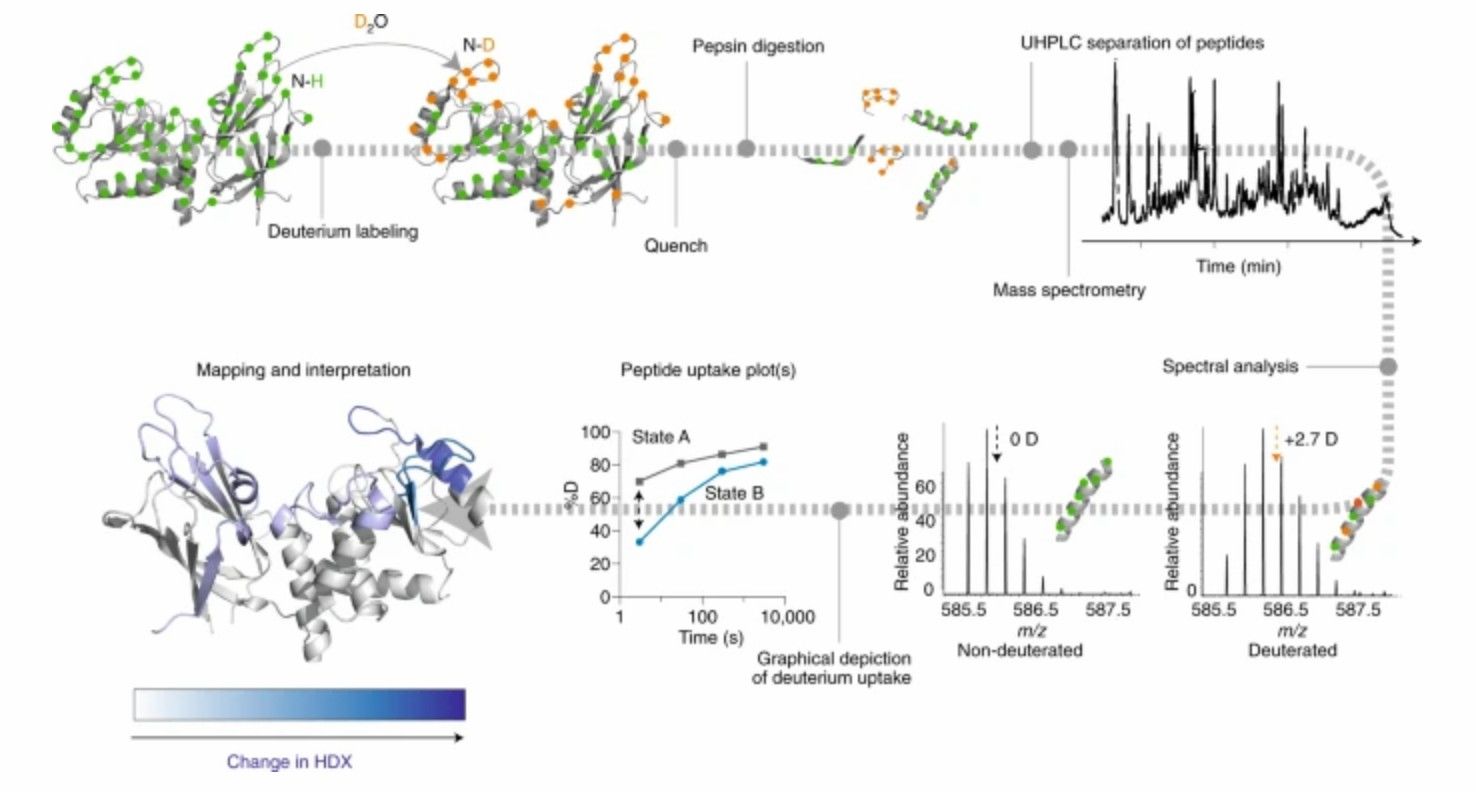 Fig.1 Workflow of the bottom-up hydrogen/deuterium exchange footprinting assay. 1
What We Can Offer
| Complete sample validation | Accurate | Sensitive | Thoroughly characterization |
|---|---|---|---|
|
Parameters include: sample purity, sequence, protein modifications, aggregation state, protein activity, and folding state. |
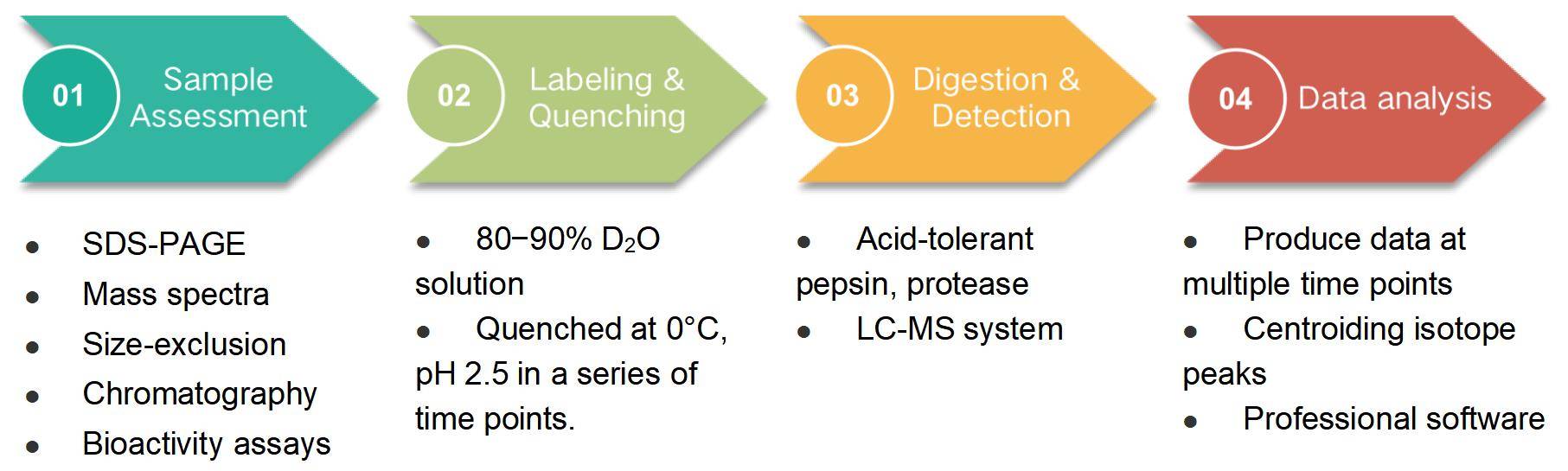
At least duplicate deuterium labeling and incorporation experiments are carried out to ensure precise results. | A higher labeling solution facilitates higher deuterium incorporation to assure high sensitivity. | Hundreds of peptides at various time points produce a large quantity of HDX-MS data, consisting of centroiding isotope peaks. |
HDX Footprinting Assay at Creative Biolabs
The HDX-MS compares the HDX exchange rates of protein segments from the antigen alone to the peptides after an antibody binds to the antigen. Creative Biolabs is talented in eliminating the back-exchange and developing suitable enzyme digestion strategies to generate peptide-level information that best describes your antigen.
| Starting Material | Our Deliverables |
|---|---|
|
|
Highlights
Physiological Relevance
Creative Biolabs' method yields data that is highly relevant, providing insight into the antigen-antibody interaction as it would naturally occur in the body, which is unattainable with conventional in vitro methods.
Unmatched Precision
Our assay provides high-resolution epitope mapping data that helps pinpoint the precise binding site. This level of detail is critical for intellectual property and understanding the mechanism of action.

World-Class Expertise
Our team consists of specialists with over 20 years of experience. We provide expert interpretation and analysis, ensuring that raw data is turned into clear, actionable insights for your project.
Solid Scientific Foundation
Our assay is built upon a solid scientific foundation and is backed by published data. We adhere to the highest standards of scientific rigor, ensuring reliable and reproducible results for your research.
Discover how a partnership with us can streamline your research - Get a quote today.
Customer Reviews
-
Seamless & Efficient
Our project timeline was greatly facilitated by the efficiency of Creative Biolabs' workflow. The detailed report was instrumental in validating our therapeutic antibody, giving us the confidence to advance to the next development stage. - T. Kn. -
Beyond Expectations
We've tried multiple epitope mapping services, but none compare to the level of detail from Creative Biolabs. The HDX-MS data gave us insights into our antibody's mechanism of action that we could not have obtained otherwise. - Jhn De.
FAQs
What is the key advantage of a B cell-based HDX assay over traditional in vitro methods?
Our assay analyzes the binding interaction directly on the surface of a living B cell, providing unparalleled physiological accuracy. This allows us to capture the binding "footprint" in a native, biologically relevant context that traditional methods cannot replicate.
What types of antigens are suitable for this assay?
The B cell-based HDX assay is well-suited for a wide range of antigens, including proteins, peptides, and even more complex targets. We can work with samples of varying complexities and sizes.
Related Services
B Cell-based Mass Spectrometry Assay
B Cell-based Cross Blocking Assay
This service is crucial for antibody development, as it determines if two or more antibodies compete for the same epitope on an antigen. It helps in the selection of a diverse panel of therapeutic candidates.
Learn More →How to Contact Us
Creative Biolabs' experienced experts offer cancer epitope mapping services using HDX-MS, providing insight into the mechanism of pathology and target therapeutic function from the protein structure view. Our HDX-MS assay is highly efficient and cost-effective. We provide rapid data analysis and high-resolution results. If you are interested in our HDX-MS service, please contact us for a quote.
Reference
- Masson, Glenn R et al. "Recommendations for performing, interpreting and reporting hydrogen deuterium exchange mass spectrometry (HDX-MS) experiments." Nature methods vol. 16,7 (2019): 595-602. Distributed under an Open Access license CC BY 4.0, without modification. https://doi.org/10.1038/s41592-019-0459-y
 Download our brochure
Loading case studies...
Online Inquiry