We support your project throughout its entire lifecycle, managing everything from initial laboratory cell line tests to extensive experimental group validations for seamless continuity.
Cancer Stem Cell Cytokine/Chemokine Profiling Service
Creative Biolabs provides a map of the signaling networks that define the CSC niche. We offer high-sensitivity quantification of a vast array of analytes, sophisticated bioinformatics, and customized panel selection. By partnering with Creative Biolabs, clients can expect to gain a deep mechanistic understanding of tumor resilience, identify novel research targets, and accelerate the validation of potential therapeutic candidates. This service transforms complex secretome data into clear, actionable insights for your drug discovery pipeline.
Introduction What We Can Offer How We Can Help Why Choose Us Customer Reviews FAQs Related Services Contact Us
Introduction to CSC Cytokine/Chemokine Profiling
The Cancer Stem Cell (CSC) niche is a dynamic signaling environment where cytokines and chemokines serve as the primary "software" for tumor resilience. These molecules mediate the transition from experimental precancerous states to full malignancy, prime the metastatic niche, and drive resistance via NF-κB and JAK/STAT pathways. Creative Biolabs' service synthesizes these complex biological insights into actionable data for the research community, providing a robust framework for understanding the underlying mechanisms of the stemness niche.
Request a Consultation →
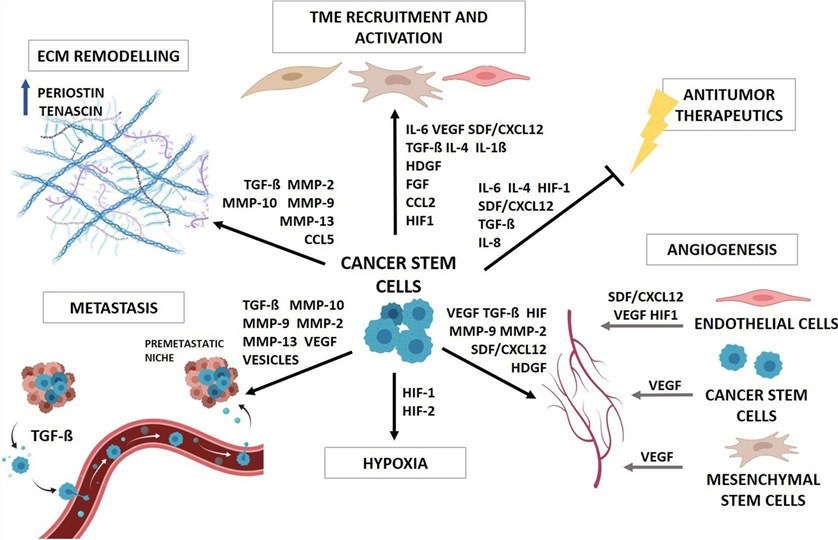 Fig.1 Decoding the CSC secretome in tumor microenvironment engineering. 1
What We Can Offer
One-stop profiling service
Fully customized profiling panels
Our team creates bespoke testing arrays specifically designed for your unique research goals, focusing on the specific signaling pathways most relevant to your study.
High-throughput processing capability
Our advanced automated systems allow us to process vast quantities of samples simultaneously, ensuring rapid project completion while maintaining exceptional consistency and reliability across every test.
Well-established quality system
We apply rigorous oversight and planning to every stage of our analysis, ensuring that your results are highly reproducible and meet the highest research standards.
How Creative Biolabs Can Assist Your Project
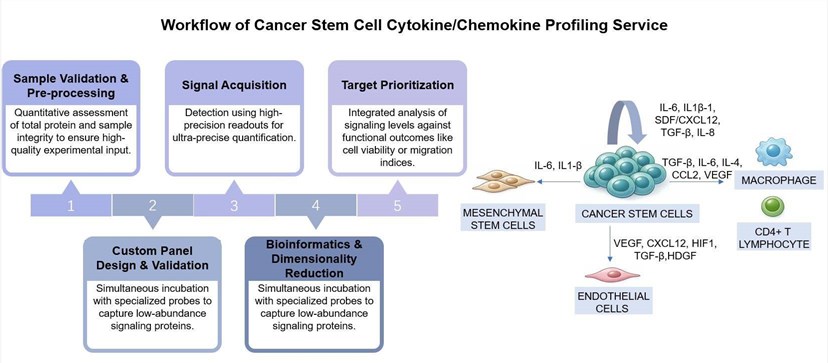
Highlights
Leading Technical Sensitivity
We remain at the forefront of stem cell research by providing analytical depth that exceeds common industry limitations. This ensures that your project captures even the rarest signals.
Optimized Niche Detection
Our platform is specifically designed to navigate the complex microenvironment. We successfully distinguish between temporary inflammatory reactions and the permanent signaling that supports chronic tumor growth and resilience.

Proprietary Analytical Context
By using our exclusive internal reference databases and benchmarks, we provide an essential perspective for your results. This allows your team to understand findings within a broader scientific framework.
Professional Research Support
We provide high-level support tailored to the rigorous demands of both academic and industrial environments. Our expertise ensures your data meets the standards required for advanced developmental milestones.
To begin tailoring a high-precision strategy that addresses your specific research challenges and resource goals, we invite you to get a quote today.
Customer Reviews
-
Enhanced Resolution of the Hypoxic Niche
Using Creative Biolabs' profiling service in our research has improved our ability to track hypoxia-induced secretome changes. The multiplex approach allowed us to see correlations we missed with single assays. - Dr. S**a. S. -
Streamlined PDX Model Validation
The high-sensitivity detection was crucial for our low-volume experimental samples. Creative Biolabs facilitated the identification of circulating markers that now serve as our primary efficacy indicators. - Prof. M**a. L.
FAQs
How does your service compare to standard ELISA?
Our platform allows for the simultaneous detection of a wide variety of markers in a single test, providing a more comprehensive and sensitive overview of cellular activity.
Can you handle samples from rare cell populations?
Yes, our specialized systems are designed to work with very limited sample amounts, ensuring high-quality results even when working with the most difficult and scarce cell types.
Related Services
Cancer Stem Cell Antigen Processing & Presentation Molecule Analysis Service
Screening of how cells prepare and display signals to the immune system, helping researchers understand mechanisms behind immune recognition and evasion.
Learn More →Tumor Metabolic Microenvironment Analysis Services
We evaluate the expression of MHC molecules and processing machinery in stem cell populations, identifying mechanisms used by tumor-initiating cells to avoid recognition by T-lymphocytes.
Learn More →How to Contact Us
Our specialists are available for technical consultations to discuss your project requirements and design the most effective analytical strategy for your research. For project inquiries to receive a personalized quote and learn more about our global support for your scientific milestones, please reach out to our team.
Reference
- López de Andrés, Julia et al. "Cancer stem cell secretome in the tumor microenvironment: a key point for an effective personalized cancer treatment." Journal of hematology & oncology vol. 13,1 136. 15 Oct. 2020. Distributed under an Open Access license CC BY 4.0, without modification. https://doi.org/10.1186/s13045-020-00966-3
 Download our brochure
Loading case studies...
Online Inquiry