Cancer Stem Cell & ICI Combination In Vitro Test Service
Creative Biolabs provides a high-fidelity platform to evaluate therapeutic interactions with the cancer stem cell (CSC)-immune axis. We move beyond standard assays to distinguish between bulk tumor debulking and the radical eradication of the CSC niche. Our data helps you refine dosing strategies and understand mechanistic synergies for bispecific antibodies and cell therapies. By targeting the "silent architects" of relapse, we provide the insights needed to transform "cold" tumors into "hot," immune-accessible targets, significantly de-risking your clinical development.
Introduction to CSC-Mediated Immune Evasion
CSCs represent a minority subpopulation of tumor cells with infinite self-renewal and multi-lineage differentiation capabilities. Crucially, they serve as a reservoir for immune evasion. By overexpressing a specific battery of inhibitory molecules, such as B7-H3, B7-H4, CD200, CD155, and VISTA, CSCs create an "immunological shield" that standard immune checkpoint inhibitors (ICIs) often fail to penetrate. Furthermore, studies have shown that immunotherapy can sometimes paradoxically enrich CSC populations through IFN-γ signaling, a phenomenon known as treatment-induced stemness. Our platform is specifically designed to identify therapies that break this shield and prevent the regenerative cycle of the tumor.
Comprehensive Service Portfolio
To address the multifaceted nature of CSC-mediated immune evasion, Creative Biolabs offers a modular and highly customizable service portfolio. Our offerings are designed to provide deep mechanistic insights while maintaining high-throughput efficiency for lead optimization.
Customized CSC-Immune Co-culture Systems
We offer a variety of effector cell options, including autologous TILs, engineered PBMCs, and specialized NK cell populations, co-cultured with patient-derived CSCs to evaluate immune recruitment and activation.
Next-Generation Checkpoint Screening
Beyond the standard PD-1 axis, we provide validation assays for emerging targets often enriched on CSCs, such as B7-H3, B7-H4, CD47, VISTA, and TIGIT.
Tumor-Microenvironment (TME) Modulation Assays
We evaluate how your candidates alter the secretome of the CSC niche, measuring changes in immunosuppressive factors like TGF-β, IL-10, and adenosine.
Combination Synergy Mapping
Utilizing advanced mathematical modeling (e.g., Bliss independence or Loewe additivity), we determine the synergistic potential of ICIs combined with epigenetic modifiers, metabolic inhibitors, or stemness pathway blockers (Wnt/Notch/Hedgehog).
High-Content 3D Imaging & Kinetic Analysis
Our platform provides continuous, real-time tracking of spheroid regression and immune cell infiltration, offering a dynamic view of therapeutic efficacy that endpoint assays miss.
Explore Our Full Assay Catalog for Overcoming Resistance - Inquiry Now for a Custom Screening Plan
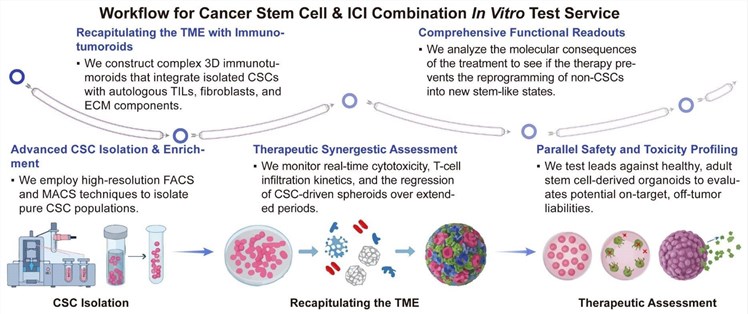
Workflow
Our structured workflow is designed to provide actionable intelligence at every stage of the drug discovery process.
Publication
This review explores the potential of combining immunogenic cell death (ICD) inducers with ICIs to improve cancer immunotherapy. While such combinations can convert immunologically "cold" tumors into "hot" ones and enhance treatment efficacy in some settings, many clinical trials show inconsistent results. The authors analyze the factors behind these discrepancies, such as dosing, scheduling, and tumor heterogeneity, and propose strategies to optimize these combinatorial regimens for greater patient benefit.
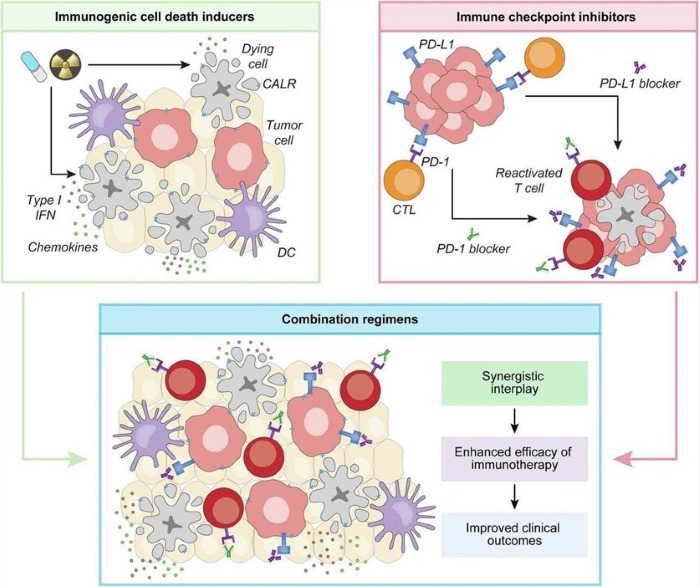 Fig.1 Boosting cancer immunotherapy: The synergy between ICD inducers and ICIs. 1
Why Choose Us?
Creative Biolabs stands at the forefront of the immunotherapy landscape by integrating deep expertise in stem cell biology with advanced immunological assays. Our unique advantage lies in our deep checkpoint profiling—we screen over 10 classical and "non-classical" immune checkpoints, which are often overexpressed on CSCs. Our methodologies are grounded in published data that demonstrates our 3D-RDL assays provide significantly higher predictive value for clinical outcomes than conventional 2D systems. By choosing Creative Biolabs, you gain access to a partner that prioritizes precision, safety, and the total eradication of the tumor's regenerative capacity.
Experience the Creative Biolabs Advantage in 3D Modeling - Get a Benefit-Driven Quote Today
FAQs
How does Creative Biolabs ensure the specificity of CSC targeting?
We use a multi-marker approach (e.g., CD133, CD44, EpCAM) combined with functional validation, such as sphere-formation efficiency, to ensure we are truly measuring the response of the stem-like subpopulation.
Can you incorporate proprietary immune cells into the 3D model?
Yes. We frequently integrate client-provided CAR-T, CAR-NK, or engineered PBMCs into our 3D immunotumoroids to evaluate their specific potency within a structured TME.
What is the benefit of the 3D-RDL framework over standard co-cultures?
The 3D-RDL (redirect lysis) framework is optimized for standardized effector-to-target ratios in a 3D space, providing more reproducible data for bispecific antibodies and other cell-engaging therapies.
Customer Review
-
Superior Predictive Accuracy
Using Creative Biolabs' 3D-RDL assay in our research has significantly facilitated our understanding of how CSCs evade T-cell killing. The inclusion of healthy organoids as a safety control was a game-changer for our lead selection. - Dr. Ama** S -
Exceptional Technical Insight
The ability to track CSC lineage shifts during ICI treatment helped us identify why our initial leads were failing. Creative Biolabs provided much more than just data; they provided a clear mechanistic path forward. - Prof. Rob** W
Related Services
Cancer Stem Cell targeted Nano-Drug Efficacy & Toxicity Assessment
Creative Biolabs validates CSC eradication by tracking intracellular fate and lysosomal escape. We provide evidence of self-renewal inhibition, bypassing ABC transporters and metabolic barriers to ensure clinical success.
Learn More →Patient Derived Organoid Models
Creative Biolabs offers patient derived organoid models for high-throughput screening and disease modeling. By combining NGS with 3D cultures, we enhance clinical decision-making and personalized treatment precision.
Learn More →How to Contact Creative Biolabs
Creative Biolabs offers a world-leading service that transforms how biopharmaceutical companies approach immunotherapy resistance. By bridging the gap between stem cell biology and immune evasion, we provide the high-fidelity evidence needed to advance your most promising leads from the bench to the clinic.
Accelerate Your Pipeline Success - Contact Our Team for More Information and to Discuss Your Project
Reference
- Catanzaro, Elena, et al. "Immunogenicity of cell death and cancer immunotherapy with immune checkpoint inhibitors." Cellular & Molecular Immunology 22.1 (2025): 24-39. Distributed under Open Access license CC BY 4.0, without modification. https://doi.org/10.1038/s41423-024-01245-8
 Download our brochure