Cancer Stem Cell Immune Interaction Network Modeling Service
Creative Biolabs provides a high-fidelity computational framework designed to dismantle the immune-privileged "quiescence" of cancer stem cells (CSCs). Conventional immunotherapies often target the bulk tumor mass while inadvertently sparing the tumor-initiating cells responsible for metastasis and recurrence. Our service assists your project by mapping the "bidirectional crosstalk" where CSCs actively sculpt an immunosuppressive landscape. We provide actionable data on how your therapeutic candidate disrupts these protective feedback loops, moving your drug discovery process from empirical observation to predictive design.
Scientific Framework of the CSC-Immune-Metabolic Niche
The CSC-immune interaction network represents a resilient biological ecosystem where tumor-initiating cells "sculpt" their microenvironment to ensure survival against host surveillance. Published literature confirms that CSCs utilize complex bidirectional crosstalk to maintain an "immune-metabolic-stroma niche." By exploiting nutrient competition, depleting glucose and glutamine required for T-cell activation, CSCs effectively starve infiltrating lymphocytes while simultaneously secreting lactate to drive M2-macrophage polarization. Furthermore, the niche provides a physical fortress through stromal ECM remodeling and paracrine signaling via exosomes, which transfer miRNAs that induce stable epigenetic "memory" and stemness.
Comprehensive Solutions for CSC Network Analysis
Our service suite is built upon multi-dimensional analysis to provide a complete picture of the CSC-immune sanctuary. We offer:
Multiscale Mathematical Oncology
We model the stochastic state transitions of CSCs, shifting between proliferative (ALDH+) and invasive (CD44+) states, to predict how your drug impacts cell plasticity.
Immune-Metabolic Niche Mapping
We analyze nutrient competition (e.g., glucose and glutamine) between CSCs and effector T-cells, identifying metabolic vulnerabilities like LDHA or GLS activity.
Stroma & Exosomal Signaling Analysis
Creative Biolabs tracks paracrine communication between CSCs and cancer-associated fibroblasts (CAFs), including the transfer of miRNA via exosomes that drives chemoresistance.
Mechanical Signaling Simulations
We model the impact of extracellular matrix (ECM) stiffness on CSC mechanotransduction (YAP/TAZ signaling) and its role in physical immune exclusion.
Discover How Our Expertise Can Empower Your Research - Request a Consultation Today
Workflow
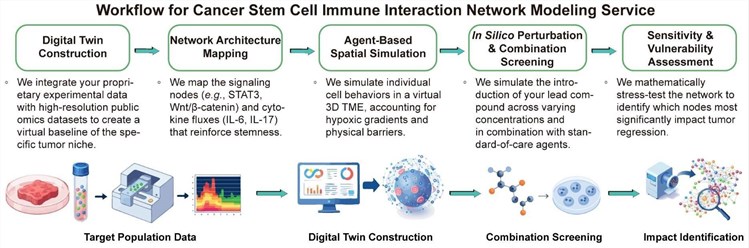
Creative Biolabs employs a rigorous, multi-stage workflow designed to bridge the gap between raw omics data and therapeutic breakthroughs.
Publication
This review explores the bidirectional interaction between CSCs and the immune microenvironment. CSCs employ multiple strategies to evade immune detection and actively recruit or reprogram immunosuppressive cells, such as M2 macrophages, Tregs, and MDSCs. Conversely, these immune subsets can reinforce CSC properties, promoting tumorigenicity, metastasis, and therapy resistance. Understanding this dynamic crosstalk is crucial for developing more effective immunotherapies that can target the resilient CSC population and improve patient outcomes.
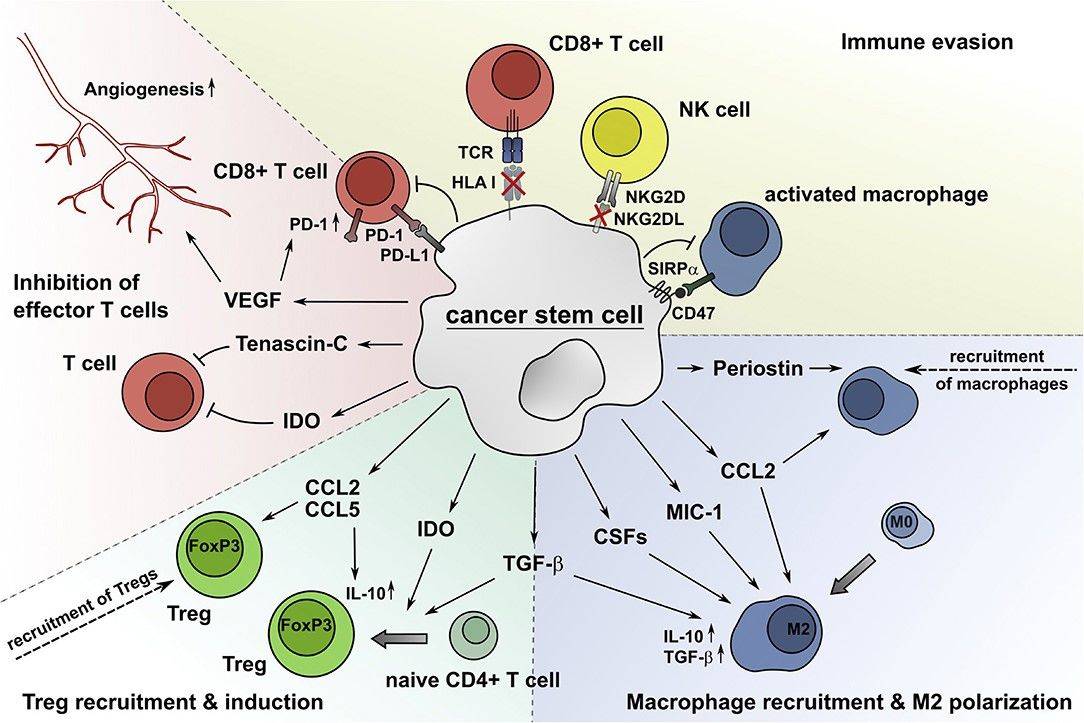 Fig.1 CSCs remodel the immune microenvironment to evade surveillance. 1
Why Choose Us?
Creative Biolabs stands at the global forefront of oncology modeling, seamlessly merging over two decades of antibody engineering expertise with cutting-edge computational systems biology. Unlike generic data science firms, we possess a profound understanding of the "immune-metabolic-stroma niche" and its multifaceted role in therapeutic resistance. Our proprietary models are grounded in high-impact research, incorporating parameters that track how CSCs utilize soluble factors like periostin, TGF-β, and CCL2 to actively recruit and reprogram myeloid-derived suppressor cells (MDSCs). By utilizing evolutionary game theory and digital twin technology, Creative Biolabs identifies transient "metabolic symbiosis" nodes that standard assays fail to detect.
Experience the Creative Biolabs Advantage - Get a Detailed Quote Today
FAQs
How does your model account for tumor heterogeneity?
We utilize single-cell RNA sequencing data to capture the full spectrum of CSC states, from proliferative epithelial to invasive mesenchymal, ensuring the model reflects real-world diversity.
Can this service help with selecting the best combination therapy?
Yes. Our in silico simulation trials test thousands of drug combinations virtually to identify which pairings most effectively dismantle the CSC-immune sanctuary.
Is your modeling platform compatible with rare cancer types?
Absolutely. Because our models are built on fundamental biological principles like evolutionary game theory, we can adapt the parameters to any solid or hematological malignancy.
Customer Review
-
Optimized Combination Strategies
Using Creative Biolabs' network modeling in our research has significantly facilitated the identification of synergistic targets. Their ability to simulate the M2 macrophage shift in response to our compound saved us months of trial-and-error in the lab. - Dr. Alan Sc** -
Superior Spatial Resolution
The agent-based modeling provided the clarity we hadn't seen before. Visualizing how the ECM stiffness was physically excluding our CAR-T cells from the CSC niche was a turning point for our engineering team. - Prof. Elena Ma**
Related Services
Cancer Stem Cell Exosome RNA Analysis
Creative Biolabs analyzes exosomal RNA shuttles to decode EMT and niche protection. We identify regulatory networks to disrupt regeneration and tumor recurrence.
Learn More →Immune Cell Surface Marker Identification Service
Creative Biolabs identifies immune phenotypes via flow cytometry and immunofluorescence. We distinguish cell subtypes and heterogeneity to accelerate immunology research and marker characterization.
Learn More →How to Contact Creative Biolabs
At Creative Biolabs, we understand that every oncology program has unique challenges. Whether you are navigating complex metabolic signaling or seeking to validate novel immune checkpoints, our scientific team is ready to provide the high-fidelity modeling and expert consultation your project deserves.
We invite you to reach out for a technical consultation to explore how our interaction network models can accelerate your lead optimization.
Reference
- Müller, Luise, et al. "Bidirectional crosstalk between cancer stem cells and immune cell subsets." Frontiers in immunology 11 (2020): 140. Distributed under Open Access license CC BY 4.0, without modification. https://doi.org/10.3389/fimmu.2020.00140
 Download our brochure