Our team provides expert isolation and characterization of CSCs from diverse origins, including established cell lines and research-grade tissues, to build biologically relevant microenvironment models.
Cancer Stem Cell Immune Suppression Functional Assay Service
Creative Biolabs provides a specialized platform for the functional evaluation of immune-suppressive mechanisms orchestrated by cancer stem cells (CSCs). Our service includes the establishment of complex 3D co-culture models, metabolic profiling of the niche, and high-content imaging of immune cell interactions. By utilizing our platform, researchers gain a deeper understanding of the molecular drivers of resistance, enabling the identification of more effective drug candidates and the validation of novel therapeutic strategies before progressing to further research stages.
Introduction What We Can Offer How We Can Help Why Choose Us Customer Reviews FAQs Related Services Contact Us
Introduction to CSC Immune Suppression
Cancer stem cells drive tumor progression and research failures through "Immune Privilege." Recent scientific literature confirms a bidirectional crosstalk where CSCs sculpt the microenvironment into an immunosuppressive landscape via specific metabolic enzymes, signaling factors, and exosomal components. Creative Biolabs' assays are designed to target this resistance continuum, ensuring that experimental therapies can penetrate structural barriers and reverse exhaustion in research models.
Request a Consultation →
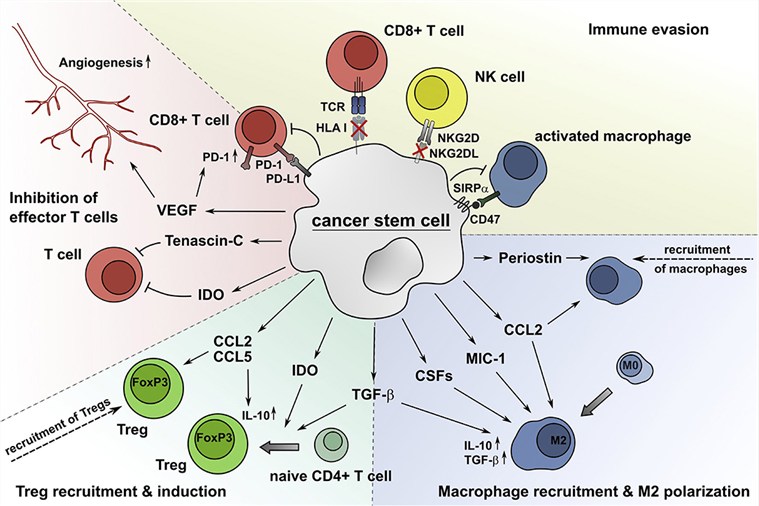 Fig.1 Impact of CSCs on the functional properties of immune cells. 1
What We Can Offer
Precision Niche Reconstruction
High-Standard Research Systems
All functional assays follow rigorous research quality protocols, utilizing Quality-by-Design (QbD) and strict aseptic verification to deliver consistent, high-fidelity, and publication-quality experimental data.
Advanced Multi-Omic Integration
We offer a one-stop service combining functional cell readouts with deep transcriptomic or proteomic analysis, revealing how your lead candidate alters the molecular landscape.
Stability & Scalability
We guarantee the phenotypic stability of CSCs during long-term co-culture, providing reliable data throughout extended resistance monitoring phases and high-throughput screening in the laboratory.
How Creative Biolabs Advances Your Project Through CSC Immune Suppression Assays
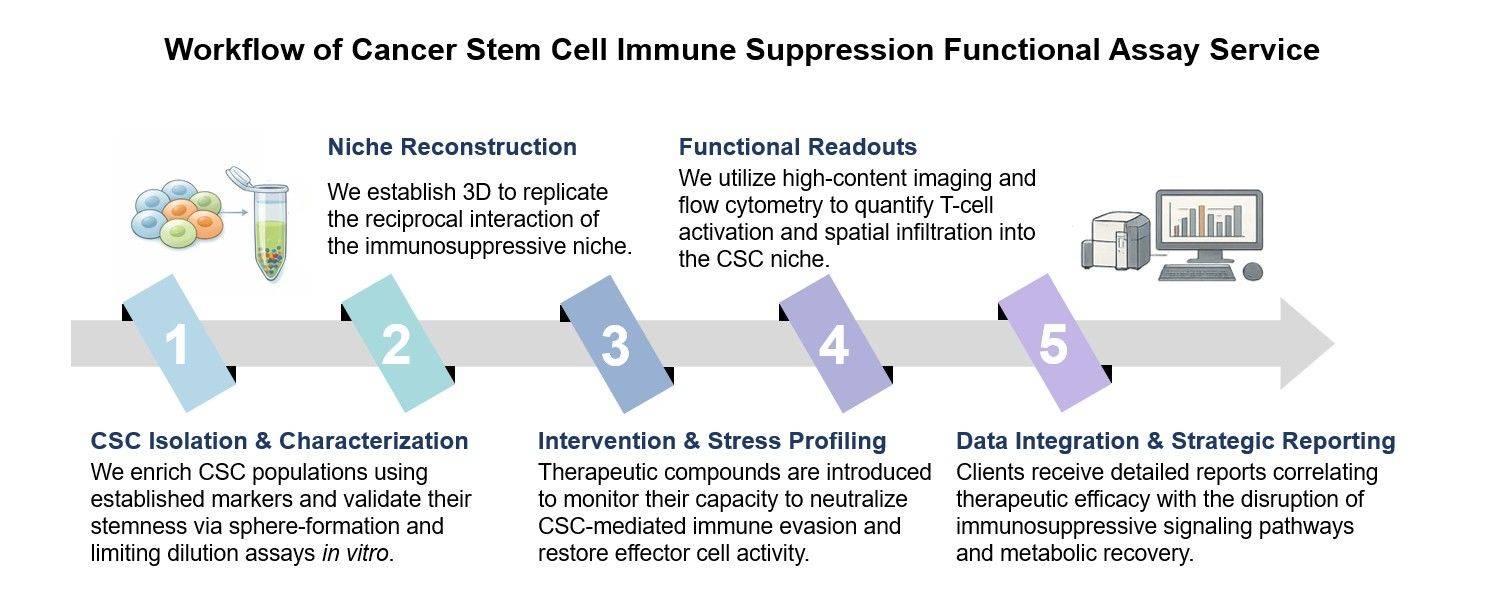 Fig2
Highlights
Plasticity Mastery
We integrate the latest findings on cellular plasticity to track how tumor cells transition between states, ensuring your drug addresses the most adaptable and resistant populations.
Metabolic Insight
Our platform evaluates metabolic exclusion mechanisms, revealing how the microenvironment starves immune cells and identifying opportunities for your therapeutic agents to restore normal nutrient signaling.

Feedback Modulation
We account for complex biological feedback loops where immune signals might inadvertently promote stemness, providing a more realistic assessment of drug efficacy in multifaceted environments.
Targeted Validation
Our methodologies ensure your research agent addresses immune-privileged populations by restoring critical marker expression and successfully blocking specific inhibitory axes in experimental models.
To explore the prospective benefits of our services for your project, we invite you to get a quote today.
Customer Reviews
-
Enhanced Immune Evasion Insights
Utilizing Creative Biolabs' CSC assay platform significantly improved our ability to quantify how cancer stem cells suppress T-cell activation. Their niche-modeling approach provided the precise data needed to validate our lead candidate's ability to disrupt this immune privilege. - Dr. A**a. W. -
Critical Insights into Niche-Mediated Suppression
Creative Biolabs' functional assay was instrumental in identifying how the CSC microenvironment induced immune cell exhaustion. This platform allowed us to characterize the inhibitory crosstalk effectively, providing a clear path for optimizing our combination therapy. – S**h. L.
FAQs
Can you handle research-grade tissue samples instead of cell lines?
Yes, we specialize in processing primary research tissue to ensure our models reflect a higher degree of biological complexity and replicate the heterogeneous microenvironment found in vivo.
How do you distinguish between bulk population impact and CSC-specific targeting?
We utilize dual-reporter systems and lineage tracing to confirm if surviving populations retain stemness markers, allowing precise differentiation between general cytotoxicity and targeted stem cell disruption.
Related Services
NGS-based Tumor Profiling Service
We provide high-throughput sequencing solutions to decipher molecular alterations in tumors, enabling rapid identification of genomic variants and mutations to guide targeted research and biomarker discovery.
Learn More →Cancer Stem Cell Exosome Cargo Analysis Service
This service provides comprehensive profiling of vesicle-derived proteins and RNAs, characterizing how CSC-secreted exosomes mediate local immune suppression and promote distant resistance in research models.
Learn More →How to Contact Us
Creative Biolabs provides a sophisticated CSC immune suppression functional assay service, moving beyond basic cytotoxicity to address the root causes of immunotherapy resistance in early-stage research. To discuss your specific research project requirements or to receive a detailed technical protocol, please reach out to our team.
Reference
- Müller, Luise et al. "Bidirectional Crosstalk Between Cancer Stem Cells and Immune Cell Subsets." Frontiers in immunology vol. 11 140. 5 Feb. 2020. Distributed under an Open Access license CC BY 4.0, without modification. https://doi.org/10.3389/fimmu.2020.00140
 Download our brochure
Loading case studies...
Online Inquiry