Cancer Stem Cell Relapse Risk Prediction Algorithm Service
Creative Biolabs provides a robust computational bridge for clinical foresight, delivering a quantitative "stemness index" (mRNAsi) to visualize recurrence probability with mathematical precision. We identify the molecular drivers of the cancer stem cell (CSC) niche, helping you prioritize lead compounds that target the most resilient cell populations. Our predictive frameworks mitigate the risks of late-stage failure by uncovering the "stemness" factors driving resistance and metastasis. By mapping these biological vulnerabilities, we ensure your small molecules or cell-based therapies target the root of tumor persistence.
Introduction to CSC Relapse Prediction
The "CSC Hypothesis" posits that a distinct subpopulation of tumor cells drives resistance and eventual recurrence through their unique ability for self-renewal and multi-lineage differentiation. Analysis of recent literature confirms that transcriptomic stemness indices (mRNAsi) and ALDHhigh populations are potent predictors of survival, acting as decisive factors in stem cell rescue outcomes. The CSC relapse prediction leverages these scientific milestones, using machine learning to integrate high-dimensional multi-omics data into a unified predictive framework. By mapping the dedifferentiation state of tumors, our platform identifies aggressive, "stem-like" clusters that remain invisible to standard histopathology.
Comprehensive Analytical Suite
Creative Biolabs provides a comprehensive analytical suite designed to decode the complexity of cancer stemness. Our offerings are built on proprietary machine learning frameworks that integrate diverse biological signatures to provide a singular, high-fidelity risk profile for every sample.
Machine Learning-Derived Stemness Indices (mRNAsi & mDNAsi)
We utilize one-class logistic regression (OCLR) to calculate transcriptomic (mRNAsi) and epigenetic (mDNAsi) stemness indices. These indices map the dedifferentiation state of cells, allowing researchers to identify highly aggressive, "stem-like" tumor clusters that are often missed by standard histopathology.
Competing Risk Survival Modeling
Our algorithms incorporate fine-grained sub-distribution hazard models. This advanced statistical approach is essential for accurately predicting relapse while accounting for competing risks, such as non-relapse mortality (NRM), ensuring that your prognostic data is mathematically rigorous.
Single-Cell Resolution Heterogeneity Mapping
For projects utilizing scRNA-seq, we offer intratumoral heterogeneity analysis. We map the distribution of stemness scores across individual cell populations, identifying rare, therapy-resistant CSC clones that drive minimal residual disease (MRD).
Multi-Omics Factor Correlation
We provide detailed correlation matrices between CSC markers (e.g., ALDH1, CD44, CD133) and biochemical variables (e.g., serum albumin, M-protein levels). This holistic view allows for the identification of systemic drivers of tumor recurrence.
Consult Our Computational Biologists to Tailor Your Relapse Prediction Model
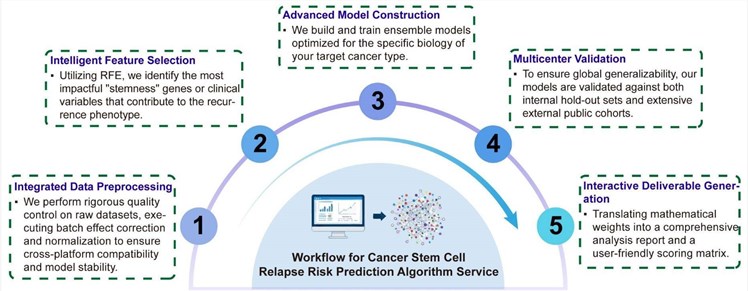
Workflow
Our workflow is meticulously designed to handle high-dimensional biological data and transform it into a refined prognostic model suitable for trial stratification or companion diagnostic development.
Publication
This prospective cohort study investigates the correlation between CSC frequency and relapse risk in patients with lung adenocarcinoma and squamous cell carcinoma. While no overall association was found, analysis revealed a significant stage-dependent relationship: higher CSC frequency strongly predicted increased relapse risk in locally advanced (IIIA) disease, but not in early-stage (I-II) patients. These findings highlight the potential prognostic role of CSCs in advanced non-small cell lung cancer.
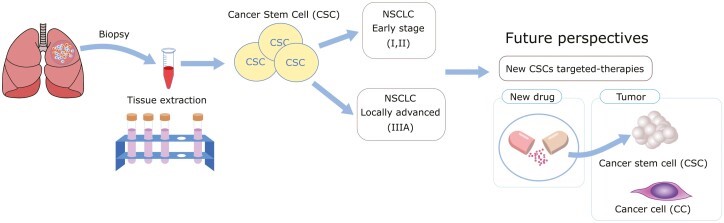 Fig.1 The role of CSCs in NSCLC progression and therapy. 1
Why Choose Us?
Creative Biolabs stands at the unique intersection of "wet lab" CSC biology and "dry lab" data science, offering a distinct advantage in oncology drug development. Our models do not merely find mathematical correlations; they are deeply grounded in the biological reality of CSC quiescence, plastic states, and metabolic activation. We leverage published data to ensure our algorithms consistently outperform standard clinical indices, such as the international staging system (ISS) or the disease risk index (DRI), which often lack the resolution to detect occult micrometastases. By integrating multi-omics data with complex survival modeling, we provide a center-agnostic, globally validated platform that ensures high reproducibility across diverse patient cohorts.
Secure Your Project's Success - Partner with Our CSC Experts for a Precision Quote
FAQs
Can this algorithm be used for any cancer type?
Yes, we can build custom supervised learning models for any malignancy, provided that high-quality training data is available. Our team specializes in tailoring model weights to the unique biology of different solid and hematological tumors.
What is the minimum sample size required for a custom model?
For robust training, we typically recommend datasets with at least 50-100 samples with longitudinal follow-up. However, we can utilize transfer learning from public databases (TCGA/GEO) to maintain high accuracy for smaller, specialized cohorts.
Is the algorithm compatible with single-cell RNA-seq data?
Absolutely. We can calculate stemness scores at the individual cell level, allowing researchers to map intratumoral heterogeneity and identify rare, therapy-resistant clones that drive MRD.
Customer Review
-
Improved Risk Stratification
Using Creative Biolabs' CSC relapse risk prediction in our research has significantly facilitated the identification of high-risk AML patients who were previously classified as intermediate by traditional cytogenetics. - Dr. Al*** J -
Reliable Stemness Indexing
The precision of the scoring allowed for much clearer efficacy readouts in our PDX models. It captured the quiescent CSC populations that standard markers often miss. - Prof. Sa*** R
Related Services
Multi-omic Analyses
Creative Biolabs provides multi-omics services, including 16S rRNA, metagenomics, and metaproteomics. We analyze host-microbe interactions and metabolic readouts to solve complex biological and clinical problems.
Learn More →Metastatic Tumor Microbiome Analysis Services
Creative Biolabs provides multi-omics analysis of intra-tumoral microbes. We profile-matched primary/metastatic lesions to identify prognostic biomarkers and mechanistic drivers of cancer progression.
Learn More →How to Contact Creative Biolabs
Creative Biolabs provides an unparalleled suite of AI-driven tools designed to eliminate the guesswork in oncology prognosis. By quantifying the "stemness" of every tumor, we empower our partners to build more effective therapeutic programs.
Contact our specialist team today to discuss how we can build a custom prediction model for your research program.
Reference
- Masciale, Valentina, et al. "The influence of cancer stem cells on the risk of relapse in adenocarcinoma and squamous cell carcinoma of the lung: a prospective cohort study." Stem Cells Translational Medicine 11.3 (2022): 239-247. Distributed under Open Access license CC BY 4.0, without modification. https://doi.org/10.1093/stcltm/szab029
 Download our brochure