Our team delivers tailored assay designs utilizing fiber analysis and proteomics to map cellular decision-making, ensuring results align with your research goals while providing actionable data for downstream laboratory analysis.
DNA-Damage Tolerance & Anti-Senescence Program Profiling Service
Creative Biolabs delivers a thorough analytical overview of cellular responses to genomic stress, providing researchers with tools to decode survival signaling. We provide precise mapping of scaffold protein modifications and terminal state markers, enabling clients to gain deep insights into how candidate compounds influence replication fork stability and long-term cellular arrest. This specialized data facilitates early identification of potential genomic instability and the optimization of lead compounds within research-only pipelines. By leveraging our approach, researchers can de-risk projects and ensure high-fidelity results for challenging experimental objectives while gaining a clear understanding of cellular fate.
Introduction What We Can Offer How We Can Help Why Choose Us Customer Reviews FAQs Related Services Contact Us
Introduction of DNA-Damage Tolerance & Anti-Senescence Program Profiling Service
The boundary between cell survival, terminal states, and potential escape is governed by specific protein axes and the choice of DNA-damage tolerance pathways. Recent research demonstrates that failing to profile these kinetics leads to induced cellular stemness and treatment-induced clonal evolution in cell models. Creative Biolabs integrates these scientific breakthroughs into a unified service, providing a definitive roadmap for assessing cellular resilience. Managing the transition from replication stress to terminal states is the new frontier of molecular research.
Request a Consultation →
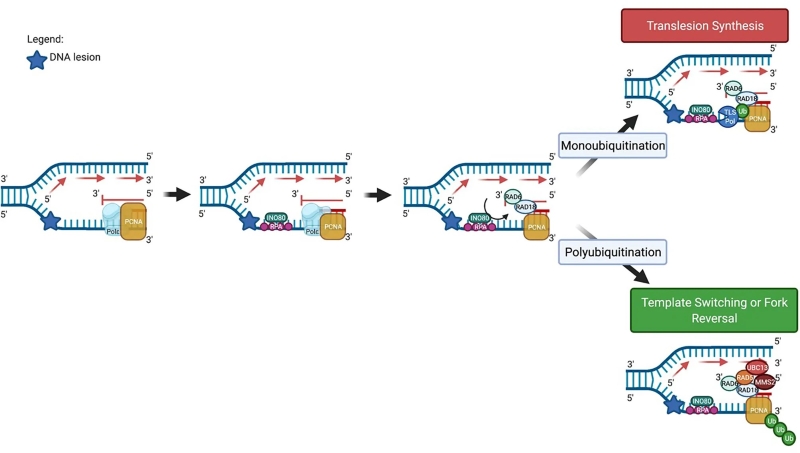 Fig.1 Initiation of DNA damage tolerance. 1
What We Can Offer
Customized Multi-Omic Integration
High-Resolution Kinetic Mapping
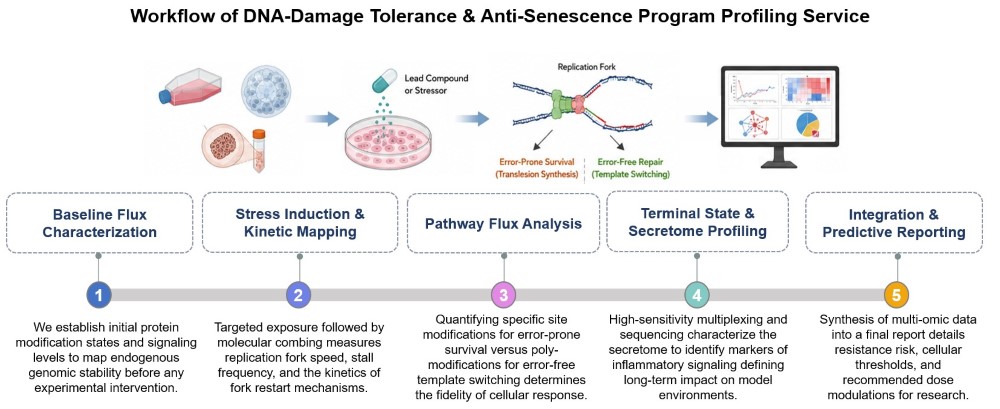
We quantify modifications on master scaffold proteins to establish metabolic flux between bypass pathways, providing a map of resilience under stress to help identify critical thresholds for genomic instability.
Specialized Enzyme Recruitment Tracking
We monitor recruitment of specialized synthesis enzymes to determine mutational drift and bypass efficiency, allowing researchers to evaluate how compounds influence long-term stability and sequence integrity in cellular models.
Dynamic Program Tracking
Our platform provides longitudinal monitoring of signaling markers to distinguish between transient arrest and terminal states, delivering vital data on the longevity and durability of various research-based cellular models.
How Creative Biolabs Can Assist Your Project
Highlights
Decades of Specialization
Creative Biolabs brings over twenty years of dedicated focus to genomic instability research, providing a depth of knowledge that ensures your projects are managed by seasoned experts who understand the nuances of replication stress.
High-Resolution Insights
We utilize specialized markers of protein recruitment and scaffold kinetics to provide deeper mechanistic understanding, identifying subtle cellular changes that traditional assays often overlook during the evaluation of early-stage research leads.

Data-Driven Benchmarking
Your results are compared against our extensive internal database of validated cell lines and primary profiles, allowing for effective benchmarking and contextualization of your specific data within broader, established research trends.
Tailored Research Protocols
We take pride in our ability to provide customizable protocols that adapt to your specific biological questions, ensuring that the generated data remains highly relevant to your unique research goals and project timelines.
Get a Quote Today to access high-resolution kinetic data and specialized benchmarking that helps you overcome genomic instability challenges while ensuring the long-term integrity of your various models.
Customer Reviews
-
Enhanced Mechanistic Clarity
Identifying how specialized enzymes drive bypass in resistant models was notably facilitated by Creative Biolabs' profiling service. Our team found the depth of the scaffold modification data to be completely unmatched and incredibly valuable for our lead optimization. - Dr. A**n. H. -
Superior Safety De-risking
Detecting latent genomic fragility has notably improved since we began using Creative Biolabs' specialized assays for our project. High rates of fork reversal were identified, helping us avoid major research failures by identifying risks standard tests missed. - Prof. M**a. S.
FAQs
How does this service differ from a standard AMES or Micronucleus test?
Standard tests detect physical DNA damage, whereas Creative Biolabs profiles the tolerance and bypass mechanisms. This identifies latent fragility and resistance risks that physical damage assays cannot see.
Can this service be used for both small molecules and biologics?
Yes. Our profiling is target-agnostic and focuses on the cellular response to stress, making it highly effective for assessing the genomic impact of any research modality.
Related Services
Autophagy Activation & Stress Survival Pathway Mapping
This specialized platform provides monitoring of organelle recycling signatures to evaluate how research candidates influence cellular persistence under extreme environmental or chemical pressure in models.
Learn More →Ferroptosis Resistance Marker Analysis Service
Our team offers precise quantification of lipid peroxidation defense systems to evaluate how research models maintain survival under high oxidative stress or iron-mediated cellular death pressures.
Learn More →How to Contact Us
Creative Biolabs provides a thorough analytical lens that goes beyond simple cytotoxicity, offering a deep dive into the molecular fate of stressed cells. We identify the precise molecular choice a cell makes between error-prone bypass and terminal states, allowing you to predict long-term outcomes with greater confidence.
Our technical experts are available to evaluate your specific research objectives and provide guidance on the most appropriate profiling strategies for your unique model systems - Get Started Today.
Reference
- Ler, Ashlynn Ai Li, and Michael P Carty. "DNA Damage Tolerance Pathways in Human Cells: A Potential Therapeutic Target." Frontiers in oncology vol. 11 822500. 7 Feb. 2022. Distributed under an Open Access license CC BY 4.0, without modification. https://doi.org/10.3389/fonc.2021.822500
 Download our brochure
Loading case studies...
Online Inquiry