Fibrocyte Immunophenotyping Service
Introduction: The Enigmatic Fibrocyte in Health and Disease
Fibrocytes (FCs) represent a unique and critical cell population, distinct from traditional fibroblasts, that play a pivotal role in both physiological wound healing and pathological fibrotic processes. These fascinating cells are of hematopoietic lineage, originating from the bone marrow, yet possess the remarkable ability to migrate to sites of injury and inflammation, where they undergo a phenotypic transition to adopt mesenchymal characteristics. This dual identity is a hallmark of fibrocytes, distinguishing them by their co-expression of both hematopoietic markers, such as CD45 and CD34, and mesenchymal markers, including collagen I and fibronectin.
The intricate involvement of fibrocytes in tissue remodeling, extracellular matrix deposition, and inflammation has positioned them as key players in a spectrum of human fibrotic disorders, ranging from pulmonary fibrosis and scleroderma to rheumatoid arthritis-associated interstitial lung disease. Despite their recognized relevance, a comprehensive understanding of their basic biology, differentiation pathways, and precise functional contributions has historically been challenging. At Creative Biolabs, our extensive experience in cellular biology, spanning over two decades, has been dedicated to unraveling these complexities, providing researchers and clinicians with the sophisticated tools necessary for precise fibrocyte characterization.
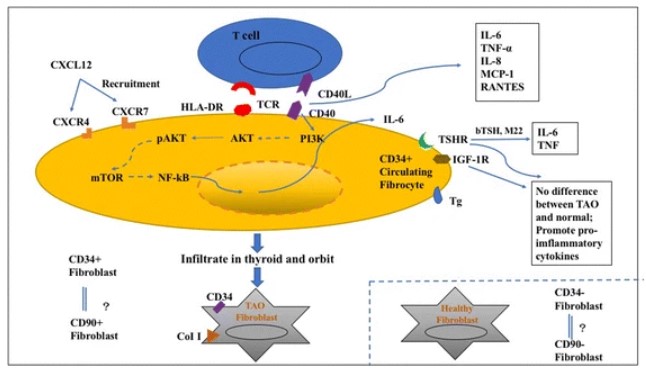 Fig,1 Fibrocytes model in the pathogenesis of thyroid-associated orbitopathy.1
Our Fibrocyte Immunophenotyping Services
Accurate identification and detailed characterization of fibrocytes are paramount for advancing research into fibrotic diseases and developing targeted therapeutic strategies. Creative Biolabs' Fibrocyte Immunophenotyping Service offers a cutting-edge, comprehensive solution for the precise analysis of these unique cells, leveraging our deep biological expertise and state-of-the-art technologies. Our service is designed to provide unparalleled insights into fibrocyte populations, their differentiation states, and their functional attributes, enabling our clients to accelerate their discoveries.
Comprehensive Service Content
Creative Biolabs' Fibrocyte Immunophenotyping Service employs a multi-faceted approach, integrating advanced methodologies to provide a holistic view of fibrocyte biology.
- Advanced Methodologies for Fibrocyte Analysis
Our primary analytical technique is Flow Cytometry, a powerful and high-throughput method that allows for the rapid identification and quantification of cells based on their specific protein expression patterns, particularly on the cell surface. Utilizing fluorescently labeled antibodies that bind with high avidity and specificity to selected antigens, we generate detailed information regarding fibrocyte populations. Creative Biolabs is at the forefront of methodological innovation, employing advanced flow cytometry protocols, including modified, faster methods for measuring circulating fibrocytes that circumvent the need for intracellular staining, thereby enhancing efficiency and throughput for our clients.
Beyond flow cytometry, our service incorporates a suite of complementary techniques for a more comprehensive characterization:
- Immunohistochemistry (IHC): This method allows for the visualization and localization of fibrocytes within complex tissue sections, providing critical contextual information about their microenvironment and interactions with other cell types in situ.
- Gene Expression Analysis: By analyzing the expression profiles of genes related to fibrocyte markers and functions, we can gain deeper insights into their activity, differentiation status, and potential signaling pathways.
- Functional Assays: To assess the biological capabilities of fibrocytes, we conduct in vitro functional assays. These include evaluating their capacity for collagen production, migratory potential, and interactions with other cells, all of which are crucial for understanding their roles in wound healing and fibrosis.
- Key Fibrocyte Markers for Definitive Identification
Fibrocytes are defined by a unique combination of markers rather than a single specific identifier. Our service meticulously analyzes these critical markers to ensure accurate identification and differentiation from other cell populations:
- CD45 and CD34: These are crucial hematopoietic markers. Their co-expression with mesenchymal markers like collagen I is a defining characteristic that distinguishes fibrocytes from other blood-derived cells.
- Collagen I (Intracellular Staining): As a key component of the extracellular matrix and a protein actively produced by fibrocytes, intracellular collagen I staining is a crucial marker for their identification.
- CXCR4: This chemokine receptor is consistently found on fibrocytes and serves as an important marker, often used in conjunction with others for precise identification.
- Fibronectin and Vimentin: These extracellular matrix and cytoskeletal proteins, respectively, are also expressed by fibrocytes, further contributing to their unique immunophenotype.
Our expertise at Creative Biolabs lies in navigating the complexities of these marker combinations, ensuring robust and reliable fibrocyte identification.
- Diverse Applications and Client Benefits
Creative Biolabs' Fibrocyte Immunophenotyping Service provides invaluable data for a wide array of research and clinical applications:
- Precise Identification and Quantification: Our service enables the accurate enumeration and identification of fibrocyte populations within various biological samples.
- Subpopulation Characterization: We facilitate the differentiation and characterization of distinct fibrocyte subsets, which may exhibit varying levels of marker expression and functional attributes.
- Understanding Fibrocyte Behavior: By analyzing changes in fibrocyte populations under different experimental conditions or in response to therapeutic interventions, researchers can gain critical insights into their dynamic roles in disease progression.
- Accelerating Drug Discovery and Therapeutic Development: By providing precise data on fibrocyte activity and differentiation, our service supports the development of targeted therapies that aim to modulate fibrocyte function, offering new avenues for treating fibrotic conditions.
- Exploring Regenerative Medicine Potential: Fibrocytes exhibit remarkable plasticity and capacity for mesenchymal function. Our characterization services can help explore their potential as an easily isolated autologous cell source for regenerative medicine. This includes their ability to form functional stromae that support epithelial maturation in organotypic cultures, promote fibroblast migration via paracrine signaling (e.g., through CXCL8/interleukin-8), and demonstrate in vivo survival as connective tissue isografts. We can also assess metabolic reprogramming during their differentiation, which favors oxidative phosphorylation, providing a deeper understanding of their bioenergetic profiles.
Our Advantages
At Creative Biolabs, our two decades of experience in the biological industry have culminated in an unparalleled understanding of cellular intricacies, particularly in the realm of fibrocytes. Our advantage stems from:
- Unrivaled Expertise
- Cutting-Edge Methodology
- Comprehensive Characterization
- Scientific Rigor and Accuracy
- Customization and Collaboration
FAQs
Q1: What are fibrocytes, and why are they important?
A1: Fibrocytes are a distinct population of bone marrow-derived cells that exhibit characteristics of both hematopoietic and mesenchymal cells. They are crucial for wound healing and are increasingly recognized for their significant role in the progression of various fibrotic diseases.
Q2: Why is immunophenotyping essential for fibrocyte research?
A2: Immunophenotyping is vital for accurately identifying and classifying fibrocytes based on their unique surface and intracellular protein markers. This allows researchers to quantify their presence, characterize different subpopulations, and understand their dynamic behavior in health and disease.
Q3: What primary techniques does Creative Biolabs utilize for fibrocyte immunophenotyping?
A3: Creative Biolabs primarily employs advanced flow cytometry for its high-throughput and precise cellular identification capabilities. We also integrate immunohistochemistry, gene expression analysis, and functional assays to provide a comprehensive understanding of fibrocyte biology.
Q4: How can fibrocyte analysis by Creative Biolabs aid in drug discovery?
A4: By providing detailed insights into fibrocyte populations, their activation states, and functional responses, our service can help identify novel therapeutic targets and assess the efficacy of potential drug candidates designed to modulate fibrocyte activity, thereby leading to new treatments for fibrotic disorders.
Q5: What types of samples can Creative Biolabs analyze for fibrocytes?
A5: Creative Biolabs is equipped to analyze various biological samples, including peripheral blood mononuclear cells (PBMCs), and can perform immunohistochemistry on tissue sections for in situ fibrocyte characterization.
Contact Us
To learn more about Creative Biolabs' Fibrocyte Immunophenotyping Service or to discuss your specific research needs, please contact us today. Our team of experts is ready to assist you in advancing your understanding of fibrocytes and their critical roles in health and disease.
Reference
- Zhang, Feng et al. "The emerging role of fibrocytes in ocular disorders." Stem cell research & therapy vol. 9,1 105. 13 Apr. 2018, doi:10.1186/s13287-018-0835-z. Distributed under Open Access License CC BY 4.0, without modification.
 Download our brochure