Creative Biolabs offers technologies to address drug immunogenicity. We use in silico and in vitro techniques for anti-drug antibody (ADA) assays and pharmacokinetic/pharmacodynamic efficacy measurements.
Learn More →Cell-Level Marker based Graft-Versus-Host Disease (GVHD) Prediction Service
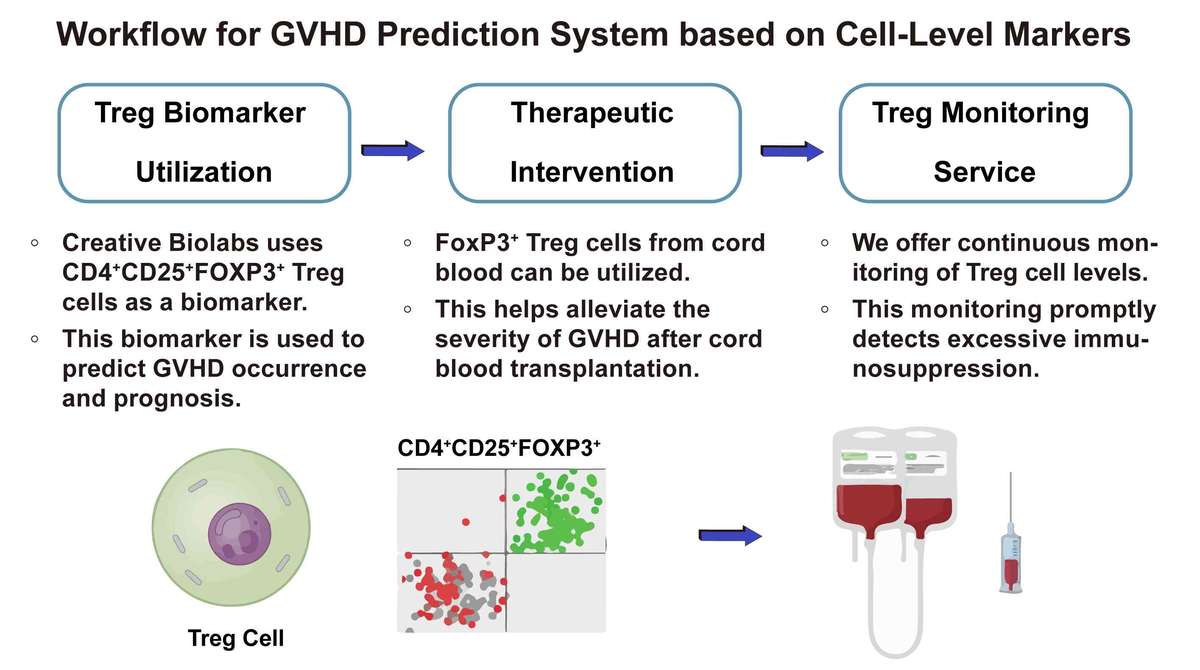
Creative Biolabs has developed a novel graft-versus-host disease (GVHD) prediction system that addresses the limitations of symptomatic diagnosis. Our approach is based on profiling the dynamics of specific immune cell populations, with CD4+CD25+FOXP3+ regulatory T cells (Tregs) serving as a core predictive biomarker for disease onset and prognosis. Through advanced flow cytometry and high-resolution cellular analysis, we precisely quantify the frequency and functional status of these critical regulatory cells.
Background What We Can Offer Workflow Why Choose Us FAQs Customer Review Related Services Contact Us
Proactive Management of Post-Transplant Complications: A Cell-Level Predictive System for GVHD
GVHD is a serious, often life-threatening complication of allogeneic hematopoietic stem cell transplantation (allo-HSCT). It occurs when donor T cells attack the recipient's tissues, creating a harmful immune imbalance. Because early detection is vital for effective treatment and better outcomes, our prediction system proactively assesses risk by monitoring cell-level biomarkers. We focus specifically on the ratio of Tregs to effector T cells (Teffs), an approach strongly supported by extensive published research that confirms this ratio is a reliable prognostic marker for GVHD.
A Multifaceted Approach to GVHD Prophylaxis and Treatment
The insights gained from our predictive system enable a new era of proactive therapeutic strategies.
Prophylactic Intervention with FoxP3+ Treg Cells
The adoptive transfer of ex vivo-expanded Tregs is a promising therapeutic approach for both acute and chronic GVHD. By enriching the transplant with a healthy population of functional FoxP3+ Treg cells, it is possible to mitigate the risk of GVHD while preserving the vital graft-versus-leukemia (GVL) effect. Preclinical studies have shown that infusion of Tregs can safely and effectively control GVHD in animal models.
Post-Transplant Monitoring and Therapeutic Adjustment
Our services extend beyond initial risk assessment to include continuous monitoring of Treg cell levels post-allo-HSCT. By closely tracking the Treg to T effector cell ratio, we provide clinicians with the data they need to detect excessive immunosuppression, adjust immunosuppressive therapy, and reduce adverse reactions.
Contact Creative Biolabs today to learn more about our GVHD prediction system and how it can advance your research.
Workflow for Predictive Biomarker Analysis
The process of implementing our GVHD prediction system is a streamlined, data-driven journey designed for seamless integration into your preclinical and research protocols. Our workflow provides a clear, step-by-step path from sample to actionable insight.
Why Choose Us?
At Creative Biolabs, our unparalleled expertise in immunology and cellular analysis has led to our advanced GVHD prediction system. Backed by years of research and development, this system empowers researchers with the knowledge to make informed decisions and improve patient outcomes. Our approach provides distinct advantages, including a specific focus on the most relevant cellular markers and a commitment to delivering actionable insights that go beyond traditional diagnostics, offering a new standard in understanding and managing GVHD risk.
Unlock Your Project's Potential with Creative Biolabs - Get a Quote Now!
FAQs
Q1: What is the main advantage of using cell-level markers over serum-based biomarkers?
A1: While serum biomarkers are useful, cell-level markers provide a more direct and fundamental insight into the underlying immune dysregulation that drives GVHD. Our focus on the Treg/Teff ratio gives you a clearer picture of the immune balance and a more actionable target for intervention.
Q2: Is your system compatible with different types of allo-HSCT?
A2: Yes, our system applies to various types of allo-HSCT, including bone marrow, peripheral blood, and cord blood transplants. The principles of immune balance are universal, and we can tailor our analysis to your specific transplant type.
Q3: How does your system help preserve the GVL effect?
A3: Our focus is on restoring the balance between T cells, not on broad-spectrum immunosuppression. By bolstering the Treg population, we aim to mitigate GVHD while preserving the beneficial GVL effect, which is crucial for preventing disease relapse.
Customer Review
-
Highly predictive
Using Creative Biolabs' GVHD prediction system in our post-transplant monitoring has significantly improved our ability to identify at-risk individuals long before symptoms appear. The data on the Treg/Teff ratio is incredibly consistent and actionable. - J*m Smith -
Actionable insights
The detailed cellular analysis provided by Creative Biolabs has been instrumental in our research on immunosuppressive therapy. It gives us tangible data to adjust dosing and minimize side effects, a major advantage over traditional methods. - M*a Rodriguez
Related Services
To further support your research, Creative Biolabs offers a suite of complementary services. These services can be combined with our GVHD prediction system to provide a holistic solution for your project.
Immunogenicity Prediction
Toxin Moiety Development Service
Creative Biolabs provides comprehensive toxin production and optimization services for immunotoxin development. We specialize in toxin selection, structure optimization, and purification to create potent, safe, and specific immunotoxins.
Learn More →How to Contact Creative Biolabs
At Creative Biolabs, our GVHD prediction system represents a transformative approach to post-transplant care. By shifting the focus to proactive, cell-level insights, we empower you to deliver more effective, personalized, and safer therapeutic strategies. We are committed to helping you improve patient outcomes and advance the field of transplantation medicine.
Contact Our Team for More Information and to Discuss Your Project
 Download our brochure
Loading case studies...
Online Inquiry