In Vivo PK Services
Creative Biolabs offers biology experts the full spectrum of pharmacokinetic analysis, centered on advanced mechanistic models and ultra-sensitive bioanalysis. We provide customized study designs utilizing specialized cannulation techniques to obtain definitive data on clearance and distribution in complex matrices. Our clients gain a clear, predictive understanding of their molecule's behavior, leading to faster data interpretation and more confident decisions in their discovery pipeline.
In Vivo PK Services for Effective Drug Development
"In Vivo PK" stands for "In Vivo Pharmacokinetics." Pharmacokinetics (PK) is the study of how a drug moves through the body, including absorption, distribution, metabolism, and excretion (ADME). "In Vivo" refers to studies conducted in living organisms, typically animals or humans, rather than in vitro (in a controlled laboratory environment). In Vivo PK studies are crucial for understanding how a drug behaves in a biological system, which is essential for determining proper dosing regimens, predicting potential side effects, and assessing overall drug efficacy.
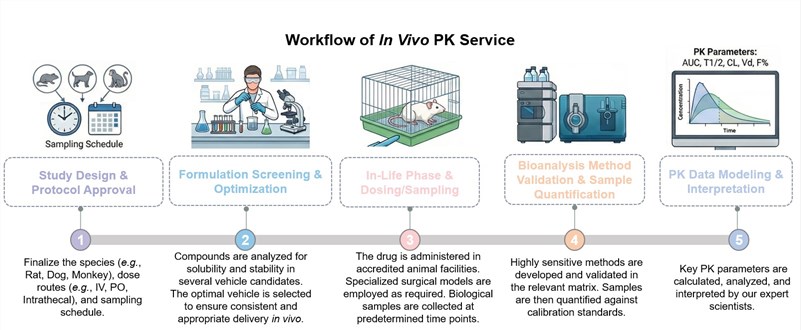
In preclinical studies, important in vivo PK parameters for compounds include:
| • Clearance (CL) | • Apparent volume of distribution (Vd) | • Half-life (t1/2) | • Bioavailability (F%) |
Review service capabilities and initiate a formal consultation.
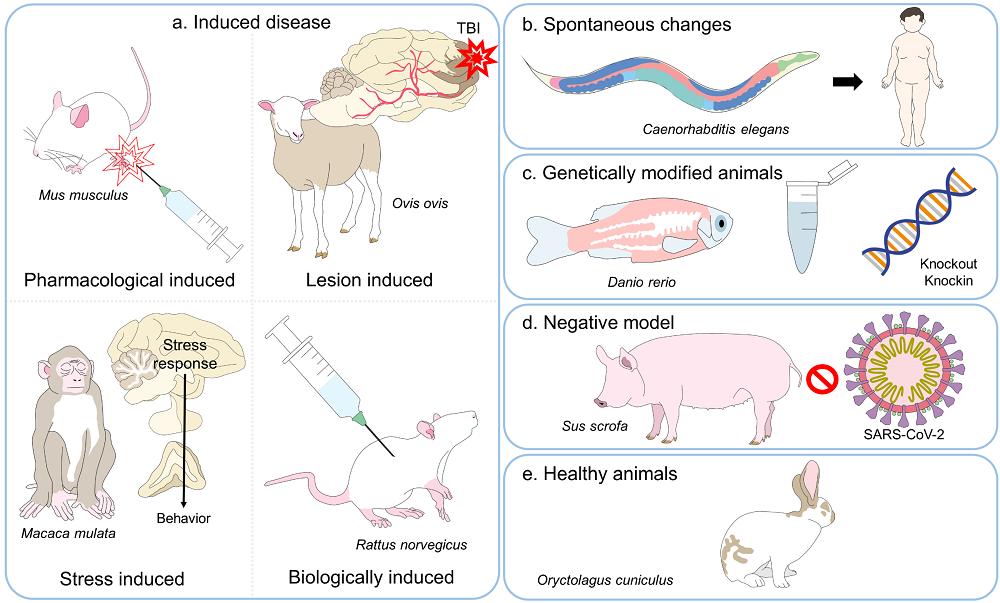 Fig.1 Classification of animal models. 1
What We Can Offer
Creative Biolabs has many years of experience in animal in vivo PK experiments, providing reliable, flexible, and cost-effective services to customers around the world. Creative Biolabs offers a variety of in vivo PK assay services, including but not limited to:
Large Animal In Vivo PK
Utilizes species with high physiological homology, such as monkeys, dogs, and pigs, to provide advanced modeling and accurate prediction of human distribution patterns.
Learn More →Small Animal In Vivo PK
Offers rapid and cost-effective screening using rodent models, facilitating high-throughput assessments during the earliest stages of the drug discovery process.
Learn More →Rodent In Vivo PK
Employs mice, rats, and guinea pigs for standard ADME profiling, essential for establishing baseline systemic exposure levels and pharmacokinetic parameters.
Learn More →Non-rodent In Vivo PK
Focuses on canines and primates for mechanistic studies, particularly when rodent models exhibit metabolic profiles that diverge significantly from human biology.
Learn More →Single Mouse Single PK Platform
An innovative platform enabling a complete PK profile to be generated from a single subject, significantly reducing animal usage and inter-subject variability.
Learn More →How In Vivo PK Service Can Assist Your Projects
Why Choose Us
| Key Advantages | Unique Features |
|---|---|
| Unrivaled Mechanistic Expertise | We specialize in the most challenging mechanistic PK studies. Our comprehensive cannulation suite provides definitive answers about distribution and excretion mechanisms that plasma-only studies cannot. |
| Advanced Bioanalytical Platform | Our bioanalysis is powered by high-resolution UPLC-MS/MS systems. This commitment to cutting-edge technology ensures exceptional sensitivity, high throughput, and the ability to quantify challenging compounds, including highly polar molecules, using HILC. |
| Full Species Capability | We maintain a large inventory and specialized facilities for both rodents (mouse, rat, guinea pig) and large non-rodent species (dog, monkey, pig, ferret), ensuring the selection of the most relevant and translationally accurate model for your project. |
Access the Creative Biolabs advantage by requesting a service proposal.
Customer Reviews
-
Definitive Biliary Clearance
The utilization of Creative Biolabs' in vivo PK service in our research substantially advanced the definitive assessment of biliary clearance, thereby mitigating the need for premature compound optimization often necessitated by high first-pass effects. - Dr. R. S**s -
Exceptional CNS Insight
Using Creative Biolabs' service in our research has significantly improved the accurate measurement of our candidate concentration in cerebrospinal fluid via cisterna magna cannulation, which accelerated our PK/PD modeling. - J. L**n.
FAQs
In the in vivo PK test, why is CL greater than Qh?
The liver is the most important organ for drug metabolism, but it is not the only way to eliminate drugs, as well as kidney elimination; (2) The drug is unstable in the blood, and the clearance of the drug is not a liver effect; (3) In some cases, when the drug concentration in red blood cells is much higher than the drug concentration in plasma, the calculation of the true clearance rate cannot be used to approximate the drug concentration in the blood by the drug concentration in the plasma; (4) In individual cases, the metabolism or uptake of the lungs occupies a major role.
Why is the bioavailability greater than 100% in the in vivo PK test?
(1) Dose deviation caused by dosing error; (2) nonlinear PK; (3) High bioavailability and individual differences in the DMPK attributes of the drug, IV and PO were given to different groups of animals; (4) unreasonable sampling; (5) the IV sample was left out for a longer period and the compound was unstable in plasma; (6) When administered in the form of racemates, the enantiomers with faster clearance are converted into enantiomers with slower clearance in the digestive tract.
What should I do if there is a large difference in AUC in the in vivo PK test?
(1) The reason for the large difference can be summarized as the poor solubility of the compound, or the solubility fluctuates greatly with the pH value of the digestive tract; (2) improve the preparation and adjust the pH value of the digestive tract.
How to Contact Us
Creative Biolabs specializes in converting complex PK challenges into clear, scientifically robust data, enabling our clients to accelerate lead optimization, predict optimal exposure levels, and confidently transition candidates into advanced testing. To learn more about our DMPK services, contact us now, and one of our scientists will get back to you as soon as possible.
Related Services
Reference
- Domínguez-Oliva, Adriana et al. "The Importance of Animal Models in Biomedical Research: Current Insights and Applications." Animals : an open access journal from MDPI vol. 13,7 1223. 31 Mar. 2023. Distributed under an Open Access license CC BY 4.0, without modification. https://doi.org/10.3390/ani13071223
 Download our brochure