Mediator Release Assay Service
Creative Biolabs offers a specialized mediator release assay service, the TNF-α-induced PGE2 assay, to precisely evaluate TNF-α agonist or antagonist activity. Our meticulously optimized assay provides high-quality, reliable data crucial for drug discovery. We accurately determine compound efficacy and potency, facilitating therapeutic advancements. Utilizing human epitheloid cervix carcinoma HeLa S3 cells, a validated model, we assess PGE2 release upon TNF-α stimulation or inhibition.
Understanding TNF-α-induced PGE2 Release
Tumor necrosis factor-alpha (TNF-α) is a pro-inflammatory cytokine that plays a pivotal role in the body's immune response, inflammation, and cellular apoptosis. One significant pathway influenced by TNF-α is the release of prostaglandin E2 (PGE2), a lipid compound that functions as an inflammatory mediator. The TNF-α-induced PGE2 release is critical in various physiological and pathological processes, including pain sensation, fever, and the modulation of immune responses.
In biomedical research and drug development, modulating the TNF-α pathway through agonists or antagonists presents a promising therapeutic strategy. TNF-α agonists can mimic the cytokine's action and enhance immune responses, beneficial in certain infectious or malignant conditions. Conversely, TNF-α antagonists can attenuate/inhibit excessive inflammatory responses, offering potential relief in chronic inflammatory states such as rheumatoid arthritis, Crohn's disease, and psoriasis. Given the critical interplay between TNF-α and PGE2 in inflammatory mechanisms, efficiently monitoring the TNF-α-induced PGE2 release can substantially advance the screening and characterization of potential therapeutics aimed at modulating inflammatory responses.
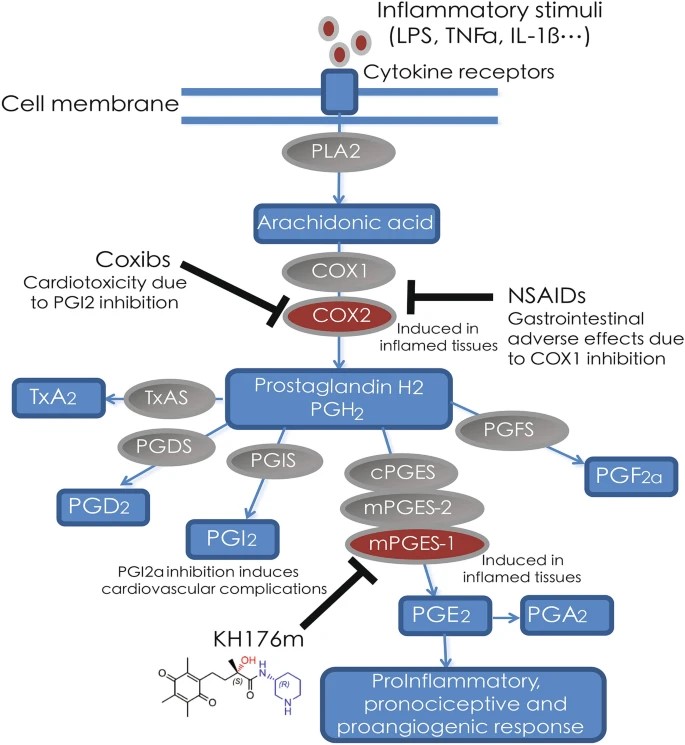 Fig.1 Inflammatory stimuli (e.g. TNF-α, LPS, IL-1β)-induced PGE2 release.1
Optimized Protocol and Controls
Our established protocol is designed for both agonist and antagonist evaluation, including robust controls that validate every assay run:
| Protocol Component | Detail | Purpose |
|---|---|---|
| Cell Type | HeLa S3 (standard) or primary cells (custom) | Standardized human model, adaptable for advanced mechanistic studies. |
| Detection Target | PGE2 | The key functional mediator was released. |
| Detection Method | TR-FRET | Superior sensitivity and signal-to-noise ratio. |
| Control Activator | TNF-α | Positive control to induce maximum PGE2 release. |
| Control Inhibitor | Indomethacin | Robust control to inhibit cyclooxygenase activity. |
We encourage you to start the conversation with Creative Biolabs today to understand how our TR-FRET platform can be immediately deployed for your compound library.
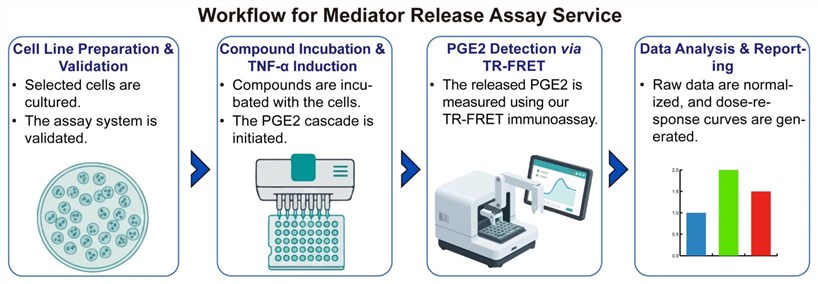
Service Workflow: From Compound to Confident Data
Our workflow is designed for transparency and efficiency, ensuring clear outcomes at every stage and providing a reliable framework for client collaboration.
Why Choose Us?
Creative Biolabs' commitment to superior technology and rigorous scientific validation makes us the premier choice for functional inflammatory pathway screening. Our TR-FRET technology provides superior sensitivity and reduced background noise compared to standard ELISA, translating to higher data reliability. We offer mechanistic validation, confirming functional activity against complex cascades, grounding your mechanism in published data. Our disease model adaptability showcases proven expertise in developing functional models for key therapeutic areas, including neuroinflammation (microglia) and cardiac fibrosis (HCFs). This comprehensive approach delivers the confidence required to drive your therapeutic leads forward efficiently.
Inspired by these successes? Experience the Creative Biolabs Advantage - Get a Quote Today to begin your optimized screening campaign.
FAQs
Why do you focus on PGE2 release rather than just measuring TNF-α levels?
Measuring PGE2 confirms that your compound is not only affecting the cytokine but also successfully blocking the ultimate downstream inflammatory effect. This functional readout provides superior mechanistic insight for optimizing your therapeutic leads.
How reliable is the TR-FRET detection method compared to a standard PGE2 ELISA?
TR-FRET is significantly more robust and accurate. By utilizing time-resolved detection, we effectively filter out short-lived background noise and sample fluorescence, achieving a much higher signal-to-noise ratio and Z' factor.
Can I use the mediator release assay to screen compounds for non-systemic diseases, like neurological disorders?
Absolutely. For neurological targets, we routinely use primary CNS cell types, which are the primary TNF-α secretors in the brain. This ensures the compound's activity is validated in a cell system directly relevant to neuroinflammation.
Customer Reviews
-
High Sensitivity
Using Creative Biolabs' service in our research has significantly improved the confidence in our IC50 measurements, particularly for low-potency leads. The TR-FRET signal was consistently cleaner than our in-house ELISA attempts, cutting our false-positive rate by over 15%. – Jae*Sh -
Mechanistic Clarity
We suspected our compound worked via JNK1/2, but the mediator release assay results, combined with the detailed report on the TNFR1 pathway, strongly supported that precise inhibitory step by showing specific PGE2 suppression. – Aln*Fz
Related Services
To ensure comprehensive characterization and achieve your broader drug discovery goals, Creative Biolabs offers several complementary services that can be bundled with the mediator release assay:
Function Assays for Immune Checkpoint
Creative Biolabs offers a one-stop service for immune checkpoint functional assays, including T-cell activation/proliferation, cytokine release, cytotoxicity, and cell-based checkpoint inhibitor assays, to identify target molecules that modulate immune function.
Learn More →Nuclear Receptor Assay Services
Our nuclear receptor assay services utilize cutting-edge technologies and high-throughput screening to accurately measure receptor-ligand binding and transcriptional activity, accelerating drug discovery for cancer, metabolic, and immune diseases.
Learn More →How to Contact Creative Biolabs
Creative Biolabs offers high-precision, mechanistic screening against the critical TNF-α/PGE2 axis, validated across complex disease models like neuroinflammation and cardiac fibrosis. We are committed to providing the clean, confident data required to accelerate your leads toward the application.
To initiate your mediator release assay project or to receive a tailored quotation and detailed protocol, please reach out to our team today.
Reference
- Jiang, X., et al. "Mechanism of action and potential applications of selective inhibition of microsomal prostaglandin E synthase-1-mediated PGE2 biosynthesis by sonlicromanol's metabolite KH176m." Scientific Reports 11.1 (2021): 880. Distributed under Open Access license CC BY 4.0, without modification. https://doi.org/10.1038/s41598-020-79466-w
 Download our brochure