Network Reconstruction & Causal Inference Service for Cancer Signaling Pathway
At Creative Biolabs, we go beyond generating simple interaction maps; we provide a functional blueprint of cellular logic. Our service assists your project by distinguishing between "driver" signaling nodes and "passenger" correlations, effectively prioritizing targets that possess true regulatory necessity. By modeling the quantitative interaction strengths and feedback loops, including the role of non-enzymatic scaffold proteins, we enable you to predict how a network will respond to single or combination interventions long before entering expensive laboratory validation stages. Our expertise ensures that every inferred edge in your network model is backed by mathematical proof of causality rather than mere association.
Mastering Mechanisms: The Science of Causal Discovery
Modern cancer research is transitioning from static pathway mapping to the dynamic modeling of causal logic. Traditional "omics" approaches frequently fall into the "correlation trap," where co-expressed genes are mistaken for functional drivers, leading to high failure rates in target validation. Network reconstruction and causal inference solve this by mathematically establishing the directionality and weight of regulatory interactions. By integrating high-dimensional data with hierarchical logic and modular response analysis, researchers can decode the next-generation complexity of feedback loops that allow cells to bypass inhibition. These advanced frameworks provide the foundational rigor needed to distinguish master regulators from passenger variations, ensuring that discovery strategies are built on functional biological reality.
Strategic High-Dimensional Modeling Solutions
Creative Biolabs provides a specialized suite of high-dimensional modeling solutions designed to decode the complexity of cancer signaling, turning heterogeneous multi-omics data into quantitative, actionable biological blueprints.
Intracellular Signaling Logic
We utilize advanced hierarchical frameworks to reconstruct high-resolution intracellular networks. By measuring quantitative interaction strengths and identifying logical feedback loops, we reveal mechanistic drivers underlying tumor growth and therapeutic resistance.
Intercellular Communication Mapping
Our causal inference platform maps communication across the microenvironment. By identifying how specific ligands and receptors drive neighbor-cell behavior, we uncover the signaling axes that maintain suppressive cellular niches.
Predictive Simulation Services
We deliver executable models that simulate perturbation effects in silico. This allows researchers to prioritize master regulators and predict the efficacy of novel combination strategies before proceeding to laboratory validation.
Quantify Your Pathway's Regulatory Strength - Request a Detailed Project Assessment and De-risk Your Strategy
Workflow
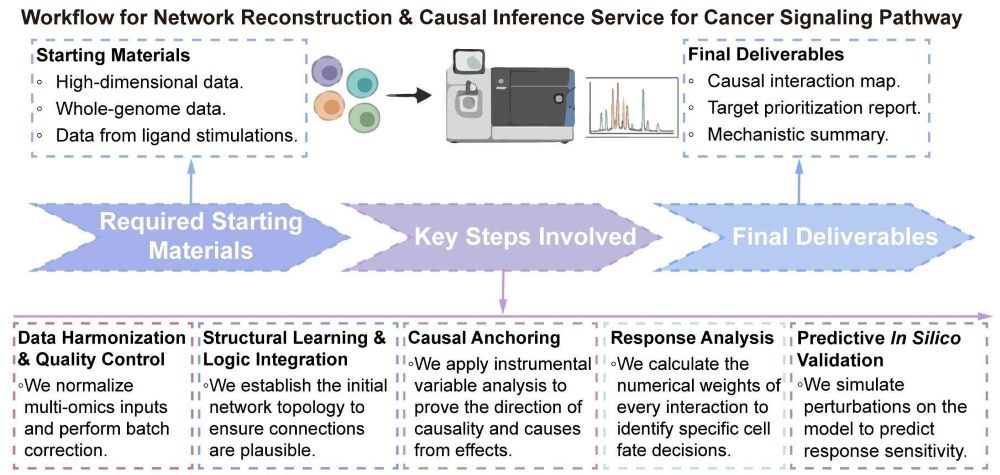
To initiate a high-fidelity causal inference project, we require specific biological or digital inputs to ensure the model is grounded in your unique system.
Publication
This study introduces scIVCCC, a causal inference framework that leverages anti-PD-1 treatment as an instrumental variable to identify genuine cell-cell communication networks from single-cell data. Applied to breast cancer patients, it reveals how exhausted T cells differentially activate M1-like anti-tumor macrophages via TNF and ICAM1 pathways versus M2-like immunosuppressive macrophages via C5AR1 and TNFR2, offering mechanistic insights and potential combination therapy targets.
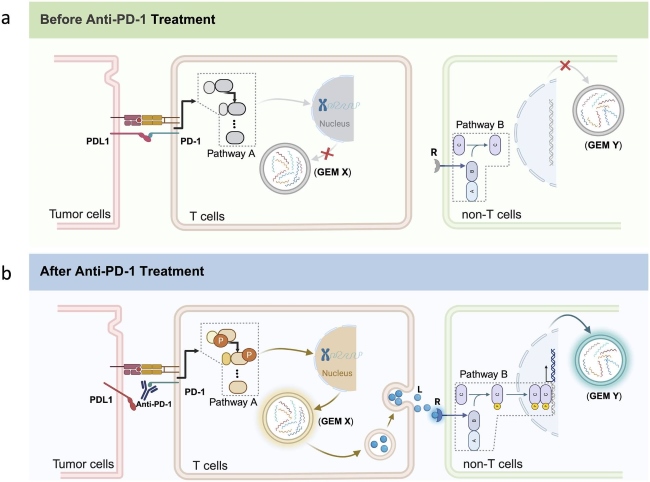 Fig.1 A conceptual overview of cell–cell communication mechanisms and causal inference frameworks. 1
Why Choose Us?
Creative Biolabs offers a unique synergy of computational physics and deep biological expertise, ensuring that every reconstructed network is grounded in mechanistic reality. Our proprietary modeling platforms go beyond traditional bioinformatics by leveraging natural stochastic variation as a "natural experiment," which often eliminates the need for expensive, large-scale physical perturbation screens. We emphasize quantitative interaction strengths and logical gates, providing the mathematical proof of regulatory necessity required to de-risk discovery pipelines. Unlike standard correlation-based tools, our hierarchical frameworks handle the noise of high-dimensional single-cell data with superior robustness.
Experience the Creative Biolabs Advantage - Request a Custom Quote to Accelerate Your Research Milestones
FAQs
How does your service differ from standard gene co-expression analysis?
Co-expression only indicates that two variables move together; it does not assign hierarchy. Our service uses causal inference to prove the direction of the relationship, distinguishing between upstream causes and downstream consequences.
Can this service handle noisy single-cell data from heterogeneous samples?
Yes. We use hierarchical frameworks specifically designed to handle the high dropout rates and noise inherent in single-cell data, ensuring robust results even with limited or heterogeneous starting material.
Do I need to perform extensive knockout screens before using this service?
Not necessarily. While perturbation data is helpful, our technology can utilize the natural stochastic noise across thousands of individual cells as a surrogate for experimental perturbations to infer network topology.
Customer Review
-
Definitive Causal Direction
Using Creative Biolabs' service in our research has significantly facilitated our understanding of bypass signaling. By anchoring the network with our genetic data, they proved that our protein of interest was a driver, not a passenger. - Dr. Elena V***s -
Predicting Resistance Logic
The integration of logical modeling with response analysis was a game-changer. Their modeling allowed us to accurately predict which feedback loops would be activated upon receptor inhibition, allowing us to select a better co-target. - Prof. Marcus H***n
Related Services
CRISPR-based Ferroptosis Target Screening Services
Creative Biolabs provides CRISPR screening, quantifying gene activation and knockout effects. We utilize gRNA libraries and NGS to evaluate ACSL4-mediated lipid peroxidation and identify novel targets within ferroptosis pathways.
Learn More →Target Genome Editing Service
Creative Biolabs provides target genome editing, quantifying gene knockout and upregulation effects. We utilize CRISPR and TALE nucleases to evaluate NHEJ-mediated indels and genomic alterations for high-throughput therapeutic screening.
Learn More →How to Contact Creative Biolabs
Creative Biolabs' service provides the mathematical rigor and biological intuition needed to master the complex logic of signaling. From identifying novel master regulators to predicting the success of combination interventions, we turn high-dimensional data into a clear roadmap for discovery.
Contact Our Team for More Information and to Discuss Your Project - Secure Your Technical Consultation Today
Reference
- Qiu, Aodong, et al. "Causal modeling reveals cell–cell communication dynamics in the tumor microenvironment during anti-PD-1 therapy in breast cancer patients." Briefings in Bioinformatics 27.2 (2026): bbag139. Distributed under Open Access license CC BY 4.0, without modification. https://doi.org/10.1093/bib/bbag139
 Download our brochure