NF-κB/STAT3 Chronic Inflammatory Pathway Activation Mapping Service
Creative Biolabs provides a comprehensive blueprint of the "unholy alliance" between NF-κB and STAT3. We deliver quantitative data on nuclear sequestration, post-translational modifications, and downstream epigenetic shifts, ensuring your candidate compound effectively breaks the feed-forward loop of chronic disease. By mapping the physical docking of the p65 subunit with phosphorylated STAT3, we help researchers identify whether a lead compound successfully disrupts this synergistic interaction or merely modulates individual pathway components.
Introduction to NF-κB/STAT3 Dynamics
The functional cooperation between NF-κB and STAT3 represents a master regulatory node in the pathogenesis of chronic inflammatory diseases and cancer. Foundational literature demonstrates that these two transcription factors are physically and functionally linked through a feed-forward loop, primarily mediated by the IL-6/gp130/JAK signaling axis. Once activated, STAT3 recruits the acetyltransferase p300 to modify p65, effectively sequestering NF-κB within the nucleus and preventing its export. This persistent nuclear retention drives the "Warburg effect" metabolic switch and stabilizes the assembly of the NLRP3 inflammasome. Recent breakthroughs highlight the STAT3-TET2 axis as the primary driver behind the transition from acute to non-resolving inflammation, making it a critical focus for next-generation drug discovery.
Comprehensive Mapping Solutions
Creative Biolabs offers a modular mapping platform that can be tailored to the unique requirements of your therapeutic area, whether in oncology, immunology, or metabolic disease. Our specialized offerings include:
Spatiotemporal Synergy Mapping
Using real-time high-resolution confocal imaging, we track the synchronized nuclear entry of p65 and STAT3. This allows us to quantify the duration of their co-occupancy on the chromatin, providing a definitive metric for synergy strength.
Post-Translational Modification (PTM) Profiling
We utilize proprietary mass spectrometry and high-specificity phospho-antibody arrays to map the activation states of key residues, including STAT3 (Tyr705/Ser727) and p65 (Ser536). We also offer unique acetylation mapping of K310 on p65, a critical site for sustained transcriptional activity.
Downstream Epigenetic Reprogramming Analysis
Our platform evaluates the recruitment of chromatin modifiers such as TET2 and p300. By performing ChIP-qPCR and bisulfite sequencing, we visualize how the NF-κB/STAT3 axis alters the DNA methylation landscape at pro-inflammatory loci, identifying "non-resolving" signatures.
Immunometabolic & Mitochondrial Flux Analysis
We integrate signaling data with functional metabolic readouts. Our team maps how pathway activation drives the upregulation of GLUT1/PDK1 and suppresses the TCA cycle, providing evidence for compound efficacy in reversing the inflammatory metabolic switch.
Inflammasome & Pyroptosis Execution Mapping
We offer comprehensive tracking of the TLR4-NF-κB-NLRP3 cascade. This includes quantifying the maturation of IL-1β and the cleavage of Gasdermin D (GSDMD), allowing you to visualize how your lead candidate halts inflammatory cell death.
Consult Our Scientists to Design Your Custom Mapping Protocol
Workflow
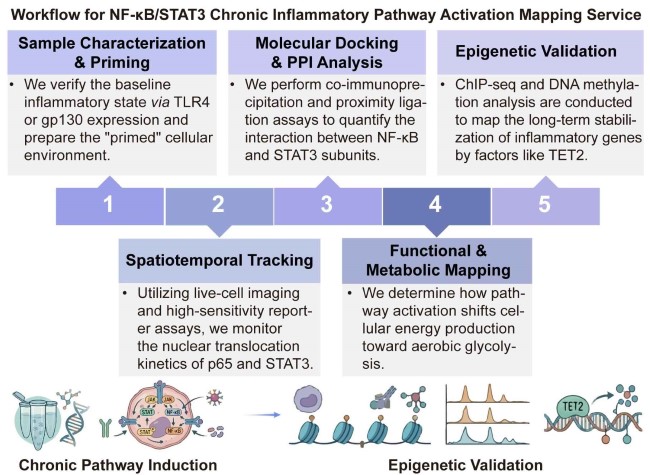
At Creative Biolabs, we employ a rigorous, stage-gated workflow designed to transform complex biological samples into high-fidelity signaling maps.
Publication
This comprehensive review elucidates the dual roles of NF-κB in inflammation and cancer. The authors describe the canonical and noncanonical signaling pathways and their contributions to acute inflammation, autoimmune diseases, and tumorigenesis. They highlight how persistent NF-κB activation drives cancer cell proliferation, survival, metastasis, therapy resistance, and tumor microenvironment remodeling. The review also discusses therapeutic strategies targeting NF-κB, including IKK inhibitors, proteasome inhibitors, and adoptive T-cell therapies, while addressing challenges such as context-dependent functions and potential side effects.
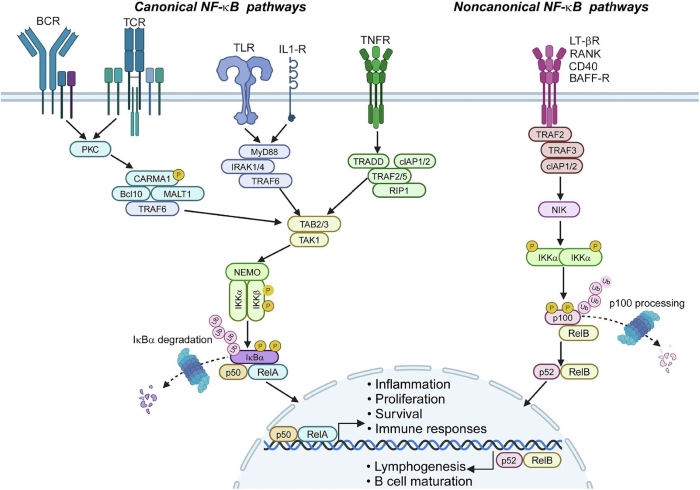 Fig.1 The NF-κB signaling network: decoding the canonical and noncanonical routes. 1
Why Choose Us?
Selecting Creative Biolabs for your NF-κB/STAT3 mapping needs provides you with more than just a service provider; you gain a strategic partner with over two decades of specialized experience in high-end signal transduction analysis. We utilize a unique multi-platform approach that bridges the gap between traditional molecular biology and cutting-edge immunometabolism. Our team leverages high-resolution spatiotemporal data and published data regarding the STAT3-TET2 and TLR4-NLRP3 axes to provide a granular view of non-resolving inflammation that standard assays simply cannot capture. By integrating metabolic flux analysis with epigenetic profiling, we deliver a "biological narrative" that illustrates exactly how your compound influences the cellular phenotype.
Elevate Your Research with Verified Expertise — Request a Detailed Quote Today
FAQs
What is the primary advantage of mapping vs. standard Western Blotting?
Mapping at Creative Biolabs provides spatiotemporal and interaction data (like PPI and nuclear retention) that standard blots miss, revealing how factors cooperate in the nucleus.
Can this service accommodate rare patient-derived samples?
Yes, our platform is optimized for low-input samples, making it ideal for clinical biopsies or primary cell cultures.
Does your mapping include the NLRP3 inflammasome?
Absolutely. We track the TLR4/NF-κB/STAT3 axis through to NLRP3 assembly and GSDMD-mediated pyroptosis.
Customer Review
-
Enhanced Mechanistic Clarity
Using Creative Biolabs' activation mapping in our research has significantly facilitated our understanding of how STAT3 stabilizes pro-inflammatory signatures through TET2. The data was pivotal for our recent grant success. - Dr. Sarah W***s -
Precise Metabolic Insights
The ability to link NF-κB/STAT3 signaling to glycolytic flux using their platform has significantly improved our metabolic syndrome project. Their OCR/ECAR correlation data was much cleaner than our in-house attempts. - Prof. James L***n
Related Services
JAK/STAT Selectivity Panel Screening Service
Creative Biolabs provides JAK/STAT selectivity panels utilizing cell-based reporter assays (STAT1–6). We quantify transcriptional activity via high-throughput screening to evaluate therapeutic potency and pathway-specific inhibition for lead optimization.
Learn More →TLR Family Reporter Panel Screening Service
Creative Biolabs provides TLR reporter panel services, utilizing cell-based assays (TLR2–9). We quantify signaling cascades and cytokine production to evaluate agonist/antagonist potency and identify high-sensitivity immunotherapeutic leads.
Learn More →How to Contact Creative Biolabs
Creative Biolabs offers an unparalleled suite of services to decode the NF-κB/STAT3 axis, providing the clarity needed to advance your inflammatory or oncology pipeline.
For detailed technical specifications or to request a project-specific proposal, please contact our scientific team.
Reference
- Mao, H., X. Zhao, and S. C. Sun. "NF-κB in inflammation and cancer." Cell Mol Immunol 22.8 (2025): 811-39. Distributed under Open Access license CC BY 4.0, without modification. https://doi.org/10.1038/s41423-025-01310-w
 Download our brochure