We manage the entire pipeline from initial biomarker discovery and pilot validation to the stratification of large-scale research cohorts for analysis.
Pre-Metastatic Niche Factor Profiling Service
Creative Biolabs provides a robust analytical platform for mapping the molecular and cellular transitions of distant organs during the pre-metastatic phase. Our service includes exosomal profiling, spatial transcriptomics, and multi-parameter flow cytometry to characterize the "soil" of future metastatic sites. By utilizing our platform, clients gain a deeper understanding of the mechanisms of organ-specific homing and the effectiveness of niche-targeted inhibitors. This allows for the identification of high-potential research leads and the validation of early-intervention strategies in pre-clinical discovery.
Introduction What We Can Offer How We Can Help Why Choose Us Customer Reviews FAQs Related Services Contact Us
Introduction of Pre-Metastatic Niche Factor Profiling Service
The Pre-Metastatic Niche (PMN) is a systemic phenomenon where primary tumors precondition distant organs for colonization. Established research defines the PMN through characteristics such as immunosuppression, vascular permeability, and ECM remodeling. Modern breakthroughs underscore that the PMN is highly heterogeneous and influenced by the gut-microbiota axis. Creative Biolabs' service leverages these insights to provide a high-resolution map of metastatic "soil" maturity for research applications.
Request a Consultation →
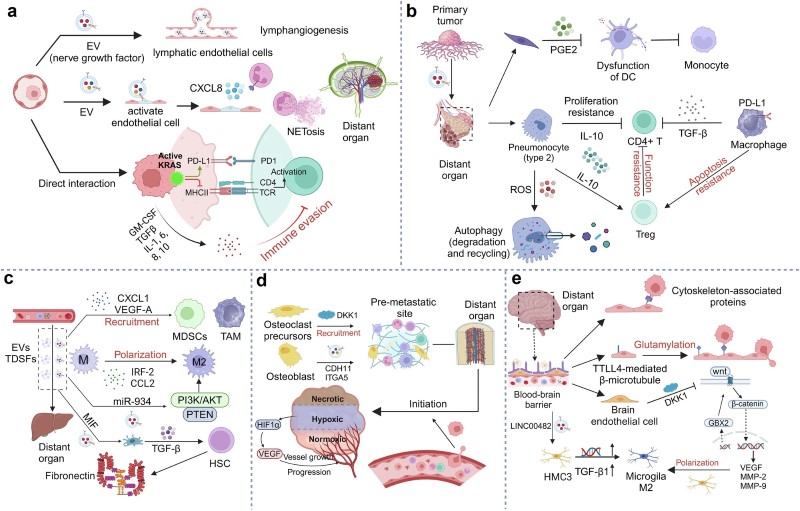 Fig.1 Landscape of pre-metastatic niche in various metastatic organs. 1
What We Can Offer
One-stop profiling service
Highly customized service modules
Our experts design specialized panels for target organs like the brain, liver, or lung, incorporating niche-specific metabolic and microbial axis investigations.
High-throughput exosome isolation
Utilizing automated platforms, we process hundreds of research samples simultaneously to maintain high purity levels while significantly accelerating your project timelines.
Well-established quality systems
Our platform employs Quality-by-Design principles to ensure the delivery of consistent, reproducible data across all spatial transcriptomic and proteomic analysis phases.
How Creative Biolabs Can Assist Your Project
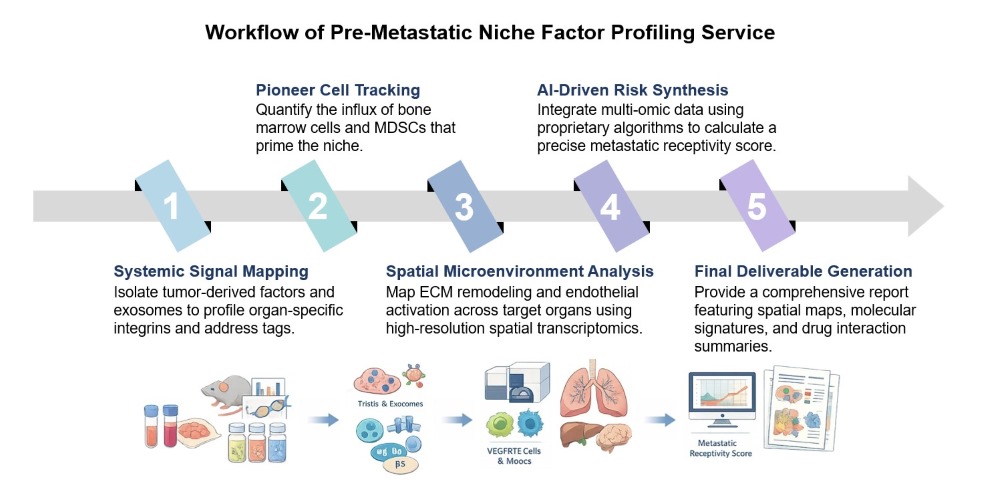
Highlights
Proven Legacy
Creative Biolabs leads the field of microenvironment research with significant tenure and extensive industry experience, delivering dependable and professional support for all complex research projects.
Modern Integration
We integrate established scientific principles with recent breakthroughs in environmental diversity and the gut-microbiota axis to provide cutting-edge insights for your research.

Predictive Modeling
Our specialized platform employs proprietary intelligent modeling to convert biological markers into reliable probabilities, helping to accelerate your discovery and validation pipeline.
Strategic Advantage
We provide advanced capabilities for mapping environmental changes, ensuring your research team can pinpoint the most high-value targets with remarkable accuracy and confidence.
Our dedicated team is standing by to help you translate complex biological signals into actionable drug discovery milestones. - Get a Quote Today
Customer Reviews
-
Strategic Research Timing
Creative Biolabs provided the tools to track immune cell movement in our models, helping us determine the exact moment environments become receptive. This improved our experimental intervention strategy. - Prof. M**l K. -
Advanced Data Integration
By analyzing microbial influences on distant organ sites, we uncovered key triggers for inflammatory responses. Creative Biolabs' sophisticated analytical platform made interpreting these complex research datasets much easier. - Dr. E**a. R.
FAQs
At what stage of research should I utilize PMN profiling?
This service is most effective during target discovery and pre-clinical validation phases to demonstrate how your compound prevents organ priming before physical colonization occurs in models.
How does your AI-driven risk scoring differ from standard bioinformatic analysis?
Standard methods often analyze isolated markers, whereas our AI integrates complex longitudinal data across multiple biological pillars to generate a single, validated receptivity score for research.
Related Services
Spatial Metabolomics Service
We offer high-resolution mapping of metabolic heterogeneity within tissue sections to identify localized metabolic shifts that drive early-stage metastatic site development.
Learn More →Metagenomic Tumor Microbiome Analysis
We provide comprehensive sequencing to identify specific microbial signatures within metastatic sites, revealing how local bacterial communities influence tumor colonization and immune evasion.
Learn More →How to Contact Us
Creative Biolabs provides a leading solution for organizations seeking to master the complexities of tumor metastasis in a research setting. By combining expertise in TME with modern technology like microbial axis profiling and AI-driven analytics, we provide the biological intelligence required to study the spread of cancer.
Whether you need to refine your experimental design, select the most relevant animal models for organotropic studies, or interpret complex multi-omic datasets, our team is available.
Reference
- Wang, Yuhang et al. "Pre-metastatic niche: formation, characteristics and therapeutic implication." Signal transduction and targeted therapy vol. 9,1 236. 25 Sep. 2024. Distributed under an Open Access license CC BY 4.0, without modification. https://doi.org/10.1038/s41392-024-01937-7
 Download our brochure
Loading case studies...
Online Inquiry