Proliferation Index Profiling Service
Creative Biolabs provides a comprehensive analytical suite to quantify cellular turnover, identifying the transformation from normal cells to malignant phenotypes. By integrating high-throughput digital pathology and multi-omics, we pinpoint exactly where carcinogenic factors disrupt the cell cycle. Our deep learning models accurately differentiate between reactive hyperplasia and true neoplastic proliferation, translating complex dynamics into actionable data for predicting survival and monitoring therapy. This precision enables high-stakes decision-making in toxicology and drug efficacy studies, moving research from observation to definitive quantification.
Introduction of Proliferation Index Profiling Service
Cellular proliferation is the primary engine of cancer progression and a vital metric in assessing carcinogenic potential. Recent scientific literature highlights that while Ki67 remains the classic immunohistochemical marker, its evaluation suffers from high inter-observer variability when assessed manually. Advanced studies now emphasize the functional role of proliferating cell nuclear antigen (PCNA) phosphorylation (Y211) as a critical growth regulator and marker of DNA damage response, as well as the emerging power of deep learning radiomics to predict proliferation status non-invasively. Collectively, these findings underscore that a multi-dimensional approach—integrating molecular, functional, and imaging data—is essential for accurate carcinogenic risk assessment.
Quadruple-Layer Marker Strategy
Creative Biolabs captures the full landscape of tumor proliferation across four distinct layers:
Ki67 (Protein Level)
The gold standard for spatial distribution. High indices correlate with tumor aggressiveness, particularly in lung adenocarcinoma and breast cancer.
PCNA (Transcriptomic Level)
Utilizing the "metaPCNA" signature, we provide a robust transcriptomic index that predicts survival in proliferation-informative cancers (PICs) and correlates with gross somatic mutation burden.
Radiomic Proliferation Index (Imaging Level)
Our newest frontier uses deep learning radiomics to predict Ki67 status non-invasively from CT/PET imaging, capturing tumor heterogeneity that single-site biopsies may miss.
Functional PCNA (Phosphorylation Level)
Beyond simple quantification, we analyze tyrosine phosphorylation (Y211) of PCNA. Phosphorylated PCNA (pY211) acts as a critical growth regulator and mediator of DNA damage responses, providing a functional measure of tumor signaling activity.
Explore Our Scientific Expertise - Request a Technical Brief
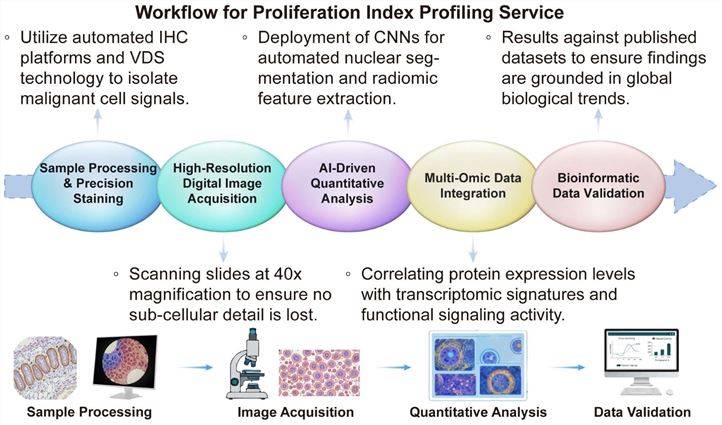
Analytical Workflow
To ensure the highest data integrity, our workflow is standardized yet flexible enough to accommodate unique research goals and diverse sample types.
Publication
This study investigates a tri-marker proliferation index to predict biochemical recurrence in prostate cancer after radical prostatectomy. Using immunohistochemistry for Ki-67, TOP2A, and E2F1, the authors found that a combined index outperformed individual markers and enhanced prognostication beyond standard clinicopathological factors. The results support the utility of this proliferation signature for improved risk stratification and treatment decisions.
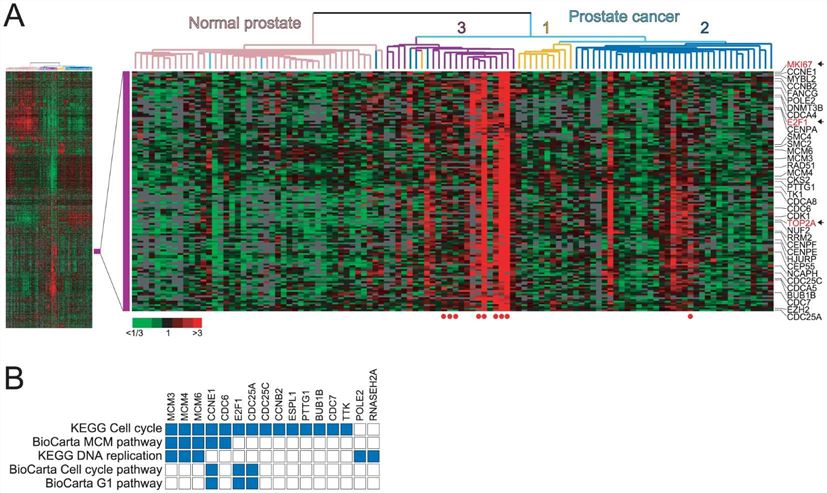 Fig.1 Proliferation signature cluster in prostate cancer. 1
Why Choose Us?
Creative Biolabs leads the intersection of classical pathology and artificial intelligence through a unique "Quadruple-Layer" approach, capturing proliferation dynamics across protein, transcriptomic, functional signaling (pY211), and macro-radiological levels. By implementing deep learning radiomics, we achieve an AUC of 0.90+ in predicting proliferation status non-invasively, a breakthrough for longitudinal studies where repeated biopsies are impossible. Our platform maps spatial "hot spots" and "cold spots" with high resolution, providing a granular understanding of tumor heterogeneity. This methodology prioritizes reproducibility and clinical relevance, utilizing rigorous quality control to transform complex biological data into actionable intelligence for drug development and regulatory compliance.
Empower your research with functional and molecular precision. Contact our specialist team today to discuss how our AI-enhanced proliferation profiling can provide the definitive evidence your project requires.
FAQs
What differentiates the metaPCNA signature from standard RNA-seq analysis?
The metaPCNA signature is a validated "meta-signature" that filters out background noise to provide a concentrated proliferation score. This has been shown to correlate more accurately with mutation burden and survival than raw transcript counts alone.
Is the pY211 (phospho-PCNA) functional assay available for all research species?
Creative Biolabs currently offers validated pY211 assays for mouse and rat samples. We are continuously expanding our antibody repertoire; please reach out to discuss custom validation for other species.
How should I interpret the SHAP values provided in the radiomics report?
SHAP values provide interpretability by explaining why the AI assigned a specific score. They highlight which tumor characteristics—such as specific textures, edges, or densities—contributed most to the predicted proliferation index.
Customer Review
-
Unmatched Spatial Precision
Using Creative Biolabs' technology in our breast cancer research has facilitated our understanding of how the tumor microenvironment modulates Ki67 expression. The digital exclusion of stromal cells saved us months of manual counting and eliminated the variance seen in manual scoring. – Dr. Sarah W*** -
Functional Insights into PCNA
The pY211 phosphorylation assay provided the definitive evidence we needed to explain drug resistance in our c-Abl inhibitor study. The correlation between signaling activity and tumor growth was clear and provided a new angle for our mechanism of action papers. – Prof. Michael R***
Related Services
Pathology & Histology Evaluation
Creative Biolabs provides comprehensive histopathology and clinicopathological services for drug discovery and safety assessments, delivering timely staining, tissue sectioning, and expert reports to meet all pre-clinical and regulatory requirements.
Learn More →Biomarker Development Service
Creative Biolabs provides expert biomarker identification, assay development, and validation services to deliver high-quality, sensitive data, enabling critical go/no-go decisions across every stage of the drug discovery and development pipeline.
Learn More →How to Contact Creative Biolabs
Creative Biolabs is dedicated to providing the most advanced, AI-integrated proliferation profiling available today. From non-invasive imaging to deep functional signaling, we provide the definitive evidence you need to move your project forward with confidence.
For detailed project discussions or to receive a custom quote tailored to your specific research needs, please reach out to our scientific team.
Reference
- Malhotra, Sameer, et al. "A tri-marker proliferation index predicts biochemical recurrence after surgery for prostate cancer." PLoS One 6.5 (2011): e20293. Distributed under Open Access license CC BY 4.0, without modification. https://doi.org/10.1371/journal.pone.0020293
 Download our brochure