Proteomic & Phosphoproteomic Profiling Service for Cancer Signaling Pathway
Creative Biolabs moves your research beyond the "blueprint" of DNA into the "engine room" of the cell. We provide high-resolution data that clarifies why certain models resist therapy despite having identical genetic backgrounds. By mapping the global proteome and specific phosphorylation events (PTMs), we identify hyper-activated pathways driving tumor growth, allowing you to validate targets with higher confidence and precision. Our service is specifically designed to uncover therapeutic "escape routes" that are invisible to RNA-sequencing or genomic panels.
The Functional Landscape of Cancer Signaling
In modern oncology research, the genome serves only as a blueprint, while the proteome reflects the functional reality of disease. Relying solely on genomic sequencing often leads to a "functional gap," as DNA mutations do not always dictate protein activity or pathway activation. Proteomic and phosphoproteomic profiling serves as the critical bridge, capturing the dynamic "signaling flux" that drives cancer progression and resistance. While a mutation might suggest a potential target, phosphorylation events indicate the actual "on/off" state of pathways within the experimental environment. By mapping these post-translational modifications, researchers identify specific "signaling addictions" and druggable kinase nodes.
Comprehensive Solutions
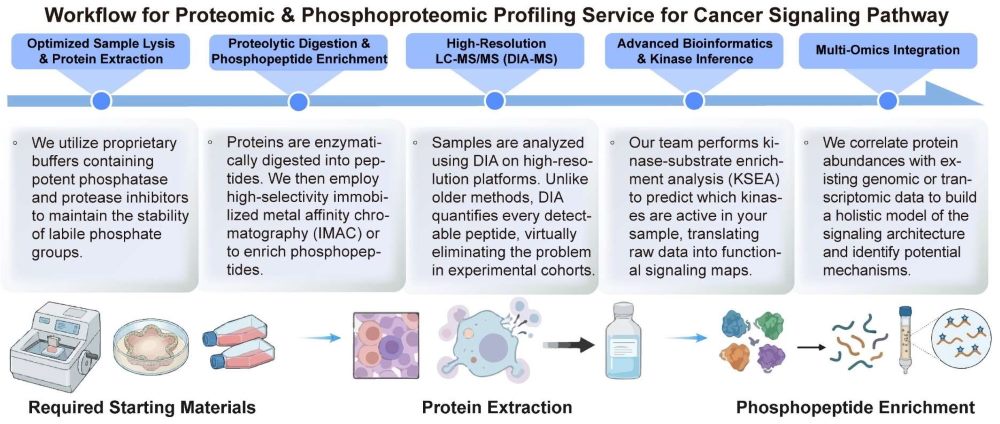
We provide a modular suite of discovery-based solutions designed to dissect the complexity of cancer signaling, transforming complex biological matrices into actionable maps of pathway activation.
Global Proteome Profiling
Quantify thousands of proteins simultaneously using high-resolution data-independent acquisition (DIA)-MS to establish a robust baseline of protein expression, ensuring that your research accounts for the total cellular landscape and potential compensatory mechanisms.
Deep Phosphoproteome Enrichment
Capture low-abundance phosphorylation events using state-of-the-art enrichment, providing site-specific resolution across Ser, Thr, and Tyr residues to reveal the real-time activation state of signaling networks in your specific models.
Kinase-Substrate Enrichment Analysis (KESA)
Utilize KSEA to infer the activation status of specific kinase nodes, allowing you to identify dominant signaling addictions and potential bypass routes in resistant tumor models and experimental conditions.
Integrative Bioinformatic Mapping
Combine proteomic and phosphoproteomic data into high-tier visualizations, including volcano plots and kinome heatmaps, to deliver a strategic biological summary that accelerates the identification of druggable signaling nodes and biomarkers.
Explore the full potential of your samples—Consult with our proteomic experts to receive a customized discovery roadmap.
Workflow
To initiate a high-depth profiling project, researchers typically provide biological materials representing the disease state or experimental condition of interest. Our workflow is optimized to handle low-input samples without compromising the depth of the phosphoproteome.
Publication
This study integrates proteomic and phosphoproteomic data from breast cancer samples to improve pathway analysis. Comparing three methods (over-representation, GSEA, and topology-based SPIA), the authors show that integrating both data types with network topology outperforms using either alone. Applied to breast cancer subtypes, the approach reveals distinct pathway rankings, such as p53 pathway enrichment in Basal-like tumors, demonstrating its potential for subtype-specific precision medicine.
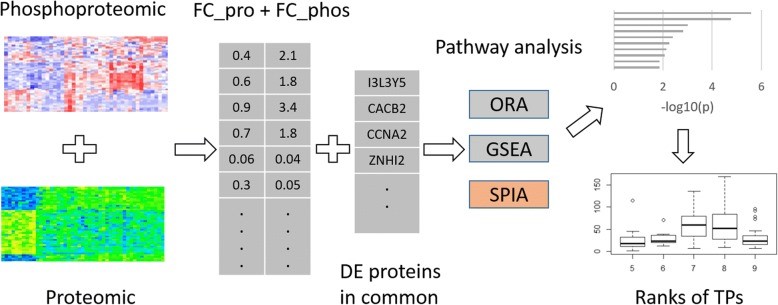 Fig.1 An integrative workflow for proteomic and phosphoproteomic pathway analysis. 1
Why Choose Us?
Creative Biolabs stands at the intersection of advanced protein engineering and high-resolution mass spectrometry, providing a specialized platform for deep signaling interrogation. Our unique DIA-MS workflow represents a significant technological leap over conventional discovery methods, offering unparalleled data completeness by virtually eliminating the "missing value" phenomenon. This ensures that every protein and phosphorylation site identified in your pilot study is consistently quantified across your entire experimental cohort, providing the statistical power necessary for robust lead optimization. We specialize in ultra-low input protocols, enabling deep-dive signaling analysis from rare cell populations and minute fragments that standard platforms cannot process.
Transform your raw data into actionable biological insights—Get an itemized quote for your project today and secure access to our in-depth kinome platforms.
FAQs
What is the minimum sample amount required for deep phosphoproteomics?
While we prefer 20-50 mg of tissue, our high-sensitivity enrichment protocols can work with as little as 1-5 mg for specialized rare cell pellets.
How do you ensure the stability of the phosphorylation during sample prep?
We use a proprietary lysis cocktail containing potent phosphatase and protease inhibitors, combined with rapid temperature-controlled processing to "freeze" the signaling state of the cell at the moment of lysis.
Is this service compatible with archival samples?
Yes, Creative Biolabs has developed specialized protocols for proteomic extraction from various preserved states. While frozen tissue remains the gold standard for maximum phosphopeptide recovery, we can achieve high-depth coverage from many standard research preservation formats.
Customer Review
-
Unrivaled Kinome Depth
Using Creative Biolabs' proteomic and phosphoproteomic profiling service in our research on PDX models has significantly facilitated our identification of kinase-addicted states that were invisible to RNA-seq. - Dr. Al* S -
Reproducibility for Large Cohorts
The consistency of the quantitative data across our 100+ organoid samples was impressive. Creative Biolabs solved our 'missing value' issue, allowing for robust statistical modeling of drug response. - Prof. Li* W
Related Services
Post-translational Modification
Creative Biolabs provides PTM analysis, quantifying phosphorylation, glycosylation, and ubiquitination. We utilize MS/MS peptide mapping and HPLC to evaluate covalent modifications and localization for cell biology and disease research.
Learn More →Therapeutic Developability Assessment Service
Creative Biolabs provides therapeutic developability assessment, quantifying aggregation, thermal stability, and PTMs. We utilize SEC-HPLC, DLS, and DSC to evaluate manufacturability, solubility, and in vivo fitness for de-risking biologics.
Learn More →How to Contact Creative Biolabs
Creative Biolabs offers a world-class proteomic and phosphoproteomic profiling service for cancer signaling pathways, specifically optimized for the complexities of modern research. By leveraging DIA-MS and expert bioinformatics, we provide the functional clarity needed to accelerate drug discovery and refine your research strategies.
Have specific technical requirements? Contact us for a detailed technical evaluation of your experimental needs.
Reference
- Ren, Jie, Bo Wang, and Jing Li. "Integrating proteomic and phosphoproteomic data for pathway analysis in breast cancer." BMC systems biology 12.Suppl 8 (2018): 130. Distributed under Open Access license CC BY 4.0, without modification. https://doi.org/10.1186/s12918-018-0646-y
 Download our brochure