Reporter Assay Service for Cancer Signaling Pathway Activity
Creative Biolabs provides reporter assay services, quantifying transcription factor activity, receptor activation kinetics, and target-gene expression. We utilize stable reporter cell lines to evaluate pathway-specific drug efficacy, cellular resistance mechanisms, and intracellular signaling flux via clear bioluminescent or fluorescent signals. Fully compatible with small molecules, therapeutic antibodies, and engineered immunotherapies, our platforms convert complex biological responses into precise, pre-clinical datasets designed to substantiate the functional mechanism of action and derisk the earliest stages of oncology drug development.
Advancing Pathway-Centric Screening
Modern oncology research highlights the transition of functional drug screening from basic monolayer endpoint assays to dynamic, physiologically relevant pathway profiling. By leveraging advanced pathway-responsive reporter systems, engineered reference benchmarks, and multi-functional platforms in both standard models and patient-derived 3D spheroids, researchers can accurately map complex pathway crosstalk, microenvironmental interactions, and therapeutic synergy. Creative Biolabs translates these scientific breakthroughs into robust, highly reproducible service platforms. Our customized reporter assays provide researchers with precise quantitative readouts of transcription factor modulation, target-gene expression, and receptor activation kinetics.
Our Core Capabilities
To accelerate your pathway-targeted programs, Creative Biolabs provides a comprehensive suite of customized, high-throughput reporter assay services designed for optimal speed and physiological accuracy.
Custom Reporter Cell Line Generation
We engineer stable reporter cell lines utilizing advanced viral transduction or targeted gene integration, delivering highly responsive monoclonal cell populations tailored to your specific host backgrounds and target signaling cascades.
High-Throughput Pathway Screening
Our automated platform supports large-scale screening of small molecules, therapeutic antibodies, and protein degraders, performing single-dose screens or complex drug synergy matrices with exceptional reproducibility and high capacity.
Real-Time Kinetic Profiling
We provide continuous monitoring of cellular signaling dynamics using live cell imaging and destabilized luciferase reporters, allowing you to capture rapid transcription factor modulation, immediate pathway inactivation, and recovery kinetics.
3D Tumor Model Transduction
We adapt established pathway reporter systems to patient-derived three-dimensional spheroids and organoid models, replicating physical barriers, hypoxic gradients, and microenvironmental interactions to maximize the physiological relevance of your candidates.
Partner with Creative Biolabs today to access highly optimized, pathway-targeted screening matrices that accelerate hit identification.
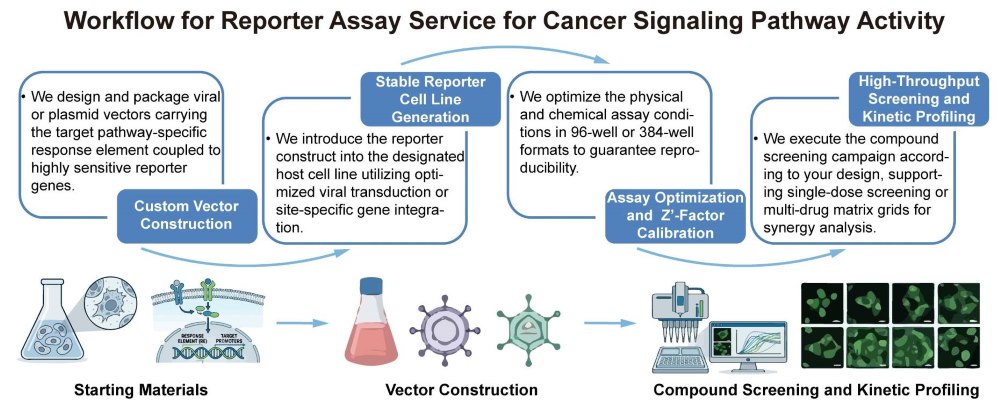
Workflow
We provide a streamlined, end-to-end workflow to transition your project from initial biological concepts to robust, high-throughput screening-ready assays.
Publication
This study improves reporter gene assays for evaluating p53 reactivators by using tetracycline-inducible wild-type p53 as a 100% activity reference, enabling objective measurement of transcriptional restoration. The system revealed differential dominant-negative effects of mutant p53 on target gene promoters and was applied to assess putative reactivators (COTI-2, arsenic trioxide) and MDM2 inhibitors. The method provides a more reliable framework for quantifying p53 functional recovery in drug discovery.
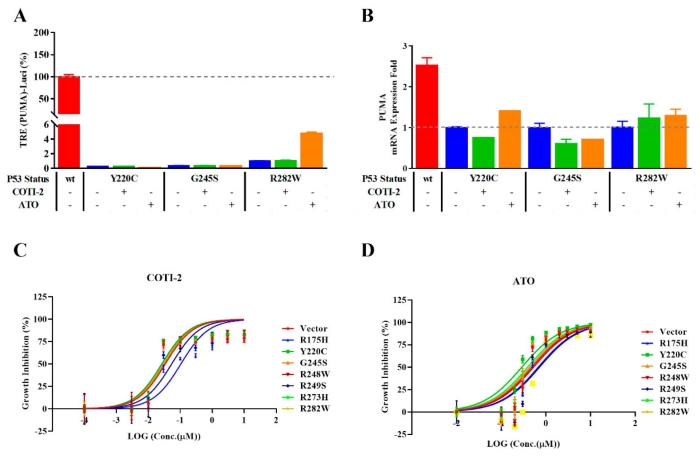 Fig.1 An improved reporter gene system for evaluating mutp53 reactivators. 1
Why Choose Us?
Creative Biolabs stands at the forefront of cellular engineering, offering a reporter assay platform designed to overcome traditional screening limitations. We provide several key advantages to accelerate your drug discovery pipeline. First, our dual-reporter system utilizes internal normalization to eliminate variations in cell viability and pipetting. Second, our advanced protein-degradation technology allows real-time tracking of rapid pathway inactivation without signal accumulation. Third, our ability to transition assays from standard monolayers into patient-derived 3D spheroids provides physiologically relevant solid tumor models. Finally, our universal immunomodulatory assays screen diverse therapeutics on a single convergent platform.
Do not let signal lag or cell-death artifacts compromise your screening quality. Contact Creative Biolabs for a customized, high-precision technical quote.
FAQs
What are the advantages of destabilized luciferase reporters over standard wild-type reporters?
Destabilized reporters possess short intracellular half-lives, enabling researchers to capture rapid transcriptional down-regulation kinetics and compound washout recovery in real time, avoiding signal accumulation errors.
Can you perform these assays in primary cell lines or patient-derived 3D spheroids?
Yes, we specialize in stably transducing primary cells and three-dimensional patient tumor spheroids to replicate complex biological microenvironments for highly physiological pathway screening studies.
How do you control for off-target transcriptional inhibition or general cell toxicity?
We integrate a dual reporter system where the target pathway drives firefly luciferase, and a constitutive promoter drives renilla luciferase to normalize for general toxicity.
Customer Review
-
Unmatched Sensitivity to Transient Feedback Loops
Using Creative Biolabs' service in our research has significantly improved the detection of rapid pathway shutoff, eliminating the signal lag of traditional endpoint assays. - Dr. Sarah L*** -
Streamlined Bioactivity Profiling
Using Creative Biolabs' service in our research has significantly improved bioactivity profiling of engineered cytokine therapeutics via a highly sensitive, convergent signaling platform. - Dr. Kenji S***
Related Services
To further support your drug discovery programs, Creative Biolabs offers several complementary services:
Target Genome Editing Service
Creative Biolabs provides target genome editing services, quantifying gene knockouts and editing efficiency. We utilize CRISPR-Cas9 and TALEN platforms to evaluate genome-scale screening, pathway-specific modifications, and target-gene disruptions.
Learn More →Engineering Leukemia Cell for Self-destruction
Creative Biolabs provides leukemia cell engineering, quantifying synthetic gene circuit delivery and editing efficiency. We utilize lentiviral, adenoviral, and CRISPR platforms to evaluate self-destruction kinetics, immune reactivity, and toxicity.
Learn More →How to Contact Creative Biolabs
Creative Biolabs' service offers a powerful, biologically accurate, and high-throughput tool for oncology drug discovery. By converting complex transcription factor events and microenvironmental cross-talk into highly reproducible optical readouts, we eliminate the blind spots of traditional biochemical screenings.
Ready to advance your pipeline with quantitative, functional insights? Contact our oncology experts today to schedule a detailed technical consultation or request a custom quote.
Reference
- Han, Xinle, et al. "Improving Reporter Gene Assay Methodology for Evaluating the Ability of Compounds to Restore P53 Activity." International Journal of Molecular Sciences 23.22 (2022): 13867. Distributed under Open Access license CC BY 4.0, without modification. https://doi.org/10.3390/ijms232213867
 Download our brochure