ScFv Generation & Optimization Service
Creative Biolabs provides a detailed suite of antibody engineering services designed to transform early-stage hits into robust, developable leads. Our clients can expect to gain high-affinity, monomeric scFv fragments characterized by superior thermal stability and high solubility. By integrating advanced machine learning with high-throughput screening, we provide precisely engineered sequences and purified proteins that streamline the drug discovery workflow, reduce development risks, and ensure seamless transition to large-scale production for research applications.
Introduction to scFv Generation and Optimization
As the most critical initial step, the production of specific scFv and the optimization of its superior affinity lay the most basic foundation for effective and specific CAR-T/NK/MA therapy. There is no doubt that high-quality scFv can lead to superior CAR cell therapy. Creative Biolabs combines our highly trusted hybridoma technology with our top antibody sequencing and recombinant antibody expression platforms to generate highly specific ScFvs to meet our clients' needs.
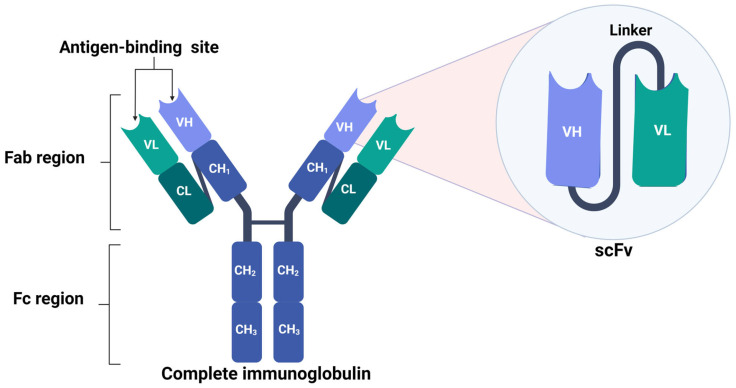 Fig.1 Structure of scFv. 1
What We Can Offer
scFv Generated from Hybridoma Cells
- The mice were immunized with the antigen, and then the spleen was taken out to obtain spleen cells (plasma B cells).
- Spleen cells obtained by fusion of cultured myeloma cells, hybridoma cell lines were established by limiting cell dilution and affinity screening.
- Convert Fv from a fully monoclonal antibody found to scFv to target tumor antigens of interest to our clients.
- The high-quality scFv was cloned with the CAR component to construct a lentiviral vector for future steps.
scFv Generated from Phage Display Library
- Design appropriate primers for cloning antibody genes from B lymphocytes of several different species, then integrate the antibody gene into a phage display vector.
- Transform recombinant phagemid into E. coli, and produce phage-displayed scFv based on helper phage.
- Screening of scFv phage display libraries using our client's specific antigens or recombinant antigen prepared by Creative Biolabs.
- The identified scFvs are sorted and the affinities are optimized using multiple parameters.
scFv Generated from Antibody Sequence
ScFv production from existing antibody sequences is the fastest way to obtain engineered antibody fragments. Our experts can synthesize two variable region gene sequences in vitro and fuse these two regions with the short peptide linker gene (10-25 amino acids). Subsequently, we inserted this long fragment into the vector and expressed it in E. coli or mammalian cell lines (depending on your choice). We also provide further services for purification of this recombinant antibody, making it available for further research.
How Creative Biolabs' service Can Assist Your Projects
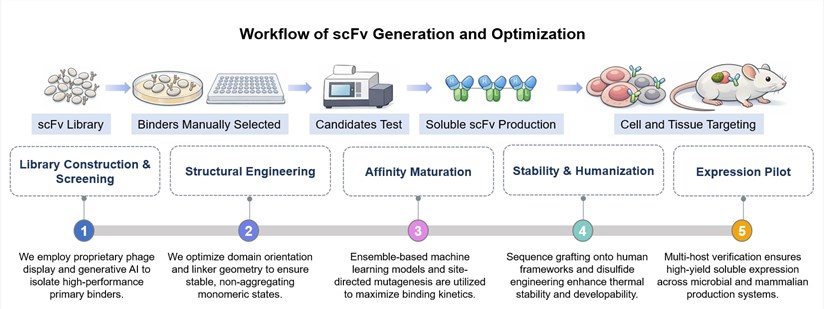
Highlights
Efficient T cell activation may vary depending on the target antigen and CAR construct, CAR expression, scFv affinity, spatial restriction, and tumor cell expression of adhesion and costimulatory ligands. scFv can affect CAR function, not just tumor specificity. Creative Biolabs' researchers can regulate the safety and/or efficacy of CAR T cells through all aspects of scFv design:
Strategic Humanization
We convert mouse-derived scFv sequences into humanized formats to minimize potential immune responses while maintaining the original paratope's binding specificity and orientation.
Targeting Optimization
We modify variable regions to optimize gene-targeted T-cell function, ensuring enhanced interaction between the targeting scaffold and the specific research antigen of interest.

Precision Sensitivity
Our platform enables detection of precise sensitivity levels in low-density antigens, allowing for robust target identification even in challenging experimental environments.
Generic CAR Design
We analyze and develop ligand-based or generic CAR architectures, providing versatile targeting solutions that integrate seamlessly with various cellular signaling domains.
Customer Reviews
-
Superior Monomeric Stability
Creative Biolabs' systematic linker refinement effectively resolved persistent aggregation, yielding stable monomeric populations that were previously unattainable for our multispecific antibody platform research. - Dr. A*n. S. -
Enhanced Affinity via ML
Our biomarker research utilized Creative Biolabs' machine learning pipeline to identify paratope configurations, achieving superior analytical sensitivity through optimized molecular recognition. - Prof. M*l. R.
FAQs
Can you convert my existing mouse hybridoma into a humanized scFv?
Yes, we provide full hybridoma-to-scFv conversion, including sequence-based humanization and framework optimization to ensure minimal immunogenicity in experimental applications.
What is the benefit of your ML-driven optimization over traditional methods?
Our ML models can "leap" across the sequence space to find high-diversity variants that iterative wet-lab screening might miss, often achieving higher affinity in a shorter timeframe.
Related Services
Bispecific Antibody Generation
We utilize diverse technology platforms to engineer high-purity bispecific molecules, facilitating simultaneous dual-antigen targeting for advanced immunological research and lead discovery.
Learn More →Bispecific Antibody Engineering
We offer sophisticated structural refinement of dual-targeting formats, employing specialized engineering to optimize molecular stability, valency, and spatial orientation for superior research performance.
Learn More →How to Contact Us
Our dedicated team of biological specialists and engineering experts is standing by to help you navigate the intricate technical hurdles of antibody fragment development. We offer comprehensive scientific support to ensure your project transitions smoothly from initial sequence design to validated protein lead.
For more details, please feel free to contact us for project quotations and more detailed information.
Reference
- Rodríguez-Nava, Cynthia et al. "Mechanisms of Action and Limitations of Monoclonal Antibodies and Single Chain Fragment Variable (scFv) in the Treatment of Cancer." Biomedicines vol. 11,6 1610. 1 Jun. 2023. Distributed under an Open Access license CC BY 4.0, without modification. https://doi.org/10.3390/biomedicines11061610
 Download our brochure