Specialized genetic engineering and pilot-scale expansion of primary T-cells for robust in vitro and in vivo research validation.
Learn More →NEXT™ CAR-T Discovery Services
Creative Biolabs supports the discovery of cellular and gene therapies via a consultative-based and strategic approach with great expertise and scientific knowledge, plus regulatory concerns. Both individual studies and integrated programs are designed covering all aspects of cellular and gene therapies. Our discovery services are provided to primarily mitigate risk factors inherent in discovery and development of the therapeutic types. Our multidisciplinary team will accommodate the specific properties of your CGT product to design an appropriate candidate for our clients. With extensive experience and a proven ability to navigate updated regulatory landscape, our scientists design and manage a series of discovery services that reduce risk and accelerate timelines.
Introduction What We Can Offer How We Can Help Why Choose Us? Customer Reviews FAQs Related Services Contact Us
Overcoming Fundamental Barriers in CAR-T Discovery
Advanced CAR-T discovery requires circumventing the formidable physical and biochemical obstacles inherent to the tumor microenvironment. Current academic consensus suggests that successful outcomes depend not merely on high binding affinity, but perhaps more crucially on the structural integrity of the immunological synapse. Furthermore, the mitigation of terminal differentiation remains a pivotal challenge. Our platform addresses these hurdles through the development of synthetic receptors designed to modulate metabolic flux and actively prevent exhaustion phenotypes in experimental models.
Request a Consultation →
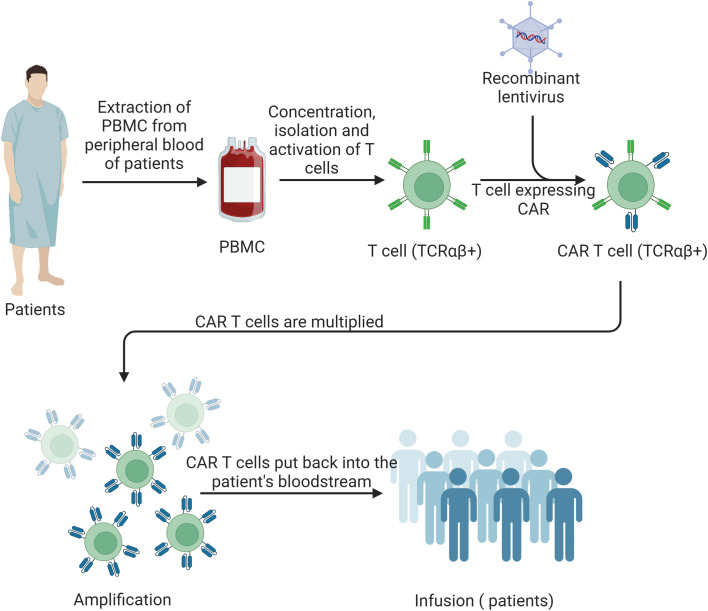 Fig.1 Schematic of CAR-T cell therapy process. 1
What We Can Offer
Strategic Program Design
We provide expert advisory services to customize study frameworks, ensuring your discovery programs align with the latest scientific and competitive landscapes.
Risk Mitigation Tactics
Our specialists implement proactive identifying and addressing of technical bottlenecks, safeguarding your research investment from common developmental pitfalls and setbacks.
Seamless Program Management
Dedicated oversight ensures streamlined workflows and milestone adherence, optimizing resource allocation while maintaining the rigorous precision required for complex cellular engineering.
Regulatory Discovery Advice
We offer foundational guidance on structural and data requirements, facilitating the alignment of early-stage research with future high-standard documentation needs.
How Creative Biolabs' Service Can Assist Your Projects
We provide the following modules of cellular and gene therapy discovery services, but not limited to these. If you are interested in any other specific requirements, please feel free to contact us to tailor a specific service for you. For current in-house services, please visit the following modules.
CAR-T Cell Design & Manufacturing
CAR-T Cell Therapy Discovery
End-to-end identification of novel antigens and binder validation to accelerate the development of high-potency cellular research leads.
Learn More →CAR NK Cell Design & Manufacturing
Custom engineering of Natural Killer cells utilizing advanced transduction methods to optimize innate cytotoxic responses in research.
Learn More →Chimeric Antigen Receptor (CAR) Macrophage Cell Therapy
Engineering specialized macrophages to investigate phagocytosis and tumor microenvironment remodeling within experimental solid tumor research models.
Learn More →Oncolytic Virus (OV) Therapy
Design and development of viral vectors that selectively replicate in research cell lines to enhance anti-tumor immunity.
Learn More →TCR Identification
High-throughput repertoire sequencing and bioinformatics analysis to identify unique T-cell receptors from diverse experimental biological samples.
Learn More →MHC-Ligandome Mapping
Advanced mass spectrometry for the direct identification of MHC-presented peptides, uncovering novel targets for specialized research projects.
Learn More →TCR Generation and Optimization
Precision engineering and affinity maturation of TCR sequences to enhance target recognition and stability in research applications.
Learn More →scFv Generation and Optimization
Development of high-fidelity antibody fragments through phage display and hybridoma technology, tailored for specific synthetic receptor architectures.
Learn More →Highlights
Risk-Reduced Discovery Pipelines
We integrate deep scientific knowledge with regulatory expertise across all CGT modalities to accelerate research timelines and minimize early-stage developmental uncertainties.
Expert Scientific Leadership
Our seasoned experts leverage decades of successful drug development experience to design sophisticated discovery solutions that meet rigorous scientific and regulatory objectives.

Collaborative Strategic Integration
By adopting a highly collaborative approach, we ensure that specialized insights in cellular engineering are seamlessly applied to optimize your project's unique requirements.
Advanced Multi-Modal Platforms
Our infrastructure supports the rapid transition of CAR designs into diverse scaffolds, utilizing proprietary "Exhaustion Shield" technology to ensure robust persistence in models.
With access to the biologics' most comprehensive portfolios (from early discovery to market support), Creative Biolabs is uniquely qualified to speed your journey through drug discovery and development.
Get a Quote→
Customer Reviews
-
Superior Specificity
Using Creative Biolabs' CAR-T discovery in our research has improved our ability to target cryptic epitopes in solid tumor models. Their MHC-ligandome mapping identified neoantigens that were previously difficult to pinpoint. - Dr. N**a. J. -
Metabolic Fitness
The metabolic tuning provided by Creative Biolabs was critical. It significantly facilitated the long-term persistence of our CAR-T cells in high-stress tumor models compared to standard designs. - T**s. H.
FAQs
How do you minimize tonic signaling in your constructs?
We employ precise TMD tuning and VH-VL orientation optimization to eliminate spontaneous receptor clustering, thereby preventing premature effector exhaustion and ensuring sustained signaling fidelity in research.
Can your platform target intracellular antigens?
Leveraging MHC-ligandome mapping and TCR-T discovery, we successfully target intracellularly-derived peptides presented on the surface, potentially allowing researchers to broaden the scope of accessible therapeutic oncology targets.
Related Services
CAR-T Engineering
Implementation of transient mRNA transfection to evaluate CAR expression and toxicity profiles before proceeding with stable viral transduction protocols.
Learn More →CAR-T In Vivo Animal Testing
Utilization of clinical tumor samples to provide physiologically relevant environments for the rigorous assessment of CAR-T efficacy in specialized research models.
Learn More →How to Contact Us
Under the complexities of scientific and technical challenges, cellular and gene therapy programs should be highly customized and vary greatly as per the product attributes. To move the CGT programs through regulatory approval faster, Creative Biolabs is the trusted and reliable partner who provides access to a deep scientific network and integrates different components of the services to achieve your desired milestones and push the program to market on time. Any questions, please contact us to learn more.
Reference
- Larson, Rebecca C, and Marcela V Maus. "Recent advances and discoveries in the mechanisms and functions of CAR T cells." Nature reviews. Cancer vol. 21,3 (2021): 145-161. Distributed under an Open Access license CC BY 4.0, without modification. https://doi.org/10.1038/s41568-020-00323-z
 Download our brochure
Loading case studies...
Online Inquiry