Senescence induced Tumor-Promoting Inflammation Assessment Service
The primary hurdle in oncology research is the paradoxical nature of the senescence-associated secretory phenotype (SASP). While acute senescence serves as a powerful tumor-suppressive mechanism, chronic persistence of these cells results in a pro-tumorigenic "para-inflammation" that actively remodels the tumor microenvironment (TME). Creative Biolabs provides a high-resolution analytical bridge to identify these inflammatory drivers. By utilizing our proprietary senescence-inflammatory response (SIR) mapping, we help researchers pinpoint exactly how senescent cells are "licensing" tumor cells to survive outside their natural niches and resist immune surveillance.
Mechanistic Origins of the Senescence-Inflammatory Response
Cellular senescence is no longer characterized as static endpoints of permanent cell cycle arrest; instead, it is recognized as a hyper-dynamic secretory state with profound non-cell-autonomous effects. Chronic cellular stress, persistent DNA damage, and oncogene activation trigger a complex differentiation-like program where cells remain metabolically hyperactive yet proliferatively silent. The resulting SASP and the more aggressive SIR serve as the primary "origins of tumor-promoting inflammation." Current research confirms that these senescent populations, particularly senescent macrophages, establish an immunosuppressive niche that facilitates epithelial-mesenchymal transition (EMT) and metastatic colonization.
Comprehensive Service Portfolio for Inflammation Assessment
Creative Biolabs provides a versatile range of assessment tiers tailored to the specific requirements of your drug discovery program, focusing on the mechanistic drivers of tumor-promoting inflammation.
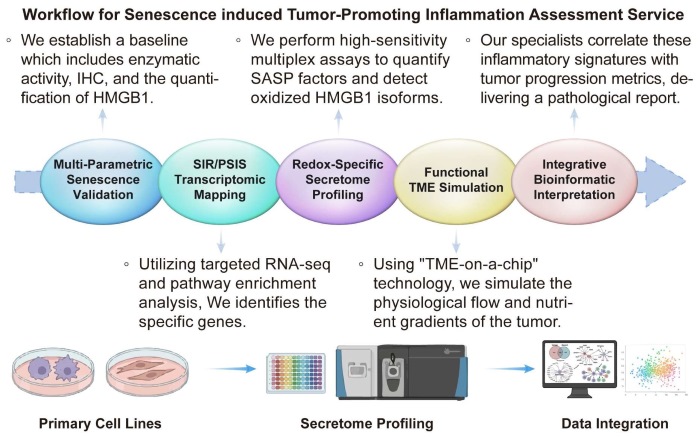
High-Resolution SASP Secretome Profiling
We utilize multiplexed immunoassay platforms to quantify a vast array of pro-inflammatory cytokines, chemokines, and matrix-remodeling enzymes, providing a detailed molecular fingerprint of the senescent cell's secretory output.
Targeted SIR & PSIS Genomic Mapping
Our advanced transcriptomic services identify the specific "invasiveness signature" genes activated when senescence-induced growth arrest is bypassed, distinguishing between benign arrest and malignant para-inflammatory states in your models.
Redox-Specific Biomarker Detection
We offer specialized mass spectrometry analysis for detecting oxidized HMGB1 isoforms, serving as a definitive indicator of chronic inflammatory priming and systemic immune dysregulation within the aging TME.
Functional TME Interaction Modeling
Leveraging proprietary TME-on-a-chip technology, we simulate complex cellular crosstalk, allowing researchers to observe how senescent-derived signals actively recruit immunosuppressive populations or impair the cytolytic functions of effector T-cells.
Accelerate Your Project with Our Specialized Portfolio — Inquire About Our Custom Assessment Tiers
Workflow
We follow a rigorous, stage-gated process to ensure every assessment is biologically relevant and statistically robust, providing a clear roadmap from raw sample to actionable insight.
Publication
This review examines the emerging role of senescent macrophages (sMACs) within the tumor microenvironment. sMACs exhibit distinct phenotypes, including cell cycle arrest, SASP, and specific markers such as PD-L1, SPP1, CXCR1, and CD22. They influence tumor progression through immune suppression, angiogenesis, and extracellular matrix remodeling. The article discusses molecular characteristics, functional abnormalities, and potential therapeutic strategies targeting sMACs, including senolytic drugs and senomorphic agents, while highlighting current challenges in biomarker identification and targeted clearance.
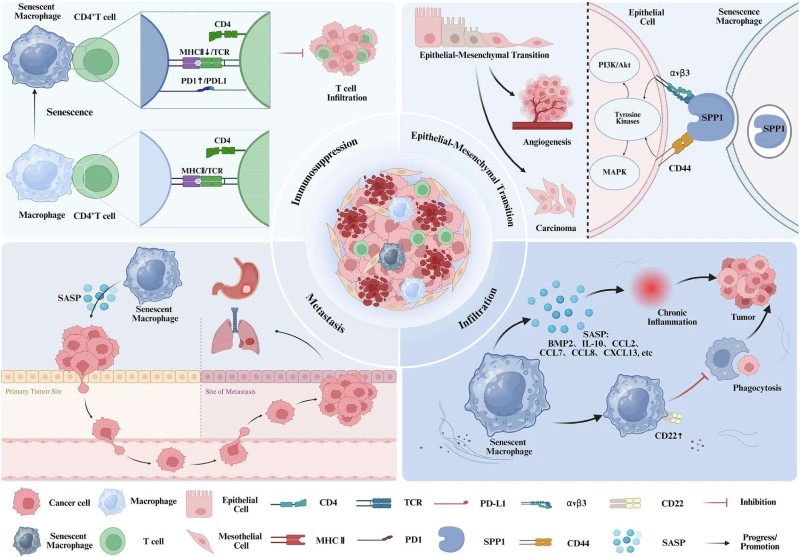 Fig.1 Potential roles of senescent macrophages in tumors. 1
Why Choose Us?
Choosing Creative Biolabs means partnering with a leader at the dynamic intersection of oncology and aging biology. Our unique advantage lies in our sophisticated ability to distinguish between "productive" tumor-suppressive senescence and "destructive" tumor-promoting para-inflammation. While conventional providers rely solely on basic SA-β-gal staining, we offer an integrated platform that connects metabolic rewiring, redox signaling, and genomic invasiveness signatures. Our protocols are meticulously updated to reflect groundbreaking research on macrophage-CAF feedforward loops, ensuring your project utilizes the most current scientific breakthroughs. Furthermore, our platform is highly scalable and versatile. Whether you are screening a small library of senomorphic candidates or performing high-resolution analysis on complex clinical biopsy samples, Creative Biolabs delivers consistent, reproducible, and publication-ready data that drives your drug discovery forward.
Experience the Precision of Creative Biolabs — Request a Customized Quote for Your Specific Research Model
FAQs
How does your service distinguish between tumor-suppressive and tumor-promoting senescence?
We utilize the PSIS panel. While both types show p16 expression, only tumor-promoting senescence exhibits the specific upregulation of matrix-remodeling and niche-independent growth genes.
Can this service be used for therapy-induced senescence (TIS) models?
Yes. It is specifically designed to evaluate if chemotherapeutic agents are creating a "senescent reservoir" that might drive future recurrence via chronic SASP secretion.
What unique insights do you provide for macrophage senescence?
We assess "inflammatory priming" through oxidized HMGB1 detection and evaluate the macrophage's ability to polarize and phagocytose, which is often impaired in senescent TAMs.
Customer Review
-
Precision in PSIS Detection
Using Creative Biolabs' SIR profiling in our research has significantly facilitated the identification of invasiveness signatures in p53-deficient models. Their ability to distinguish para-inflammation from standard SASP provided the mechanistic proof we needed for our data package. - Dr. Ar S -
Invaluable Macrophage Insights
The redox-specific HMGB1 analysis using the Creative Biolabs platform has significantly improved our understanding of inflammatory priming in aged TMEs. The data were exceptionally clear, particularly the differentiation of HMGB1 isoforms. - Prof. Li* W
Related Services
STAT Reporter Panel Screening Service
Creative Biolabs provides STAT reporter panel screening, quantifying JAK/STAT signaling and gene expression. We utilize cell-based reporter assays to evaluate antibody-mediated inhibition and functional selectivity for therapeutic optimization.
Learn More →Pro-inflammatory Cytokine Panel Screening Service
Creative Biolabs provides pro-inflammatory cytokine panel screening, quantifying TNF-α, IL-1β, and IL-6 release. We utilize multiplex ELISA and primary cell assays to evaluate immune cell activation and cytokine modulation for anti-inflammatory drug discovery.
Learn More →How to Contact Creative Biolabs
Creative Biolabs provides the most comprehensive analytical suite for understanding the inflammatory consequences of cellular senescence. Our integrated approach ensures your drug discovery program is built on solid biological foundations.
Contact Our Team for More Information and to Discuss Your Project
Reference
- Shen, Wenhui, et al. "Senescent macrophages in tumor: phenotypes, roles, and interventions." Cell Death & Disease 16.1 (2025): 677. Distributed under Open Access license CC BY 4.0, without modification. https://doi.org/10.1038/s41419-025-08000-5
 Download our brochure