Senescent Cell-Immune Interaction Mapping Service
At Creative Biolabs, we bridge the gap between static cell identification and dynamic functional understanding. Traditional senescence assays often fail because they treat senescent cells in isolation, ignoring the surrounding immune landscape. Our service provides high-dimensional data to confirm whether your therapeutic agent successfully restores immune surveillance or merely suppresses the senescence-associated secretory phenotype (SASP). We offer a "blueprint of interaction" that identifies exactly which immune subsets are successfully recruited to senescent niches and which are being actively excluded.
Pioneering Insights into Senescent Cell-Immune Surveillance Dynamics
Cellular senescence acts as a vital tumor-suppressive mechanism; however, its chronic accumulation and subsequent SASP drive systemic aging and progressive tissue degeneration. Recent research reveals that senescent cells do not accumulate randomly; they actively orchestrate their survival by establishing "immune deserts" through the upregulation of inhibitory checkpoints like HLA-E and the strategic shedding of MICA/B ligands. This sophisticated evasion prevents NK and CD8+ T-cell recognition, leading to an "inflammatory continuum" where the immune system is actively reprogrammed into a pro-inflammatory, dysfunctional state.
Comprehensive Service Portfolio
To support your geroscience and oncology research, Creative Biolabs provides a suite of specialized analytical services focused on the interface of senescence and immunity:
High-Resolution Spatial Profiling
We utilize multiplexed imaging to visualize the architecture of senescent niches. By mapping p16+ cells against eight immune markers, we identify exactly where surveillance fails within your specific tissue models.
SRTS Metabolic Fingerprinting
Our team analyzes senescence-related transcriptional signatures in infiltrating immune cells. This reveals if your drug successfully reverts SASP-induced metabolic exhaustion, particularly markers like PDK4 and RHOB in macrophage populations.
Nearest-Neighbor Proximity Analytics
We provide quantitative data on immune-cell distancing. By distinguishing density-driven proximity from active exclusion, we define the "kill zone" efficacy of your senolytic leads compared to standard benchmark treatments.
Custom Immuno-Senolytic MoA Studies
We design tailored studies to validate how your candidates modulate the local microenvironment. This includes identifying surface ligand changes, checkpoint expression shifts, and the restoration of natural cytotoxic effector recruitment.
Bridge the Gap Between In Vitro Potency and In Vivo Efficacy - Request Your Custom Mapping Proposal Today
Workflow
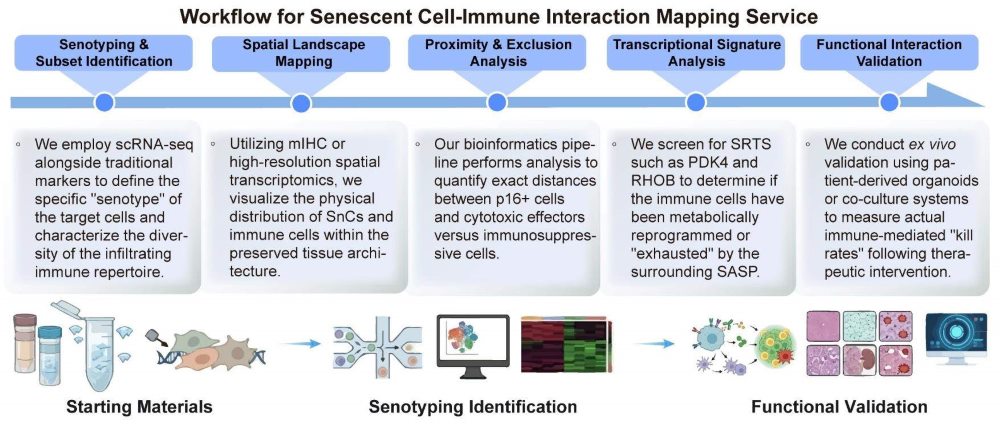
To ensure the highest precision, our workflow is designed to handle the complexity of heterogeneous tissues while maintaining strict quality control. We utilize a multi-omics approach to ensure that spatial data is supported by robust transcriptional evidence.
Publication
This commentary highlights recent discoveries on the bidirectional crosstalk between senescent cells and CD8+ T lymphocytes. Senescent cells can upregulate MHC-I and antigen presentation machinery, rendering them susceptible to CD8+ T cell–mediated killing via type I interferon signaling. Conversely, senescent cells may evade immune clearance by expressing immune checkpoints such as PD-L1. These insights open avenues for immunotherapies targeting senescent cells in aging and age‑related diseases, including vaccination against "seno‑antigens" and checkpoint blockade as senolytic immunotherapy.
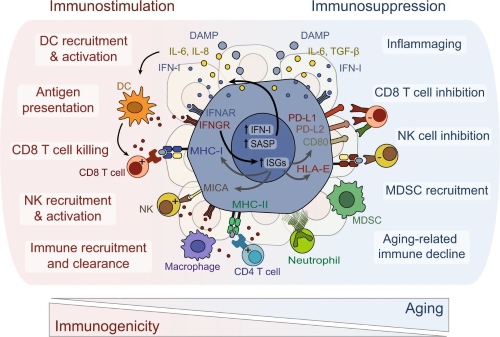 Fig.1 Immunomodulatory properties of senescent cells. 1
Why Choose Us?
Creative Biolabs stands at the forefront of geroscience by integrating multi-omics with high-resolution spatial biology to decode the "inflammatory continuum." Unlike standard pathology services that offer mere cell counts, we focus on the functional "handshake" between senescence and immunity. Our platform is powered by advanced analytical tools capable of identifying "immune deserts"—regions where senescent cells establish exclusionary zones that prevent effector recruitment. We provide the specialized expertise required to decode metabolic reprogramming in immune cells, identifying critical markers like HLA-E upregulation or MICA/B shedding that serve as molecular barriers to clearance.
Experience the Creative Biolabs Advantage - Partner with Us to Overcome Immune Evasion
FAQs
What tissue types are compatible with your mapping service?
We can process almost any mammalian tissue, though we specialize in high-impact areas like the synovium, lung, skin, and endometrium. We also offer specialized protocols for lymphoid organ architecture analysis.
How do you distinguish between density-driven and exclusionary spatial patterns?
We employ analysis between senescent cell density and nearest-neighbor distances. If distances remain high regardless of cell density, it indicates an active exclusionary effect rather than a random distribution.
Is it possible to combine this with our own therapeutic candidates?
Absolutely. We frequently perform "before-and-after" mapping studies to demonstrate how your specific drug candidate changes the spatial and transcriptional landscape of the immune environment.
Customer Review
-
High-Resolution Spatial Data
Using Creative Biolabs' mapping in our lung fibrosis research has significantly improved our ability to visualize NK-cell exclusion from p16+ niches. The nearest-neighbor analysis provided quantitative proof of efficacy that we couldn't get elsewhere. - Dr. Al M -
Innovative SRTS Mapping
The discovery of PDK4 signatures in our synovial T-cell populations was a game-changer. Using this service facilitated our move from a general senolytic to a targeted metabolic reprogrammer. - Prof. Jo S
Related Services
Ferroptosis Signaling Pathway Related Target Services
Creative Biolabs provides ferroptosis signaling pathway analysis, quantifying lipid peroxidation and iron accumulation. We utilize CRISPR screening and compound libraries to evaluate GPX4-related pathways and antioxidant systems for target discovery.
Learn More →Methyltransferase Panel Screening Service
Creative Biolabs provides methyltransferase panel screening, quantifying SAM-to-SAH conversion and substrate methylation. We utilize bioluminescent assays to evaluate selectivity profiling and kinetic MOA for epigenetic drug discovery.
Learn More →How to Contact Creative Biolabs
Creative Biolabs provides the most advanced, data-driven solutions for mapping the complex dialogue between senescent cells and the immune system. From identifying metabolic "blind spots" to quantifying spatial exclusion, we provide the evidence you need to advance your leads with confidence.
Empower Your Geroscience Research - Contact Our Team for a Detailed Consultation and Discussion
Reference
- Marin, Ines, Manuel Serrano, and Federico Pietrocola. "Recent insights into the crosstalk between senescent cells and CD8 T lymphocytes." npj Aging 9.1 (2023): 8. Distributed under Open Access license CC BY 4.0, without modification. https://doi.org/10.1038/s41514-023-00105-5
 Download our brochure