We develop bespoke spatial transcriptomics and proteomics panels tailored to your specific research target. Our team aligns every marker with your candidate's mechanism of action to capture the most relevant myeloid recruitment data.
TAM/MDSC Recruitment Signature Profiling Service
Creative Biolabs provides a detailed analytical overview of the myeloid landscape within the tumor microenvironment. We offer researchers the tools to identify the specific chemokine gradients and metabolic factors that drive the influx and survival of suppressive myeloid populations. By utilizing Creative Biolabs' platform, clients gain a deeper understanding of the molecular barriers preventing immune activation in their models. Our deliverables include spatial mapping of recruitment axes and functional checkpoint profiling, enabling the identification of novel synergy opportunities and the refinement of drug discovery pipelines.
Introduction What We Can Offer How We Can Help Why Choose Us Customer Reviews FAQs Related Services Contact Us
Introduction of TAM/MDSC Recruitment Signature Profiling Service
The tumor microenvironment (TME) is often dominated by myeloid-derived suppressor cells (MDSCs) and tumor-associated macrophages (TAMs) that act as a "myeloid wall" against immunity. Recent literature highlights that these cells are recruited via specific chemokine gradients and sustained by metabolic signals like Lactate. Creative Biolabs' service integrates these findings to provide a functional and spatial map of myeloid-driven resistance, ensuring that research strategies are grounded in current biological frameworks.
Request a Consultation →
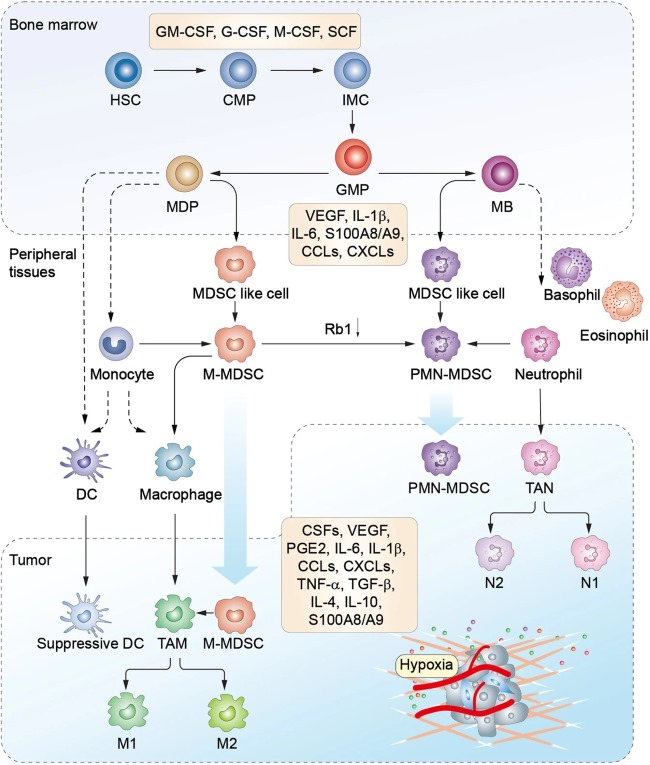 Fig.1 Development and characteristics of MDSCs. 1
What We Can Offer
Customized Panel Design
High-Throughput Processing Power
Our facility utilizes automated high-plex staining and scanning platforms for industrial-scale processing. This ensures rapid turnaround times and high-quality imaging for large sample cohorts without compromising the integrity of delicate biological specimens.
Research-Grade Documentation
We maintain rigorous data management and standardized laboratory protocols throughout the profiling process. This ensures full data traceability and integrity, providing researchers with reliable documentation suitable for high-level discovery-phase submissions and internal audits.
Stability & Scalability
Our platform offers unmatched consistency across longitudinal studies, facilitating a seamless transition from initial laboratory-scale validation to large-scale screening. We ensure that recruitment signatures remain comparable across different batches and experimental timelines.
How Creative Biolabs Can Assist Your Project
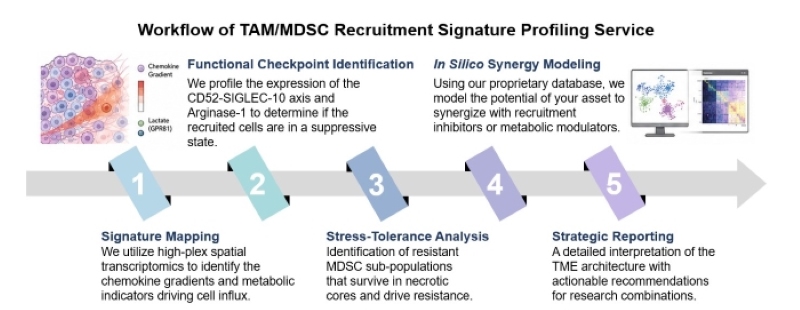
Highlights
Pioneering Biological Expertise
Creative Biolabs leads the field in myeloid biology, leveraging the latest breakthroughs in CD52-mediated exhaustion. We focus on identifying stress-tolerant gene networks that allow suppressive cells to persist within challenging research environments.
Integrative Metabolic Profiling
Our platform uniquely combines metabolic assessments, such as Lactate and pH levels, with traditional recruitment signatures. This provides a detailed 3D visualization of the immunosuppressive landscape that conventional laboratory methods often fail to capture.

Advanced Detection Capabilities
We utilize high-resolution techniques to identify cellular subsets that traditional flow cytometry misses. This ensures a more nuanced understanding of how specific myeloid populations interact within the architectural context of the research specimen.
Evidence-Based Scientific Rigor
All Creative Biolabs methods are grounded in the most current research data. This ensures that every strategic recommendation we provide is backed by high-impact science, maintaining the highest standards for your drug discovery projects.
Get a Quote Today to begin your project with the industry's most comprehensive myeloid profiling engine, designed to translate complex cellular interactions into streamlined research milestones.
Customer Reviews
-
Uncovering Overlooked Pathways
Creative Biolabs' profiling improved our understanding of recruitment axes and survival markers in MDSCs, enabling us to identify and target pathways we previously overlooked. - Dr. A*r. L. -
Decoding Metabolic Barriers
Integrating lactate profiling with recruitment signatures proved that metabolic acidity drives macrophage polarization and prevents T-cell infiltration in our resistant research models. - Dr. S*n. K.
FAQs
How does this service differ from standard IHC or Flow Cytometry?
Standard methods only quantify cell counts. Our service maps spatial recruitment signatures and functional checkpoints, providing actionable molecular insights into why cells arrive and how they suppress immunity.
Can this service be used for research samples?
Yes. We utilize advanced high-plex imaging and transcriptomics to analyze FFPE blocks and fresh specimens, facilitating robust retrospective research and mechanistic discovery in various biological models.
Related Services
Tumor Metabolic Microenvironment Analysis Services
We analyze how metabolic substrates like glucose and amino acids drive immune evasion within research models. This service provides comprehensive evaluations of targeted intervention strategies to normalize the suppressive microenvironment.
Learn More →Immune Checkpoint Assay Service
We evaluate candidate therapeutics through cell-based potency assays and primary immune cell assessments. Our team provides high-resolution data on target binding and functional mechanisms to significantly accelerate discovery pipelines.
Learn More →How to Contact Us
Creative Biolabs' TAM/MDSC recruitment signature profiling service is a specialized tool for dismantling the myeloid barriers to successful research. By seamlessly integrating high-resolution recruitment mapping, metabolic flux analysis, and functional checkpoint profiling, we turn complex biological datasets into clear, actionable discovery strategies.
For detailed information, pricing structures, or to discuss your specific research requirements in depth, please reach out to our scientific advisory team. We provide tailored consultations to ensure our profiling services align perfectly with your unique project milestones and research objectives - Get Started Today.
Reference
- Li, Kai et al. "Myeloid-derived suppressor cells as immunosuppressive regulators and therapeutic targets in cancer." Signal transduction and targeted therapy vol. 6,1 362. 7 Oct. 2021. Distributed under an Open Access license CC BY 4.0, without modification. https://doi.org/10.1038/s41392-021-00670-9
 Download our brochure
Loading case studies...
Online Inquiry