TCR Generation & Optimization Service
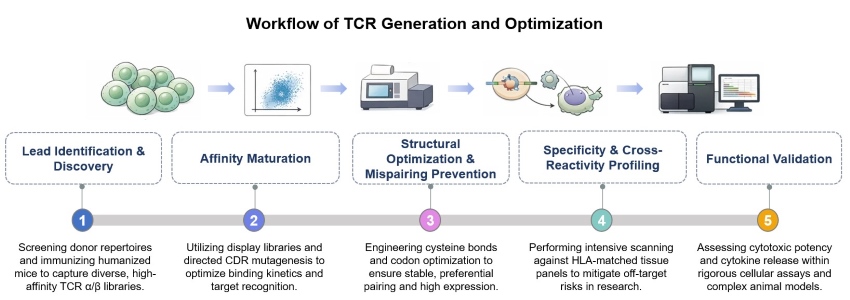
To increase efficiency and accelerate drug discovery and development, Creative Biolabs offers comprehensive TCR engineering T cell early development services. The one-stop TCR engineering T cell development service process includes TCR biomarker identification and selection, TCR generation and optimization, design and construction, TCR gene packaging and delivery, TCR in vitro validation, and TCR-T pre-clinical in vivo animal testing. In particular, the generation and optimization of TCR is a key step in the development of TCR, and the optimization strategy can be tailored to your specific needs.
Introduction of TCR Generation and Optimization
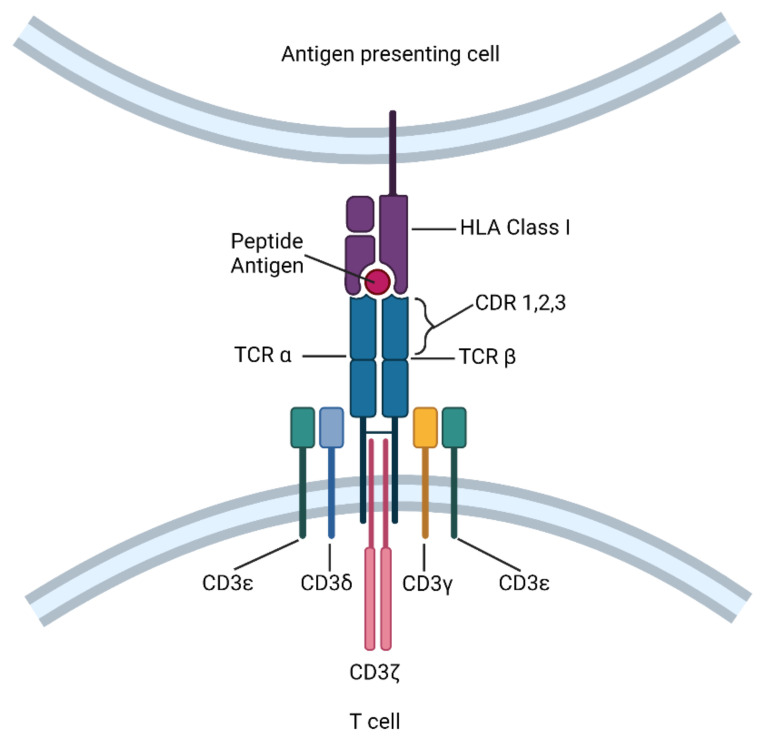 Fig.1 The TCR structure. 1
The paradigm of T-cell receptor (TCR) engineering has transitioned from rudimentary isolation toward sophisticated molecular architectures. Central to this evolution is "Signal 3" integration. Notably, armored TCR-engineered research cells constitutively expressing specific cytokines exhibit superior durability in tumor models compared to unengineered counterparts. These findings suggest that metabolic resilience is as vital as binding affinity. Consequently, modern optimization protocols prioritize an equilibrium between paratope affinity and rigorous specificity profiling. Creative Biolabs integrates these breakthroughs into a unified pipeline for optimal stability and persistence.
What We Can Offer
Creative Biolabs can use genetic engineering techniques to insert different functional TCR-encoding genes into T cells, making them specifically reactive to tumors. Our experienced team can provide you with a wide range of TCRs specifically for more tumor cell type antigens: TCR generated from patient's TILs, TCR generated from phage display, and TCR generated from in vivo system.
Optimizing the affinity
The term affinity is used when referring to the binding strength of a TCR to an MHC/peptide complex. To increase the affinity of the TCR, yeast or phage displays has been successfully used to screen for random mutations. In addition, TCR with higher affinity can be identified by targeting mutations in the CDR3 region and screened for variants after transfection into T cells.
Optimizing the avidity
The term avidity is used when referring to the sum of all bindings between T cells and antigen presenting cells. Several strategies have been developed to increase the affinity of transduced T cells by increasing TCR levels on the cell surface:
An improved gene transfer system (based on retroviral vector)
Optimization of TCR-encoding nucleotide sequences (codon optimization)
Molecular design of the TCR interface
Overview of Different TCR Optimization Strategies
| Optimization Strategies | Improved Functions |
|---|---|
| in vitro evolution | increased affinity |
| codon optimization | higher protein levels, no changes of amino acid sequence |
| maturation | preferential pairing, improved functional avidity |
| additional disulfide bond | preferential pairing, improved functional avidity |
| amino acid exchanges between TCR and TCR | slightly reduced mispairing |
How Creative Biolabs' service Can Assist Your Projects
Highlights
One-stop TCR Development
We provide an all-inclusive workflow spanning initial antigen discovery and library screening to pilot-scale expression vector production and thorough in vivo validation within specialized animal research models.
Customized Engineering Strategies
Our team delivers tailored CDR maturation and variable region modifications designed to meet your project's specific affinity requirements while ensuring exceptional specificity against your chosen research targets.
Advanced Mispairing Solutions
We implement proprietary constant region modifications and cysteine engineering to guarantee the structural stability of the research construct, effectively preventing the formation of non-functional endogenous TCR pairings.
High-Throughput Expression Systems
Our platform utilizes large-scale screening via advanced display systems to identify rare, high-affinity clones from vast libraries, ensuring the selection of the most potent research leads.
Get a quote to receive a detailed feasibility assessment and take the first step toward high-potency TCR engineering.
Customer Reviews
-
Superior TCR Stability
Creative Biolabs' TCR optimization in our research has noticeably improved the surface expression of our leads. The extra disulfide bond virtually eliminated endogenous mispairing issues in our laboratory models. It was a game-changer for our workflow. - Dr. J**n. S. -
Exceptional Specificity Profiling
The scanning platform facilitated our research project by identifying a potential cross-reactivity early in the discovery phase. This allowed us to pivot our lead selection effectively before wasting resources. Highly recommended for specificity. - S**h. L.
FAQs
How do you prevent mispairing with endogenous TCR chains in research models?
We utilize several structural strategies, including the introduction of additional disulfide bonds in the constant regions and chain centricity analysis. This ensures the engineered pair has a competitive advantage for assembly.
Can you optimize a TCR for a rare HLA allele?
Yes. Our transgenic mouse platforms and healthy donor libraries cover a broad spectrum of HLA alleles. Please contact us to discuss your specific research requirement.
Related Services
TCR Identification
We utilize antigen-specific B-cell and T-cell sorting combined with high-throughput sequencing to identify rare, naturally occurring TCR sequences for diverse research applications.
Learn More →CAR-T Cell Design & Manufacturing
We provide comprehensive solutions for TCR-T cell therapy research, including vector design, viral transduction optimization, and functional assessment of engineered T-cell effector sub-populations.
Learn More →How to Contact Us
Creative Biolabs provides an end-to-end platform for the generation, optimization, and validation of research-grade TCR-engineered T cells. From target discovery through structural maturation and armored cytokine engineering, we provide the technical expertise and high-quality data necessary to advance your discovery projects.
For more details, please feel free to contact us for project quotations and more detailed information.
Reference
- Sun, Yimo et al. "Evolution of CD8+ T Cell Receptor (TCR) Engineered Therapies for the Treatment of Cancer." Cells vol. 10,9 2379. 10 Sep. 2021. Distributed under an Open Access license CC BY 4.0, without modification. https://doi.org/10.3390/cells10092379
 Download our brochure