These models utilize murine tumor cell lines in genetically matched, immunocompetent mice. They are powerful, cost-effective tools for evaluating anti-tumor responses and interactions within a fully functional, native immune environment.
Learn More →Human PBMC-T Mouse Model Service for Immuno-Oncology Study
Creative Biolabs provides a rapid, reliable, and highly customizable platform for the in vivo validation of T-cell-focused immunotherapies. We deliver critical efficacy, safety, and mechanism of action (MOA) data, focusing on T-cell function and tumor inhibition. Clients gain accelerated pre-clinical decision-making capabilities, an extended therapeutic observation window thanks to our GVHD mitigation protocols, and sophisticated immunological reports, ensuring their research assets move forward with high confidence.
Introduction What We Can Offer How We Can Help Why Creative Biolabs Customer Reviews FAQs Related Services Contact Us
Introduction of Human PBMC-T Mouse Model
The PBMC-T mouse model is an innovative tool wherein human PBMCs are transplanted into immunodeficient mice like NSG or NOD-SCID strains. This transplantation leads to the reconstruction of human-derived T cells, establishing a human immune microenvironment within the mice. Such a setting is crucial for evaluating the efficacy, pharmacodynamics, and mechanisms of action of diverse cancer therapeutics, including checkpoint inhibitors, monoclonal antibodies, therapeutic vaccines, and cytokine-based therapies.
Discover how we can help - Request a consultation.
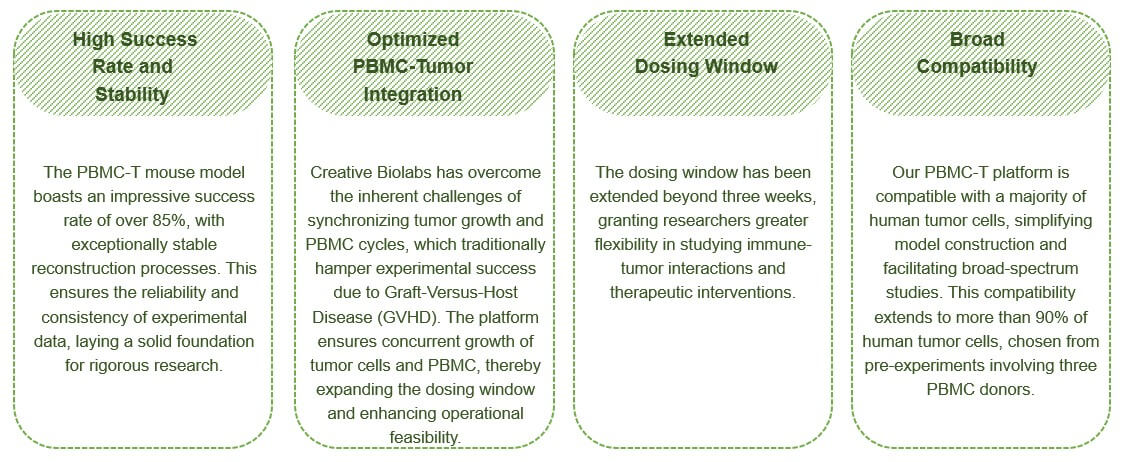 Fig.1 Humanized immune system mouse models. 1
What We Can Offer
Establishment of Humanized Mouse Model
Creative Biolabs offers comprehensive services for creating customized humanized mouse models tailored to specific research demands. The process includes:
| Selection of the Mouse Background | Transplantation of Human PBMCs and Tumor Cells | Pretreatment and Monitoring |
|---|---|---|
| Immunodeficient strains such as NSG or NOD-SCID are selected to ensure successful humanization. | Human PBMCs are transplanted into the mice, followed by the introduction of human tumor cells or tissues. | The mice are pre-treated and monitored throughout the humanization process to ensure stable integration of human immune cells. |
Immune Cell Detection and Monitoring
Advanced techniques like flow cytometry are employed to monitor and quantify the immune cells within the mouse post-transplantation. This includes:
| Quantitative and Qualitative Analysis | Functional Assessments |
|---|---|
| Regular evaluations of the type and quantity of immune cells ensure accurate tracking of immune cell populations. | Assessing the functional status of these cells to verify the effective reconstruction of the human immune system. |
Tumor Growth Monitoring
| Size Tracking | Treatment Impact Evaluation |
|---|---|
| Tumor growth is consistently measured to observe changes over time. | Analyzing how different therapeutic interventions affect tumor progression. |
Immunotherapy Efficacy Evaluation
Our platform enables thorough assessments of various immunotherapy strategies:
| Immune Modulation | Immune Cell Analysis |
|---|---|
| Evaluating the therapeutic effects of immune checkpoint inhibitors, CAR-T cells, and other modalities. | Before and after treatment, immune cells are analyzed using methods like flow cytometry to determine changes influenced by the therapy. |
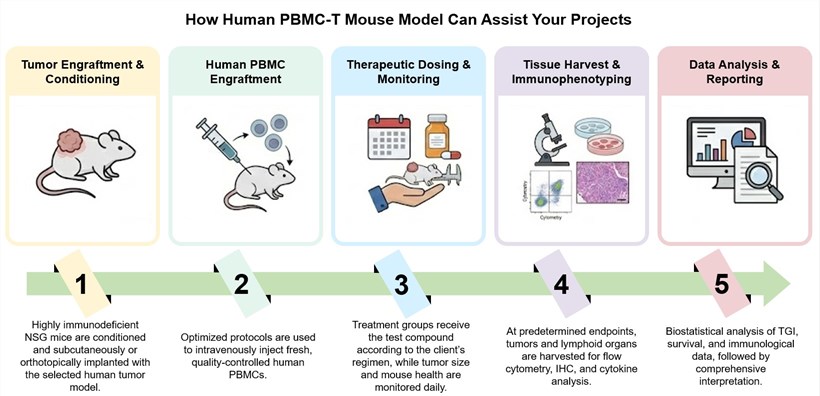
How Creative Biolabs' service Can Assist Your Projects
Highlights of Our Human PBMC-T Mouse Model
Discover how a partnership with us can streamline your research - Get a quote today.
Customer Reviews
-
Extended Experimental Window
Using Creative Biolabs' human PBMC-T mouse model in our research has significantly improved the reliability of our chronic dosing studies. Their GVHD mitigation protocols allowed us to test a complex six-week dosing regimen that would have been impossible in a standard Hu-PBL-SCID model, yielding critical data on delayed therapeutic response. – J*n S**h. -
Superior T-cell Activation Data
The quality and resolution of the flow cytometry data post-study facilitated a clear understanding of our CAR-T product's activation kinetics. Compared to standard in vitro assays, this model provided the essential in vivo context for tumor infiltration and function, confirming the superiority of our third-generation construct. – L**a M**a.
FAQs
What are the primary advantages of using the PBMC-T mouse model in immuno-oncology research?
The PBMC-T mouse model offers a human immune microenvironment, stable reconstruction of human immune cells, extended dosing windows, and compatibility with a broad range of human tumor cells - all of which contribute to more accurate and reliable preclinical studies.
What is the significance of extending the dosing window in PBMC-T mouse models?
Extending the dosing window beyond three weeks allows for more prolonged and flexible experimental timelines, enabling comprehensive studies of immune-tumor interactions and the evaluation of various therapeutic interventions.
Related Services
Syngeneic Models
Human PBMC-B Mouse Model for Immuno-Oncology Study
This platform specializes in evaluating therapies targeting human B-cells. It enables high-resolution research into B-cell-driven anti-tumor responses and antibody-dependent cellular cytotoxicity within a rapid in vivo framework.
Learn More →How to Contact Us
By leveraging Creative Biolabs' innovative PBMC-T mouse models, researchers can gain a deeper understanding of immune-oncology dynamics, evaluate novel immunotherapies, and accelerate the development of effective cancer treatments. Please feel free to contact us for more information about our services.
Reference
- Serr, Isabelle et al. "Advances in Human Immune System Mouse Models for Personalized Treg-Based Immunotherapies." Frontiers in immunology vol. 12 643544. 18 Feb. 2021. Distributed under an Open Access license CC BY 4.0, without modification. https://doi.org/10.3389/fimmu.2021.643544
 Download our brochure
Loading case studies...
Online Inquiry