Kinase Activity Profiling Service for Cancer Signaling Pathway
Our service transforms raw biological samples into actionable intelligence by measuring actual enzymatic flux within the cell. We help you move beyond identifying "what is there" to telling you "what is working." By quantifying kinase velocity and substrate affinity, we allow you to pinpoint the exact nodes in a signaling cascade that are sensitive to your lead compounds. Whether you are identifying "synthetic lethal" targets or mapping out bypass resistance pathways, our platform provides the quantitative resolution needed for high-stakes decision-making in precision drug development.
Introduction to Advanced Functional Kinomics
Kinase signaling serves as the primary engine of oncogenesis, yet traditional genomic assays frequently fail to capture the functional enzymatic states that dictate therapeutic efficacy in drug discovery. Extensive evidence demonstrates that protein abundance levels rarely correlate with actual signaling flux or compound sensitivity, creating a critical hurdle in modern research. By integrating breakthroughs in resolution and computational activity modeling, Creative Biolabs' kinase activity profiling bridges this critical functional gap. This methodology identifies actionable therapeutic vulnerabilities and uncovers temporal feedback loops that drive bypass resistance.
Comprehensive Capabilities for Signal Transduction Research
Creative Biolabs provides a modular, high-resolution platform designed to decode the functional signaling landscape of oncology models. Our capabilities span from single-cell resolution to global phosphoproteomic mapping, providing the definitive data required for target validation and lead optimization.
Single-Cell Resolution Profiling
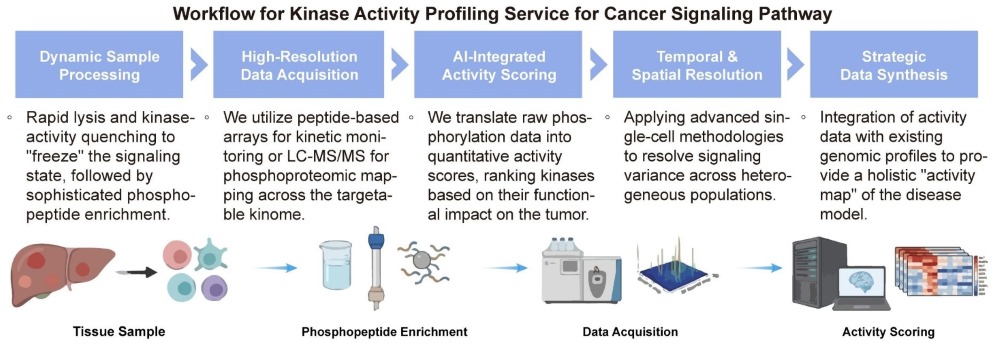
We deliver high-resolution profiling at the single-cell level to identify rare resistant sub-clones within heterogeneous models. This ensures discovery efforts target specific drivers of therapy evasion with absolute precision.
AI-Integrated Activity Scoring
Our proprietary algorithms translate raw phosphoproteomic data into quantitative kinase activity scores. This computational transformation allows researchers to rank kinases based on actual signaling flux rather than simple protein abundance.
Kinome-Wide Selectivity Mapping
We provide comprehensive kinome-wide selectivity panels to map compound activity across hundreds of kinases. This reveals off-target liabilities early, allowing for effective lead optimization and thorough de-risking of your pipeline.
Temporal Kinetic Flux Analysis
Our platform monitors real-time kinetic flux to capture transient signaling responses and feedback loops. By quantifying kinase velocity and substrate affinity parameters, we identify optimal dosing windows and potential bypass mechanisms.
Request a detailed technical breakdown of our kinome-wide panels—Inquire for a Custom Capabilities Overview
Workflow
The process is designed for seamless integration into your current research pipeline, providing a clear path from sample submission to strategic insight.
Publication
This review discusses the challenges in protein kinase inhibitor (PKI) development, including high attrition rates and limited understanding of the drug's mechanism of action. It presents a toolkit of kinase activity assays, such as substrate microarrays, targeted mass spectrometry, and multiplexed inhibitor beads, each with distinct biological and analytical properties. The authors map these assays to specific challenges, including studying understudied kinases, off-target effects, drug repurposing, combination therapy, and biomarker development, to improve PKI efficiency.
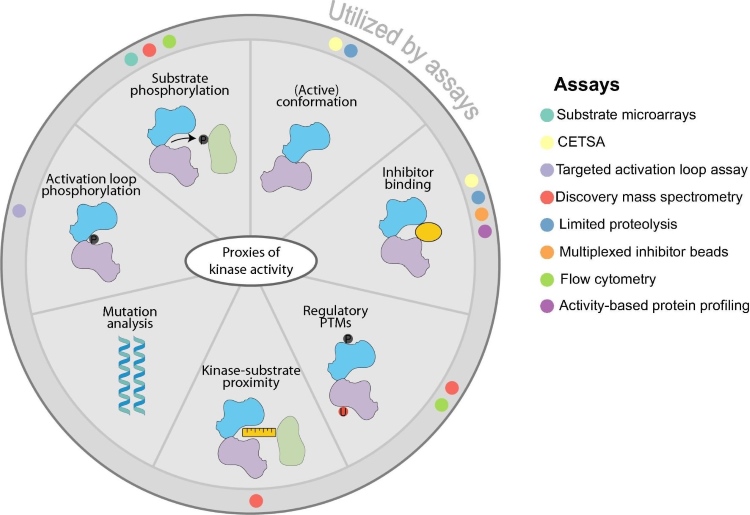 Fig.1 Diverse strategies for inferring kinase activity in kinase activity assays. 1
Why Choose Us?
Creative Biolabs stands at the vanguard of signal transduction research, offering a unique synergy between two decades of wet-lab expertise and sophisticated computational architectures. Unlike standard service providers that deliver raw, uninterpreted data tables, our platform utilizes proprietary methodologies to resolve the functional gap in drug discovery. Our AI-driven algorithms calculate absolute enzymatic velocity, ensuring your target validation is based on active signaling flux rather than static protein expression. By implementing our de-risking engine, we map your lead compounds against the full human kinome, allowing for the early identification of potential liabilities. This comprehensive approach transforms complex phosphoproteomic signatures into actionable strategic intelligence, enabling our partners to navigate the drug discovery landscape with unparalleled confidence, precision, and efficiency.
Transform your raw phosphoproteomic data into actionable lead-generation intelligence—Get a Quote Today
FAQs
How does kinase activity profiling differ from standard phosphoproteomics?
While standard phosphoproteomics lists phosphorylated sites, our profiling uses AI-modeling to calculate the actual activity state of the kinase. We translate the "presence" of a phosphate group into a quantitative score of enzymatic flux.
How accurate is the AI-driven KAS?
Our KAS algorithms are validated against established kinetic benchmarks and have shown high correlation with phenotypic drug response across hundreds of models, making it a reliable prioritization tool.
Do you offer comparisons between our lead compound and other discovery-stage leads?
Yes, we can include reference inhibitors in your profiling run to provide a side-by-side comparison of potency, selectivity, and signaling fingerprint, helping you define your compound's unique value proposition.
Customer Review
-
Unprecedented Resolution in Heterogeneous Models
Using Creative Biolabs' kinase activity profiling in our triple-negative breast cancer research has significantly improved our ability to identify drug-resistant sub-clones that bulk assays simply missed. The single-cell resolution is a game-changer for precision targeting. - Dr. A*** Miller -
Actionable AI-Driven Insights
The transition from raw phosphoproteomics to kinase activity scores (KAS) facilitated our lead optimization process immensely. We no longer spend months guessing which phosphorylation site matters; the activity map points the way to the most active nodes. - Prof. L*** Chen
Related Services
To further accelerate your drug discovery journey, consider these complementary services:
Phosphatase Assay Service
Creative Biolabs provides phosphatase assays, quantifying enzyme kinetics and inhibitor potency. We utilize fluorogenic and colorimetric substrates to evaluate SHP-1/2 and PTPN22 activity for modulating checkpoint signaling and antitumor immunity.
Learn More →Ion Channel Screening Service for Venom Peptide
Creative Biolabs provides ion channel screening, quantifying Kv and Cav channel inhibition. We utilize patch-clamp technology and autocrine-NGS libraries to evaluate venom peptide specificity and diversity for immunotherapy research.
Learn More →How to Contact Creative Biolabs
Creative Biolabs provides the high-resolution, functional insights necessary to navigate the complexities of cancer signaling. From identifying novel targets to de-risking preclinical leads, our kinase activity profiling service is the definitive tool for modern drug discovery.
Ready to decode your signaling pathways? Contact our scientific team to receive a custom-designed profiling strategy tailored to your specific project needs.
Reference
- Veth, Tim S., et al. "Innovative strategies for measuring kinase activity to accelerate the next wave of novel kinase inhibitors." Drug Discovery Today 29.3 (2024): 103907. Distributed under Open Access license CC BY 4.0, without modification. https://doi.org/10.1016/j.drudis.2024.103907
 Download our brochure