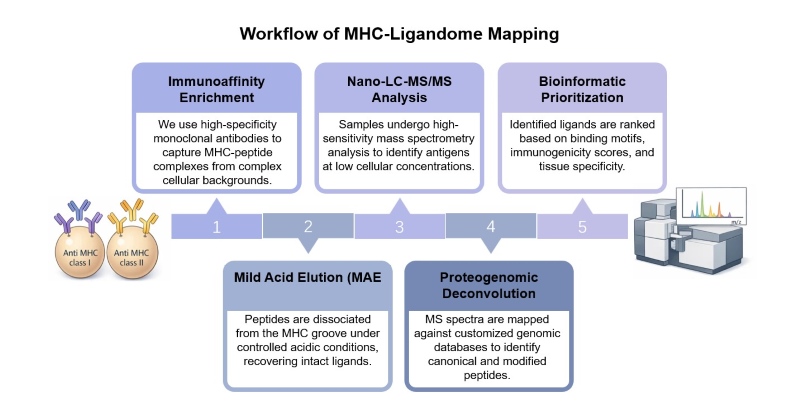
Our team develops tailored antibody selection and cross-linking strategies optimized for your specific MHC alleles or non-canonical presentation molecules to ensure high-purity isolation.
MHC-Ligandome Mapping Service
Based on our state-of-the-art mass spectrometry (MS) platform technology, Creative Biolabs map tumor immunopeptides to comprehensively observe the pathophysiologically relevant antigenic characteristics of malignant tumors. In peptide-specific immunotherapy settings, MS-based strategies can produce highly enriched amounts of truly presented peptides due to dramatic improvements in accuracy, sensitivity, and resolution. At the same time, our bioinformatics analysis team have developed professional bioinformatics tools to process MS data to provide reliable data analysis for your tumor immunopeptide discovery.
Introduction What We Can Offer How We Can Help Why Choose Us? Customer Reviews FAQs Related Services Contact Us
Introduction to MHC-Ligandome Mapping
MHC-Ligandome Mapping is the empirical study of peptides presented by the Major Histocompatibility Complex. Research confirms that in silico predictions often fail to account for the "Dark Proteome" and complex intracellular processing. By utilizing high-resolution mass spectrometry, we bridge this gap, providing a validated landscape of the immunopeptidome. Our methodology ensures that research targets are not just theoretical possibilities but are physically present on the cell surface, thereby maximizing the scientific rigor of downstream developmental programs.
Request a Consultation →
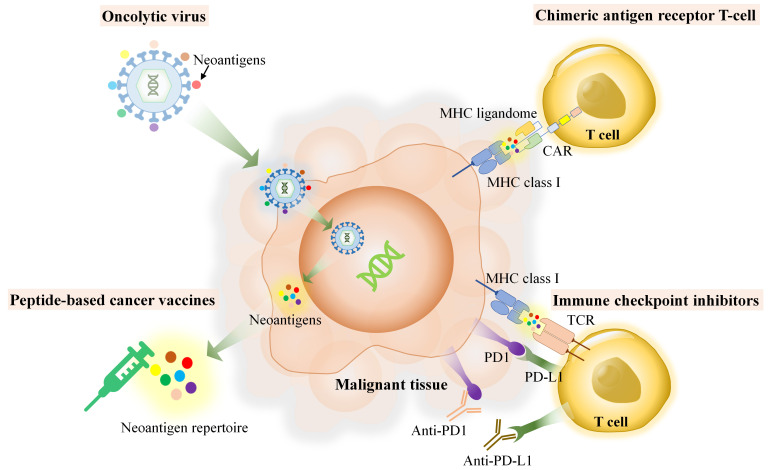 Fig.1 Role of immunopeptidomics or MHC ligandomes in various cancer immunotherapy platforms. 1
What We Can Offer
Customized Immunoaffinity Enrichment
One-Stop Proteogenomic Integration
We provide seamless merging of your specific NGS data into our search algorithms to identify specialized sequences and previously hidden variants.
Scalable Throughput & Capacity
Our facility manages projects ranging from single-cell line pilot studies to large-scale cohort screenings while maintaining industry-leading turnaround times for all clients.
High-Standard Quality Control
We implement Quality-by-Design principles and rigorous internal protocols to ensure data reproducibility and scientific relevance for every stage of your research.
How Creative Biolabs' service Can Assist Your Projects
Highlights
Proven Target Identification
We successfully identify the small fraction of high-affinity binders that actually reach the cell surface, ensuring your research focuses on viable targets.
Precision Signal Filtering
Our refined approach effectively eliminates the vast amount of noise generated by standard predictive algorithms, delivering much higher data purity.

Baseline Specificity Mapping
Utilizing our proprietary "Normal Human Ligandome" database, we perform baseline subtraction to ensure all identified targets are truly research-specific and unique.
Enhanced Lead Discovery
By bypassing theoretical models, we provide empirical evidence that accelerates your discovery process and strengthens the quality of your lead constructs.
To experience the Creative Biolabs Advantage and secure the high-resolution data your project demand - Get a Quote
Customer Reviews
-
Exceptional Sequence Recovery
Using Creative Biolabs' MHC-Ligandome Mapping in our research has facilitated the identification of rare, low-abundance sequences in our pancreatic research models that were invisible to standard genomic tools. - Dr. A***a. S. -
Critical for Specificity Profiling
The baseline subtraction from Creative Biolabs' normal tissue database improved our ability to filter out housekeeping peptides, preventing potential cross-reactivity in our novel construct pipeline. - Prof. M**n L.
FAQs
How do you handle rare MHC alleles?
Creative Biolabs utilizes allele-specific motif deconvolution and an internal database to accurately assign peptides to specific MHC molecules, even in heterozygous research samples with rare alleles.
How does this compare to standard NetMHCpan predictions?
Research shows that only a small portion of predicted high-affinity binders are actually presented. Our service identifies these active targets, saving you time in downstream validation.
Related Services
MHC-associated Peptide Proteomics (MAPPS) Assay Service
This specialized service identifies MHC-associated peptides from biotherapeutic proteins to assess potential immunogenicity risks during the early stages of drug discovery research.
Learn More →Oncolytic Virus (OV) Therapy Discovery Service
We provide comprehensive engineering and testing services for oncolytic viruses, enabling the targeted destruction of tumor cells and stimulation of research-model immune responses.
Learn More →How to Contact Us
Determining the right target is critical for T cell-mediated cancer immunotherapy, and direct identification of MHC neoligands by MS has proven to be a potential strategy. Creative Biolabs' sophisticated approach to MHC-ligandome mapping services, the higher resolution, sensitivity of LC-MS / MS devices, as well as optimized acquisition methods accompanied by tailored bioinformatics tools, will allow you to gain deeper insights into immunopeptidome.
To obtain further information, please contact us for detailed information.
Reference
- Pongcharoen, Sutatip et al. "Immunopeptidomics in the cancer immunotherapy era." Exploration of targeted anti-tumor therapy vol. 5,4 (2024): 801-817. Distributed under an Open Access license CC BY 4.0, without modification. https://doi.org/10.37349/etat.2024.00249
 Download our brochure
Loading case studies...
Online Inquiry