Spatial Omics Analysis Service for Cancer Signaling Pathway in TME
Creative Biolabs provides end-to-end spatial omics services to capture high-resolution, coordinates-driven landscapes, moving beyond dissociated data to provide essential spatial context. Our workflows empower your team to validate drug target exposure in situ, map complex paracrine networks, and characterize how lead candidates alter behaviors within specialized tissue zones. From mapping signaling gradients at invasive tumor borders to assessing metabolic blockades within lymphoid aggregates, our platforms deliver actionable spatial patterns, ensuring you can systematically evaluate therapeutic efficacy and accelerate your oncology research programs.
Understanding Spatial Omics for Cancer Signaling in the TME
By integrating landmark spatial paradigms, this service resolves the loss of spatial coordinates during tissue dissociation. We combine deep spatial transcriptomics, multiplexed proteomics, and advanced spatial bioinformatics. This platform enables research teams to dissect the tumor stroma boundary, identify recurrent niches, and quantify metabolism-driven tertiary lymphoid structure maturation to accelerate translational oncology programs. In conclusion, this platform bridges technical innovation with direct therapeutic applicability. By translating raw cellular data into coordinate-mapped molecular networks, our pipeline provides the ultimate biological clarity required to optimize drug candidate selection and uncover highly specific predictive biomarkers designed to accelerate all modern drug discovery pipelines.
High-Resolution Spatial Profiling Solutions
Our integrated portfolio delivers high-resolution spatial mapping of the TME. We combine advanced transcriptomics, multiplexed proteomics, and state-of-the-art bioinformatics to resolve preclinical signaling cascades within native architectural niches.
High-Resolution Spatial Transcriptomics
We map transcriptomic activity at subcellular resolution, preserving exact tissue coordinates to resolve localized signaling gradients, identify specialized cellular niches, and trace cellular transition dynamics across complex solid tumor borders.
Advanced Multiplexed Spatial Proteomics
We simultaneously quantify more than forty distinct protein markers at single-cell resolution, measuring target effector physical distance metrics, localized checkpoint expression, and kinase phosphorylation events directly within tissue architectures.
Intelligent Spatial Bioinformatics Modeling
We apply advanced deconvolution and neighborhood mapping algorithms to classify complex tissue architectures, automatically segmenting recurrent spatial niches and tracing localized immunometabolism trajectories that regulate functional lymphoid tissue structure maturation.
Unlock your project's true potential—discover how our expert spatial omics services can accelerate your drug discovery journey by requesting a dedicated consultation with our scientific team today.
Workflow
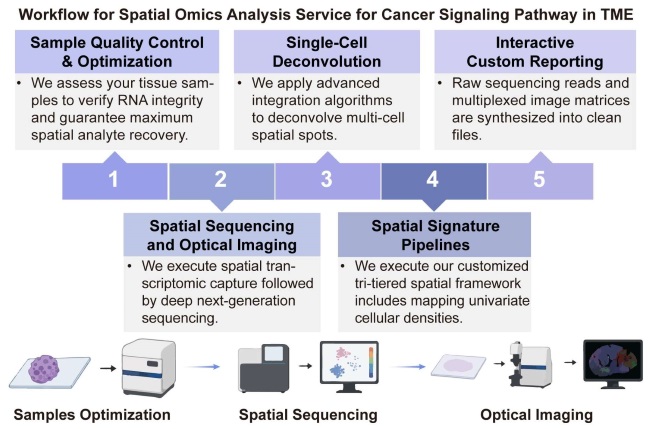
Our spatial biology pipeline is structured to ensure rigorous tissue processing, high-fidelity capture, and deep, publication-ready bioinformatics. The step-by-step process is fully mapped out below to provide full transparency from sample receipt to interactive data visualization:
Publication
This review highlights how spatial omics technologies and computational tools decode the three-dimensional tumor microenvironment, revealing cellular heterogeneity, tumor-immune interactions, and evolutionary dynamics. It discusses clinical applications in precision oncology and proposes integrating ecological principles, such as edge effects and biodiversity indices, to model cancer ecosystems. Spatial omics promises to transform spatiotemporal molecular medicine and improve diagnostic and therapeutic strategies.
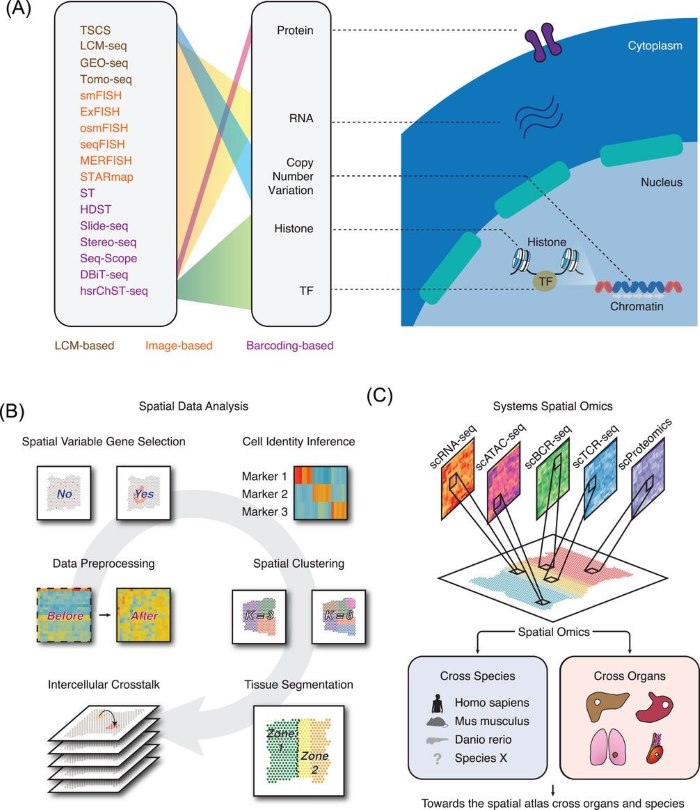 Fig.1 Decoding the three-dimensional architecture of the TME with spatial omics. 1
Why Choose Us?
Choosing Creative Biolabs means partnering with a premier contract research organization with over two decades of dedicated preclinical oncology experience. Our customized pipelines bridge the gap between abstract mathematical coordinates and tangible biological insights. We do not just generate raw sequencing reads; we translate those high-dimensional datasets into clear target effector interactions, functional tissue boundaries, and defined cell states. Backed by extensive Published Data, our spatial deconvolution protocols, boundary reconstruction methodologies, and niche modeling setups are proven to rescue stagnating pipelines, validate therapeutic mechanisms of action, and uncover novel, patentable target biomarker relationships to secure your intellectual property and accelerate lead optimization.
Explore Our Complete Offerings - Connect with Our Scientists Today to Tailor Your Spatial Profiling Strategy
FAQs
What is the primary advantage of spatial transcriptomics over single-cell RNA sequencing?
Spatial omics preserves tissue physical coordinates, allowing researchers to map localized signaling pathways directly within intact architectural niches instead of analyzing dissociated, homogenized, and bulk cellular suspensions.
Can your services analyze challenging fixed tissue blocks, or do we need fresh-frozen samples?
We have engineered proprietary sample optimization protocols for both types, enabling highly detailed pathway mapping from either freshly frozen tissue or archived, fixed paraffin block source materials.
How does Creative Biolabs ensure accurate single-cell resolution when using spatial spots that contain multiple cells?
We apply advanced deconvolution algorithms that integrate matched single-cell reference datasets, mathematically separating individual cellular signatures from multicellular spots with superb, predictable, and highly consistent scientific accuracy.
Customer Review
-
Direct Observation of Immune Exclusion
Using Creative Biolabs' service has significantly facilitated our mapping of cytotoxic immune cells at invasive stroma margins. This detailed spatial profiling provided pristine molecular clarity for our target validation research. - Dr. Al*** Jones -
Discovery of Recurrent Spatial Niches
Using Creative Biolabs' service has significantly facilitated our classification of local macrophage populations into distinct functional spatial niches. Their advanced deconvolution algorithms resolved cellular programs with superb, predictable scientific precision. - Prof. Ke*** Zhang
Related Services
To help you achieve your spatiotemporal drug discovery goals, Creative Biolabs offers several highly complementary services that can be integrated into your study design:
Retrospective Methods & Computational Lineage Tracing Service
Creative Biolabs provides retrospective and computational lineage tracing, utilizing somatic mutation and epigenetic barcodes to reconstruct clonal evolution, metastatic dissemination, and tumor heterogeneity for pre-clinical oncology research programs.
Learn More →Protease-Activatable Cytokine Design Service
Creative Biolabs provides protease-activatable cytokine engineering, utilizing cleavable linkers and autoinhibitory masking domains to achieve logic-gated, tissue-specific activation, reducing systemic toxicity while amplifying localized immune responses in your pre-clinical models.
Learn More →How to Contact Creative Biolabs
Unlock the structural secrets of the tumor microenvironment. From validating target signaling gradients at the invasive border to modeling the metabolic gates that regulate lymphoid maturation, Creative Biolabs is your strategic partner for next-generation spatial biology. Our end-to-end services bridge high-end technology with translation, transforming high-dimensional spatial data into clear, actionable therapeutic insights.
Contact Our Team for More Information and to Discuss Your Project
Reference
- Wu, Yingcheng, et al. "Spatial omics: Navigating to the golden era of cancer research." Clinical and Translational Medicine 12.1 (2022): e696. Distributed under Open Access license CC BY 4.0, without modification. https://doi.org/10.1002/ctm2.696
 Download our brochure