Creative Biolabs offers T/NK cell cytotoxicity assays to assess small molecule drug candidates, T cell therapy, or antibody-based targeted tumor cell killing. We provide long-term cytotoxicity assays using a wide range of cancer and healthy cell lines.
Learn More →T Cell based 51 Chromium Assay Service
Background Applications Workflow Why Choose Us FAQs Customer Review Related Services Contact Us
Multiple immunotherapies developed targeting specific antigen peptides have acquired exciting clinical achievements. As a famous service provider of gene and cell therapy, Creative Biolabs is also devoted to exploring cancer epitopes using various methods, including T cell-based 51 chromium release assay.
51 Chromium Release Assay for Epitope Analysis
In recent years, peptide-dependent therapeutic vaccines and immune cell-based products have raised dramatic attention as one of the most promising treatments for multiple tumors and cancer diseases. Peptide epitope, the minimum unit of tumor antigen recognized by T cell receptors, can activate CD8+ cytotoxic T lymphocytes (CTL) and CD4+ T helper cells and induce specific killing of the antigen-positive tumor cells. 51 chromium release-based assay is the ideal method combining screening cancer epitopes and testing cytotoxicity of engineered T cells. The chromium release assay for investigating cell cytotoxicity is old, but it is most widely used to test the killing function of T cells and NK cells. The method is simple and sensitive, regarded as the gold standard for measuring cytotoxicity.
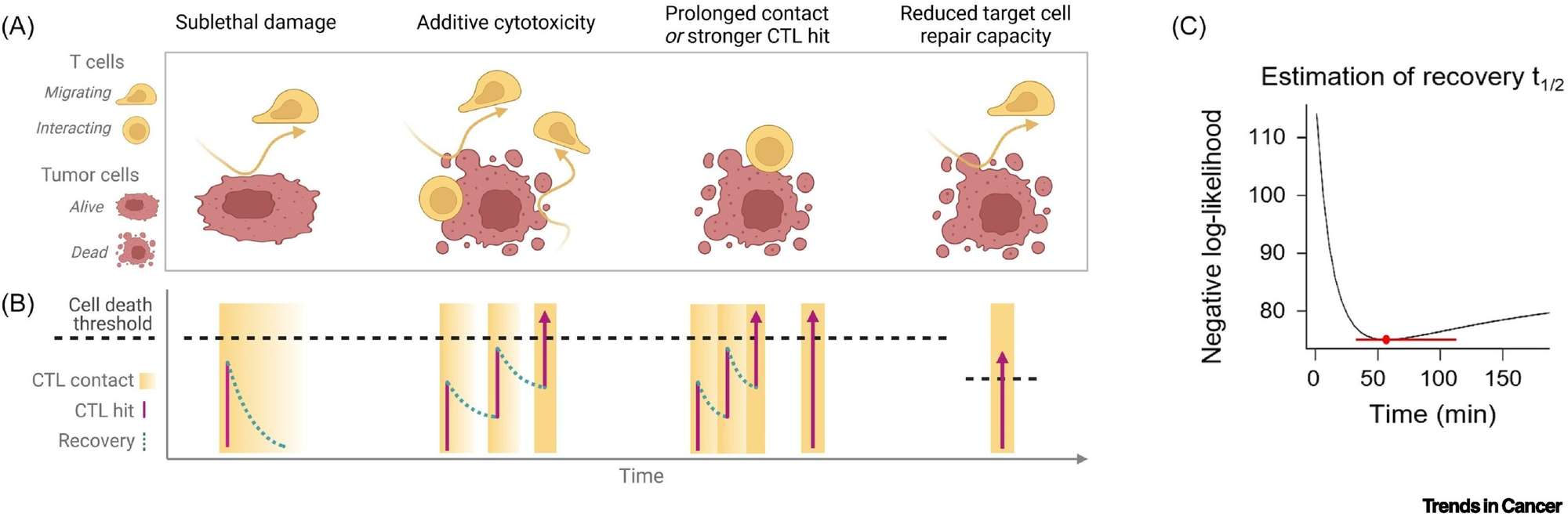 Fig.1 T cell cytotoxicity against tumor cells. 1
Pivotal Applications in Your Research
For researchers in the immuno-oncology space, the 51Cr release assay is an indispensable tool. It serves as a powerful method for:
Evaluating the Efficacy of Novel Immunotherapies
Assessing the cytotoxic potential of CAR-T cells, bispecific T-cell engagers, and other engineered cell therapies against specific tumor cell lines.
Determining T Cell Functionality
Measuring the lytic activity of T cells in response to antigen stimulation provides critical insights into their activation and effector function.
Screening and Characterizing Peptide Epitopes
Identifying and validating immunogenic peptide epitopes that can be used for vaccine development or as targets for T cell therapies.
Assessing Patient Immune Response
Monitoring the activity of T cells from patient samples to gauge the effectiveness of a treatment regimen.
Contact us today to learn how our T cell-based 51 chromium assay services can provide the definitive data you need to advance your research pipeline.
How Creative Biolabs Can Assist Your Project
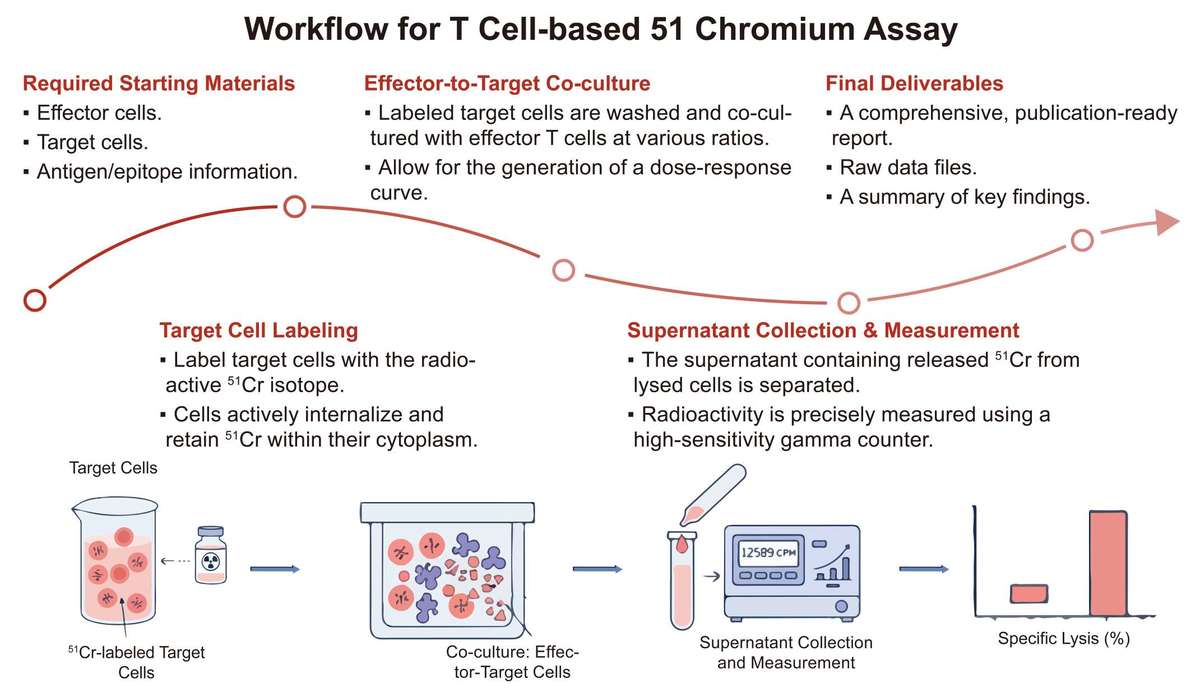
The workflow for our T cell-based 51 chromium assay service is a streamlined, professional, and clear process designed for seamless integration into your research and development pipeline.
Why Choose Us?
Creative Biolabs distinguishes itself with unparalleled expertise and a steadfast commitment to scientific excellence in T cell-mediated cytotoxicity. Our unique advantages, built on decades of experience and a deep understanding of immunology, ensure the highest quality and most reliable data. We recognize that T cell-mediated killing is a complex process. Our highly sensitive and reproducible T cell-based 51 chromium assay accurately quantifies these cumulative interactions. Our profound knowledge of upstream mechanisms, including the physical properties of antigen-presenting cells, enables us to design assays that truly reflect biological reality, providing meaningful and actionable data for our clients.
Discover how we can help your project succeed. Request a consultation today to begin the conversation about your specific goals.
FAQs
Q1: Why should I choose the T cell-based 51Cr assay over non-radioactive alternatives?
A1: The 51Cr assay is considered the gold standard for a reason and is crucial for detecting subtle cytotoxic effects, especially at low effector-to-target ratios, providing a level of confidence and reproducibility that other assays often cannot match.
Q2: Is the use of radioactivity a safety concern for my project?
A2: You don't need to worry. We manage all aspects of radioactivity in our professional, fully-equipped lab, adhering to the highest safety standards and regulations. This eliminates the need for your team to handle any radioactive materials, simplifying your logistics and ensuring a safe research environment.
Q3: Can this assay be adapted to different types of target cells?
A3: Yes, our assay is highly versatile. We can apply the assay to a wide range of target cells, including various tumor cell lines, primary cells, or virally infected cells. Our team will work with you to optimize the assay conditions for your specific cell type to ensure accurate and reliable results.
Customer Review
-
Eliminating Radioactive Concerns
Our lab had major concerns about handling radioactive materials, but Creative Biolabs' professional lab completely alleviated those worries. The assay they provided was both sensitive and reliable. - Dr. K. M**rphy -
Superior Consistency
We compared the results from Creative Biolabs' assay to a non-radioactive alternative and found that Creative Biolabs' service has significantly improved the confidence in our epitope validation studies, providing a true gold-standard comparison. - Dr. P. Al**n
Related Services
To further support your immunotherapy research, we offer a range of complementary services that can be used in conjunction with the T cell-based 51Cr assay.
TCR-T and CAR-T/NK Cytotoxicity Assay
Cell-based Lysosomotropism Assay Service
Creative Biolabs' high-quality, cell-based lysosomotropism assay service assesses drug safety and efficacy by measuring lysosomal accumulation and its impact on cellular function.
Learn More →Contact Us
Leveraging the full potential of the 51Cr release assay requires a specialized facility and a team with deep expertise in handling radioactive materials and executing complex cell-based assays. At Creative Biolabs, we have both. Our professional radioactivity lab and highly trained technicians ensure the safe and precise execution of every assay, providing you with reliable, high-quality data. We offer end-to-end services, from peptide synthesis and T cell activation to the final cytotoxicity measurement, all customizable to your unique research needs.
By partnering with us, you can bypass the logistical and regulatory complexities of working with radioactive materials and focus on what matters most: accelerating your breakthrough discoveries in immuno-oncology.
Reference
- Weigelin, Bettina, and Peter Friedl. "T cell-mediated additive cytotoxicity–death by multiple bullets." Trends in cancer 8.12 (2022): 980-987. Distributed under Open Access license CC BY 4.0, without modification. https://doi.org/10.1016/j.trecan.2022.07.007
 Download our brochure
Loading case studies...
Online Inquiry