Upon receipt, samples undergo rigorous quality assessment to ensure integrity and viability. This includes cell counting, viability assessment, and preliminary checks for contamination.
Immunophenotyping based Sclerosis Multiplex Recognition Service
Background Service Workflow Advantages FAQs Related Sections Contact Us
Multiple Sclerosis (MS), a complex autoimmune disease affecting the central nervous system, presents significant challenges in diagnosis, prognosis, and therapeutic monitoring. The heterogeneity of its clinical presentation and progression underscores the critical need for precise diagnostic and prognostic tools. Creative Biolabs offers a cost-effective immunophenotyping based sclerosis multiplex recognition service to help you accelerate drug discovery, develop highly specific antibodies, and streamline clinical trial processes through advanced recombinant DNA technology, high-throughput screening platforms, and innovative protein engineering techniques.
Enhancing MS Recognition through Immunophenotyping
The current landscape of Multiple Sclerosis diagnosis often relies on clinical symptoms and imaging, which can be non-specific or delayed, leading to challenges in early intervention and personalized treatment. Immunophenotyping, the identification and quantification of cell populations based on surface and intracellular markers, offers a powerful approach to characterize the immune dysregulation central to MS. Recent research highlights the utility of immunophenotyping in identifying specific immune cell subsets, such as classical monocytes, associated with disease evolution and aggressive phenotypes in MS patients. This precision in immune profiling is crucial for understanding disease heterogeneity, identifying novel biomarkers, and developing targeted therapies, thereby addressing the urgent need for more accurate and early recognition strategies.
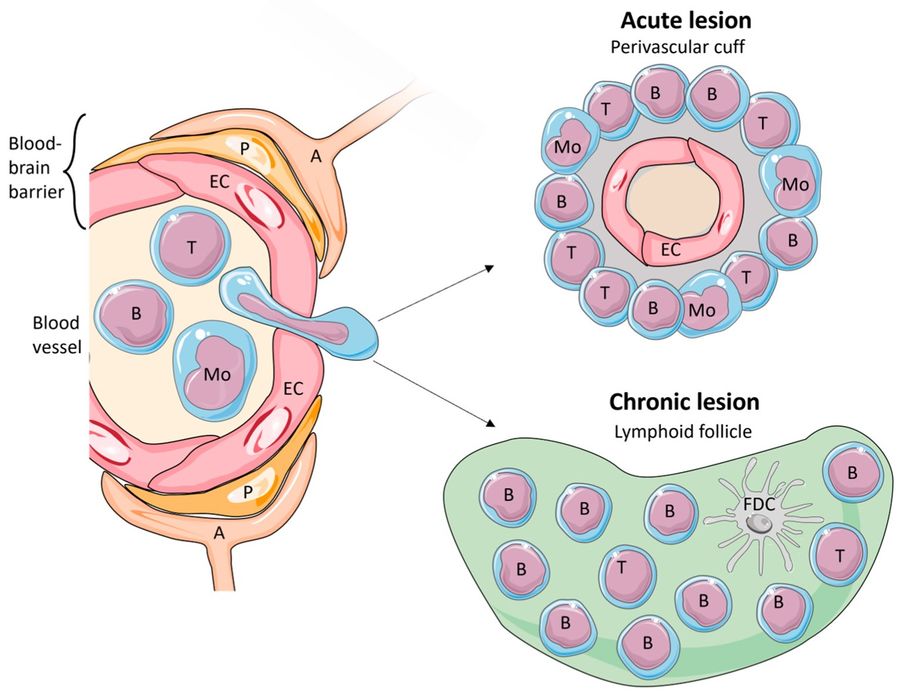 Fig.1 Immune cells transmigrate across the blood-brain barrier in multiple sclerosis.1
Immunophenotyping based Sclerosis Multiplex Recognition Service at Creative Biolabs
Creative Biolabs' immunophenotyping based sclerosis multiplex recognition service provides comprehensive solutions for precise immune cell profiling, crucial for understanding disease mechanisms, biomarker discovery, and therapeutic development in MS. Clients can expect detailed immune cell subset analysis, identification of disease-associated cellular signatures, and robust data for clinical and research applications. This service is designed to accelerate your drug discovery efforts, identify potential therapeutic targets, and monitor treatment efficacy with unparalleled precision.
Required Starting Materials
- Peripheral Blood Mononuclear Cells (PBMCs): Fresh or cryopreserved, isolated from patient or control samples.
- Cerebrospinal Fluid (CSF) Samples: Collected from lumbar puncture, essential for assessing intrathecal immune responses.
- Clinical Data: Relevant patient demographics, disease history, treatment status, and MRI findings to contextualize immunophenotyping results.
Workflow
Step 1: Sample Reception & Quality Control
Step 2: Panel Design & Antibody Staining
Our experts collaborate with you to design customized multi-parameter flow cytometry panels, selecting appropriate fluorescently labeled antibodies targeting specific immune cell markers relevant to MS (e.g., CD4, CD8, CD19, CD56, CD206, CD209, CCR5, CCR2). Samples are then stained according to optimized protocols.
Step 3: Flow Cytometry Acquisition
Stained samples are acquired using state-of-the-art multi-laser flow cytometers. High-throughput acquisition ensures comprehensive data collection from each sample.
Step 4: Data Analysis & Interpretation
Acquired data undergoes sophisticated bioinformatics analysis, including compensation, gating strategies, and unsupervised clustering. This identifies and quantifies various immune cell subsets, activation states, and their relative frequencies. Pathophysiological insights are derived by correlating cellular profiles with clinical data.
Step 5: Quality Assurance & Reporting
Throughout the process, stringent quality control measures are applied, from reagent validation to instrument calibration and data integrity checks. A comprehensive report detailing methods, raw data, analyzed results, and interpretations is provided.
Our Service Highlights
- Precision Diagnostics: Provides a highly granular view of immune cell dynamics, enabling the identification of subtle shifts in cell populations and activation states.
- Early & Accurate Recognition: Supports earlier and more precise diagnosis of MS onset and progression.
- Novel Biomarker Discovery: Facilitates the identification of new biomarkers for disease activity, prognosis, and therapeutic response.
- Personalized Medicine: Allows for the stratification of patient cohorts, paving the way for more targeted and personalized treatment approaches.
- Enhanced Disease Understanding: Offers a deeper, more comprehensive understanding of the immune system's intricate role in MS pathogenesis.
- Accelerated Drug Development: Significantly enhances the efficiency and success rate of drug discovery and clinical trials by providing critical cellular insights.
FAQs
Q1: How does this service compare to traditional diagnostic methods for Multiple Sclerosis?
A1: Our immunophenotyping service offers a much more detailed and dynamic view of the immune system compared to traditional methods like MRI or neurological exams alone. It provides quantitative data on specific immune cell subsets and their activation states, which can aid in earlier diagnosis, monitoring disease activity, and assessing treatment response with higher precision.
Q2: Can this service help in identifying new therapeutic targets for MS?
A2: By providing granular insights into the immune dysregulation in MS, our service can help identify specific pathogenic cell populations or pathways that could serve as novel therapeutic targets. The detailed immune profiling can guide the development of highly specific and effective immunomodulatory drugs.
Q3: What kind of data will I receive from this service?
A3: You will receive a comprehensive report including raw and analyzed flow cytometry data (FCS files), detailed immune cell population statistics, graphical representations, and an interpretive summary of the findings. All data is rigorously quality-controlled to ensure accuracy and reliability.
Q4: Is the service customizable for specific research questions or clinical trial needs?
A4: Yes, our service is highly customizable. We work closely with each client to design tailored immunophenotyping panels and analysis strategies that align precisely with your research objectives, whether for basic research, biomarker discovery, or clinical trial support. We encourage you to reach out for a personalized consultation.
Related Sections
Creative Biolabs offers a comprehensive suite of complementary services designed to advance research and development efforts in the field of autoimmune disorders:
- Immunophenotyping based Rheumatoid Arthritis Recognition Service
- Immunophenotyping based Systemic Lupus Erythematosus Recognition Service
- Immunophenotyping based Systemic Sclerosis Recognition Service
Why Choose Creative Biolabs
Creative Biolabs stands at the forefront of immunophenotyping services, offering an unparalleled combination of scientific expertise, cutting-edge technology, and a client-centric approach. Our commitment to quality and precision ensures that your projects yield reliable, actionable insights. We leverage state-of-the-art multi-parameter flow cytometry platforms and advanced bioinformatics tools, enabling the comprehensive analysis of complex immune cell populations with high sensitivity and specificity. Our team of seasoned immunologists and data scientists brings over two decades of experience, providing expert consultation and tailored solutions for your unique research needs. Please don't hesitate to get in touch with us.
Reference
- Patil, Manisha S., et al. "Multiple Sclerosis: Immune Cells, Histopathology, and Therapeutics." Sclerosis, vol. 2, no. 3, 2024, pp. 117-139, https://doi.org/10.3390/sclerosis2030009. Accessed 7 Aug. 2025. Distributed under Open Access License CC BY 4.0, without modification.
 Download our brochure
Loading case studies...
Online Inquiry