We collaborate closely to create a customized longevity study design, carefully tailoring the approach to match your compound's unique mode of action. This ensures optimal delivery and endpoint selection for robust functional assessment, maximizing the relevance of your preclinical data.
Mouse Model based Longevity Validation Service
Creative Biolabs delivers the most scientifically rigorous proof-of-concept for geroscience compounds. We provide a complete, integrated validation approach combining the gold-standard frailty index (FI) for functional healthspan with deep molecular profiling to confirm your compound's specific mode of action (MOA). Clients gain the critical data required for preclinical filings, accelerated pipeline de-risking through the use of predictive aging clocks, and the strategic evidence needed to secure significant investment and confidently move toward later-stage development.
Introduction What We Can Offer Workflow Why Creative Biolabs Customer Reviews FAQs Related Services Contact Us
Introduction of Mouse Model based Longevity Validation Service
The mouse remains the preeminent mammalian model for studying human aging due to its genetic homology and complex physiology. Research has demonstrated that targeting specific aging mechanisms can causally extend healthy lifespan in mammals. Our service leverages this foundation, using multi-dimensional deep phenotyping and the established mouse frailty index - proven to accurately predict life expectancy - to provide robust evidence of agent efficacy. We rigorously measure your intervention's ability to stabilize homeostatic gene regulatory networks against age-related destabilization.
For an in-depth analysis of how our services can be tailored to your specific project needs, request a consultation.
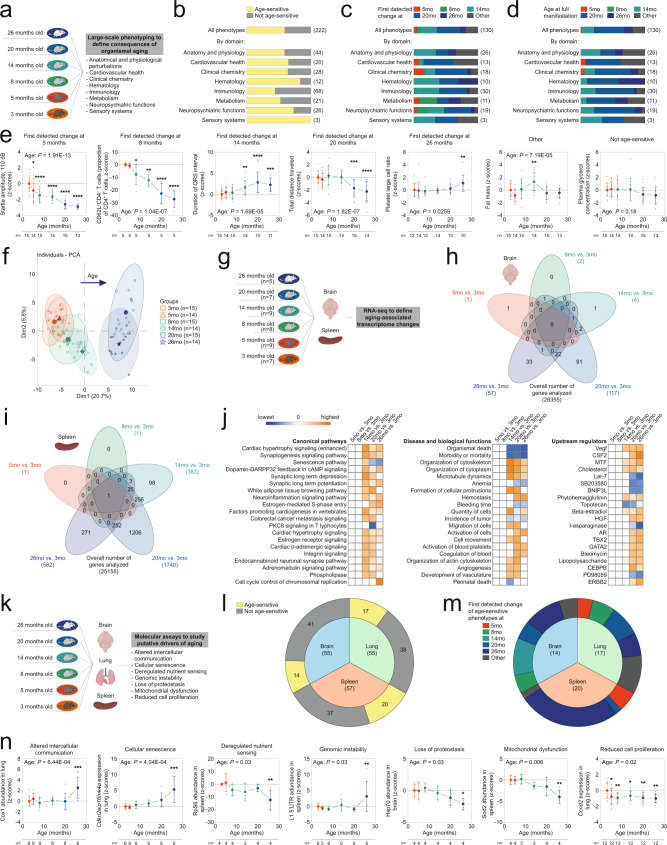 Fig.1 Multidimensional analyses of age-dependent phenotypic change in C57BL/6J mice. 1
What We Can Offer
Tailored Study Design
Molecular Data Generation
We generate high resolution molecular data, including analysis of epigenetic clocks and key senescence markers. This comprehensive profiling definitively links your compound to specific core hallmarks of aging, providing critical mechanistic insight to support your claims.
Predictive Data Analysis
Our expert team employs advanced statistical analysis, featuring life expectancy clocks, to predict final longevity outcomes earlier in the study. This predictive modeling provides accurate, actionable insights, significantly de-risking your research investment by accelerating decision-making.
How We Can Help
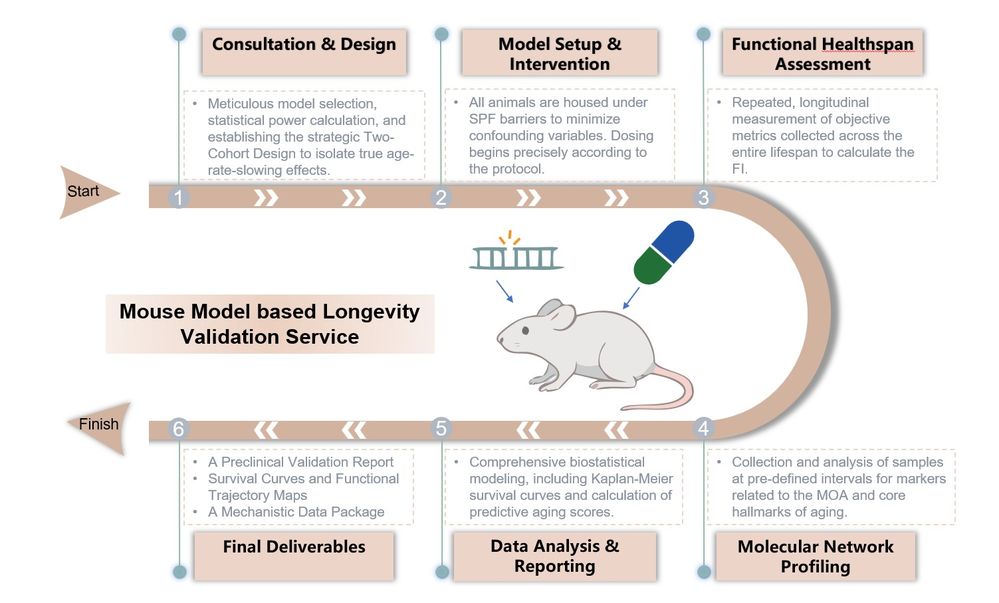
Highlights
Integrated Healthspan FI
We utilize the mouse frailty index, recognized as the gold standard in functional longevity assessment. This provides compelling evidence investors demand by demonstrating longer and healthier lives for your research compound.
Unmatched Geroscience Focus
Our specialized scientific team possesses deep, current knowledge of aging models and complex protocol optimization. This commitment minimizes the risk of experimental failure and ensures highly reliable data output.

Molecular Age Profiling
We integrate advanced epigenetic and transcriptome-based clocks into our analysis, allowing us to accurately measure the biological age of test subjects. This provides a high-resolution, objective metric of your compound's true impact on the aging process.
Superior Animal Husbandry
All mouse models are maintained under strict specific pathogen-free (SPF) conditions throughout the study duration. This stringent control is essential to eliminate environmental variables and confounding factors that could compromise the integrity of long-term longevity data.
To schedule a confidential consultation and receive a comprehensive service quotation, we invite you to contact our team.
Customer Reviews
-
Statistical Rigor
Using Creative Biolabs' service in our research has significantly facilitated the rigor of our survival analysis, yielding publication-quality Kaplan-Meier curves and advanced proportional-hazards modeling. Creative Biolabs' SPF standards are truly unmatched. - S. N***i -
Pipeline De-risking
Creative Biolabs' service has significantly improved our decision to proceed to a preclinical filing by providing the full, integrated functional and molecular data package. The predictive FI modeling offered an earlier, accurate prediction of longevity compared to simply waiting for maximum lifespan, effectively reducing our pipeline risk exposure. - M. F***an.
FAQs
Q: How does the "Two-Cohort Design" (young vs. old start) work, and why is it mandatory?
A: We test your intervention starting in both young and late-middle-aged mice. If your compound only improves health in the young cohort, it's often a baseline health effect. If it slows the rate of decline in the older cohort compared to controls, that confirms a genuine aging-rate-slowing effect, which is the definition of a true geroscience breakthrough.
Q: What specific molecular processes do you profile, beyond general inflammatory markers?
A: Our molecular network profiling is focused on the core hallmarks of aging: proteostasis (e.g., chaperone expression), mitochondrial function (e.g., respiration markers, biogenesis factors), and genomic stability. This provides mechanistic clarity that goes beyond general blood biochemistry.
Related Services
Gene Expression Profiling
Deep analysis of gene activity using RNA-seq or microarrays to confirm the compound's effect on age-related gene networks, providing definitive mechanistic proof of action.
Learn More →Saccharomyces cerevisiae Model
Rapid, cost-effective initial longevity validation and compound triage using model organisms like Saccharomyces cerevisiae before committing to the full mammalian study.
Learn More →How to Contact Us
Creative Biolabs provides definitive proof of efficacy, confirm healthspan extension via the frailty index, and elucidate your compound's mechanistic MOA through advanced molecular profiling. Ready to move your longevity research to the next stage? Please contact us.
Reference
- Xie, Kan et al. "Deep phenotyping and lifetime trajectories reveal limited effects of longevity regulators on the aging process in C57BL/6J mice." Nature communications vol. 13,1 6830. 11 Nov. 2022, doi:10.1038/s41467-022-34515-y. Distributed under an Open Access license CC BY 4.0, without modification. https://doi.org/10.1038/s41467-022-34515-y
 Download our brochure
Loading case studies...
Online Inquiry