Organic Acid Quantitative Analysis Service
Decoding Metabolic Signatures: Precision Organic Acid Analysis Service at Creative Biolabs
Organic acids drive critical biological and industrial activities, especially in Sugar Metabolism. Precise measurement of these compounds helps researchers decode biochemical networks, refine fermentation systems, and verify product standards. Creative Biolabs provides comprehensive organic acid analysis services, which meet the rigorous demands of sugar-focused research.
Accurate and Reliable Analysis Process
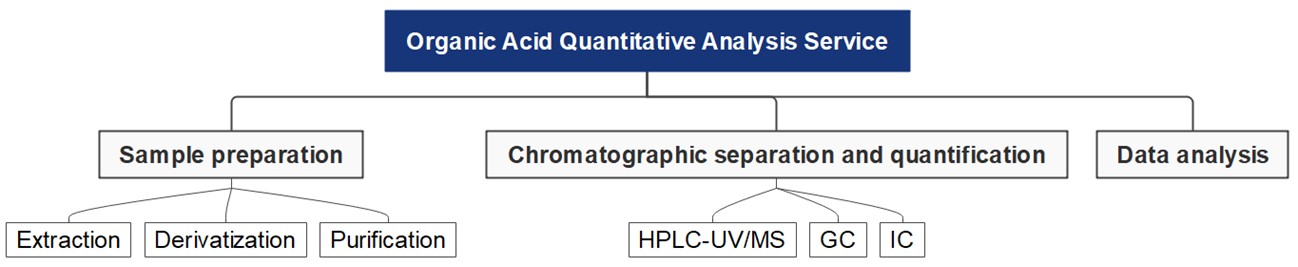
The meticulous sample preparation is a critical factor for accurate results. Matrix complexity demands tailored approaches. We deploy:
-
Extraction techniques for target isolation
-
Derivatization enhances the detection sensitivity
-
Purification removes interfering substances
-
Chromatographic separation and quantification
Different column chemistries help us to distinguish structurally similar acids, handle varying sample viscosities, and maintain resolution in complex mixtures. We utilize various techniques to quantify organic acids in different samples. The main techniques include:
-
High-performance liquid chromatography (HPLC): This technique employs a stationary phase and a mobile phase to separate organic acids based on their physicochemical properties. Different detectors, such as UV-Vis or mass spectrometry (MS), can be coupled with HPLC to achieve high sensitivity and specificity.
-
Gas chromatography (GC): It is suitable for volatile organic acids or those that can be readily derivatized. Flame ionization detectors (FID) or MS detectors are commonly used detectors.
-
Ion chromatography (IC): IC is particularly effective for quantifying organic acids in aqueous matrices.
Our analysis service quantifies a wide range of organic acids, and we also develop custom methods for specific organic acids. Please provide a list of the acids you're interested in, and we can confirm their detectability.
We use standard solutions to establish the relationship between signal intensity and organic acid concentration, determine the organic acid concentration in the sample according to the calibration curve, and present the quantitative results in a clear and concise format.
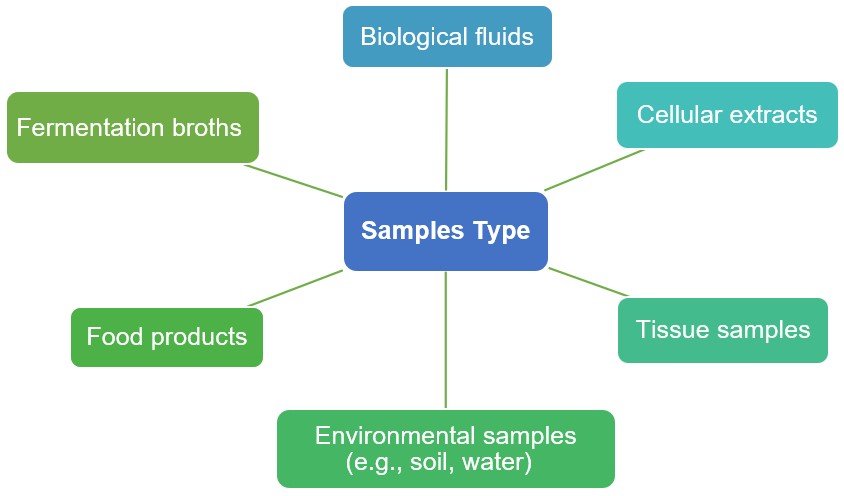
Diverse Sample Types
Creative Biolabs provides clients with the highest-quality organic acid quantitative analysis services. In addition, we also provide a variety of sugar metabolism-based compound analysis services, such as Bile Acid, Arachidonic Acid, Catechin, Neurotransmitter, Trimethylamine N-oxide, etc. Please contact us to inquire about our analysis services if you require one.
Published Data
This article uses bacteria as the research object and accurately measures the content of multiple organic acids produced after bacterial fermentation. The figure below shows a comparative analysis of organic acid concentrations in in vitro bacterial fermentation cultures. The authors used liquid chromatography-mass spectrometry (LC-MS) to quantify acetic acid, propionic acid, butyric acid, valeric acid, caproic acid, and lactic acid in the samples. This method is a rapid and reliable method that can analyze various samples. This method has been successfully used in the analysis of organic acids in bacterial fermentation cultures and fecal samples.
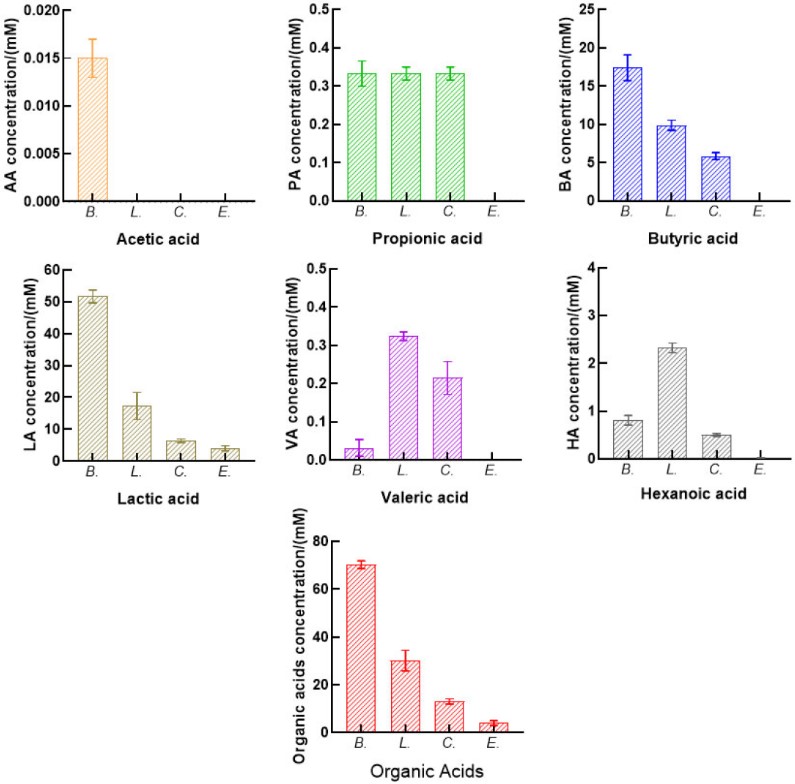 Fig.1 Comparison of organic acid concentrations after bacterial in vitro fermentation.1
FAQs
Q1: Can you handle complex sample matrices, such as fermentation broths or food products?
A1: Yes, we have extensive experience handling complex matrices. We have various sample preparation protocols, including liquid-liquid extraction (LLE), solid-phase extraction (SPE), and protein precipitation. We optimize the method for each matrix to minimize interference and to ensure accurate and reliable results.
Q2: What are the sample volume requirements?
A2: The sample volume depends on the number of analytes and the complexity of the matrix. Typically, we require a minimum of 1-5 mL of liquid samples or 1-5 grams of solid samples. We provide specific requirements based on your project.
Q3: Why do you need to accurately analyze organic acids?
A3: (1) Clinical studies: Abnormal acid patterns flag metabolic diseases, enabling timely treatment.
(2) Nutritional science: Tracking acids in foods or fluids informs nutrient studies and functional food design.
(3) Microbial fermentation: Process optimization through acid-level monitoring boosts output efficiency.
(4) Environmental studies: Soil acidification tracking via organic acid measurement.
Customer Review
Tailored Solutions for Unique Challenges
"The team at Creative Biolabs impressed us with their ability to tailor the analytical protocol specifically for our samples, guaranteeing the accurate quantification of the organic acids we were targeting." - Dr. C. Wil***n
Comprehensive Quantification of Diverse Organic Acids
"We required the quantification of a wide range of organic acids, and Creative Biolabs' service covered all our target analytes. Their ability to simultaneously quantify diverse compounds in a single run was highly efficient and saved us considerable time and resources." - Ms. D. Bro***e
Reference
-
Wang, Jing, et al. "Development of an LC-MS Method for the Quantitative Determination of Six Organic Acids Produced by Bacterial Fermentation In Vitro and In Vivo." Processes 13.3 (2025): 697. DOI: 10.3390/pr13030697. Distributed under an Open Access license CC BY 4.0, without modification.
Related Services
For Research Use Only.