Soil Physical & Chemical Property Analysis Service
Soil Physical and Chemical Property Analysis Service: Unlock the Potential of Your Land, Sustainably.
Are you currently facing challenges with site suitability, environmental compliance, or agricultural productivity due to unknown soil conditions? Creative Biolabs' soil physical and chemical property analysis service helps you gain precise insights into soil health, mitigate risks, and optimize land use through advanced analytical techniques and expert interpretation. Soil serves as the bedrock of terrestrial ecosystems, offering vital nutrients, water, and structural anchorage for vegetation, while simultaneously governing a multitude of Earth's biogeochemical cycles. Its physical and chemical properties directly influence agricultural productivity, environmental health, and the viability of infrastructure projects. Understanding these properties through rigorous analysis is paramount for sustainable land development. Creative Biolabs stands at the forefront of Soil Analysis, providing unparalleled expertise and a commitment to delivering actionable insights. Our unique advantages stem from our comprehensive analytical capabilities, our integration of cutting-edge technologies like advanced spectroscopy, and our deep understanding of the long-term ecological impacts of land management. We provide various soil analysis services, including Soil Polysaccharide Content, Elements, and Soil Glycoproteinase Activity analysis services, which help provide a complete understanding of your soil's potential and limitations.
Mature Soil Physical and Chemical Property Analysis Service at Creative Biolabs
Creative Biolabs' soil physical and chemical property analysis service delivers actionable data and expert interpretations crucial for diverse projects, from large-scale infrastructure development to precision agriculture and environmental remediation. Clients can expect comprehensive reports detailing critical soil parameters, clear identification of potential constraints or opportunities, and evidence-based recommendations tailored to their specific objectives. Our solutions empower informed decision-making, ensuring project stability, regulatory compliance, and long-term environmental sustainability. We provide a comprehensive suite of soil physical and chemical property analyses designed to meet diverse client needs. Our detailed process ensures accuracy and provides actionable data. Our analysis typically begins with meticulous sample preparation (drying, grinding, sieving) to ensure homogeneity and consistency. Depending on the property, we employ a combination of classical wet chemistry methods and advanced instrumental techniques.
Soil pH analysis is a fundamental service that quantifies the acidity or alkalinity of a soil sample, a critical factor influencing nutrient availability for plants and overall microbial activity within the soil ecosystem. This essential measurement is typically performed using a pH meter, which employs a sensitive glass electrode immersed in a well-prepared soil-water or soil-salt solution slurry. This method ensures an accurate reading that reflects the soil's chemical environment, providing vital insights for agricultural management and environmental assessments.
-
Soil organic matter (SOM) analysis
SOM analysis is crucial for understanding soil health, as it quantifies the organic carbon content, which is vital for maintaining soil structure, enhancing water retention capabilities, and facilitating crucial nutrient cycling processes. Creative Biolabs employs several reliable methods for SOM determination. For rapid, non-destructive assessments, visible and near-infrared (Vis-NIR) diffuse reflectance spectroscopy can also be utilized, correlating distinct spectral signatures to the soil's organic carbon content.
-
Cation exchange capacity (CEC) analysis
The CEC analysis measures the soil's inherent ability to hold onto and exchange positively charged nutrients, known as cations, directly reflecting its nutrient retention capacity. This service is key for understanding how well a soil can store and supply essential plant nutrients. The method involves first saturating the exchange sites within the soil with a specific known cation, such as ammonium acetate. Following this saturation, the amount of that specific cation that has been adsorbed onto the soil particles, or subsequently replaced by other cations, is then precisely quantified to determine the soil's CEC.
-
Major exchangeable ions analysis
Analysis of major exchangeable ions such as potassium (K), calcium (Ca), magnesium (Mg), and sodium (Na) quantifies the readily available forms of these essential plant nutrients and other significant cations present in the soil. These ions are vital for plant growth and overall soil fertility. To determine their concentrations, the ions are first extracted from the soil using appropriate solutions like ammonium acetate. Once extracted, their precise quantities are then measured using highly sensitive instrumental techniques such as inductively coupled plasma-optical emission spectrometry (ICP-OES), atomic absorption spectrophotometry (AAS), or ion chromatography, ensuring accurate data for nutrient management recommendations.
Available phosphorus analysis specifically measures the amount of phosphorus that is readily accessible for plant uptake, making it a critical indicator for plant nutrition and fertilizer recommendations. Since phosphorus availability varies greatly with soil type and pH, Creative Biolabs utilizes specific extraction procedures tailored to different soil conditions. After the extraction, the extracted phosphorus is then precisely quantified through colorimetric analysis, where the intensity of a colored solution formed by a chemical reaction with phosphorus indicates its concentration.
-
Particle size distribution analysis
Particle size distribution determines the relative proportions of sand, silt, and clay particles within a soil sample. This fundamental physical property profoundly influences critical soil characteristics such as water movement (drainage and retention), aeration, and the soil's capacity for nutrient retention. The analysis typically employs methods based on the differential sedimentation rates of particles in a liquid, including the hydrometer method and the pipette method, which measure the concentration of suspended particles over time to classify the soil into its appropriate textural class.
Creative Biolabs' soil physical and chemical property analysis service is your essential partner in understanding, managing, and optimizing the health of your land. Our analysis processes adhere to international standards and undergo stringent internal quality control, ensuring the reliability and defensibility of all reported data. We provide the precise, actionable insights necessary to navigate complex environmental challenges, enhance productivity, and ensure the long-term sustainability of your projects. Our team of experienced soil specialists is eager to discuss your specific project needs and demonstrate how Creative Biolabs can provide the precise data and expert guidance you require. Please contact us for more content and to discuss your project!
Published Data
This study investigates the intricate relationships between various soil physical properties and other crucial soil characteristics, including chemical, biological, and biochemical attributes, as well as their ultimate impact on crop yields. The researchers focused on six key physical properties: bulk density (BD), wet aggregate stability index (WASI), average slake aggregate (ASA), clay concentration, saturated hydraulic conductivity (SHC), and intact core available water holding capacity (IAWHC). The findings indicate that ASA, WASI, and IAWHC consistently showed strong associations with a wide array of other soil properties and exhibited significant relationships with average crop yields across the study years. ASA was identified as a particularly strong candidate for a soil health indicator due to its comprehensive correlations and ease of measurement.
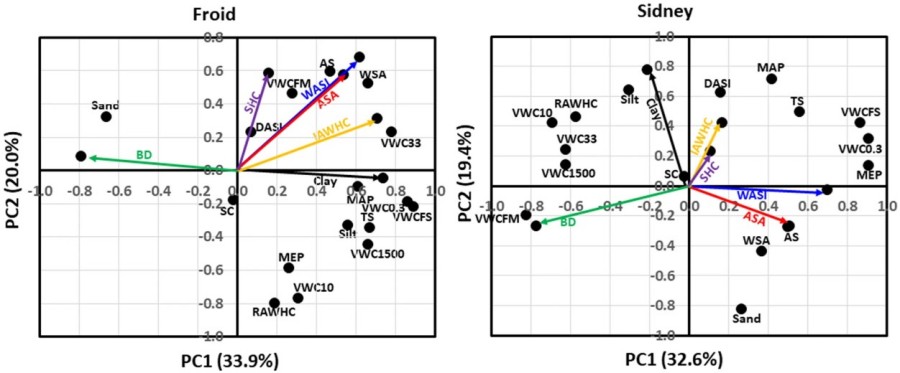 Fig.1 Results of principal component analysis of soil physical properties at different study sites.1
FAQs
Q1: How do I collect soil samples for analysis?
A1: We provide detailed sampling protocols according to your project type (e.g., agricultural field, construction site, environmental assessment). Proper sampling is crucial for accurate results. Generally, this involves taking multiple subsamples from a defined area to form a composite sample, ensuring it is representative of the site.
Q2: What is the typical analysis time for results?
A2: Analysis times vary depending on the complexity of the analyses requested and the number of samples. Basic analyses typically take 3-5 weeks, while more comprehensive packages or specialized tests may require 6-8 weeks. We strive to deliver results promptly and provide an estimated timeframe during the project scoping phase. For urgent needs, please discuss expedited options with our team.
Q3: How can your soil analysis help with sustainable land management?
A3: Our services provide the fundamental data needed for informed decisions in sustainable land management. By understanding properties such as organic matter content, nutrient levels, and physical structure, you can optimize fertilization, enhance water use efficiency, select suitable crop types, and implement best practices for erosion control and carbon sequestration.
Customer Review
Precise pH Adjustments
"Using Creative Biolabs's soil physical and chemical property analysis service in our vineyard management has significantly improved our understanding of soil pH variations, allowing for precise lime applications that optimized nutrient uptake and grape quality. The detailed ion analysis also highlighted previously unknown deficiencies, guiding targeted amendments." - Dr. E. Bac***h
Unveiling Organic Matter Dynamics
"Creative Biolabs's analysis of soil organic matter (SOM) has been instrumental in tracking the success of our long-term agroforestry experiments. Their ability to provide consistent and reliable data on SOM, alongside crucial physical properties like bulk density and porosity, allowed us to see the positive impact of our improved natural systems on soil health over several years, validating our sustainable practices. Their methodology is far superior to our previous in-house tests, providing a much deeper understanding of soil dynamics." - Prof. F. Ros***o
Reference
-
Sainju, Upendra M., Daniel Liptzin, and Jalal D. Jabro. "Relating soil physical properties to other soil properties and crop yields." Scientific Reports 12.1 (2022): 22025. DOI: 10.1038/s41598-022-26619-8. Distributed under an Open Access license CC BY 4.0, without modification.
Related Services
For Research Use Only.