Chitosan Analysis Service
Introduction and Main Categories of Chitosan
Chitosan is a natural high molecular weight polysaccharide obtained by deacetylation of chitin. Chitin is widely found in the shells of crustaceans (such as shrimps and crabs), the cell walls of fungi, and other parts, and it is the second-largest natural polysaccharide after cellulose. Chitosan has garnered significant interest because of its biocompatibility, degradability, and versatility. With the continuous expansion of application areas, the quality and performance requirements of chitosan products are also getting higher and higher. Providing professional chitosan analysis services not only aids in ensuring product quality and satisfying clients but also fosters technological innovation and supports the sustainable development of the industry.
Chitosan is classified according to different criteria, which help researchers and application developers select the appropriate type of chitosan according to different physicochemical properties, uses, and performance.
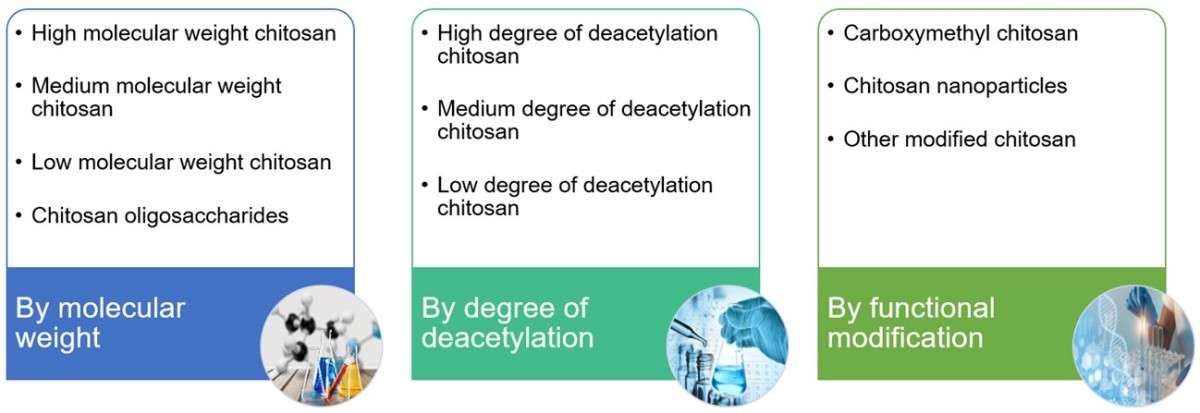
Professional Chitosan Analysis Service at Creative Biolabs, Promotes Sustainable Development of the Industry.
Creative Biolabs has a professional technical team with rich experience in Monosaccharide, Oligosaccharide, Polysaccharide, and other Carbohydrate Analysis projects. We use advanced analysis techniques to ensure the accurate determination of various physical and chemical indicators of chitosan. The following is the chitosan analysis content we provide.
-
Degree of deacetylation analysis
The degree of deacetylation is an important parameter of chitosan, reflecting the degree of removal of acetyl groups in chitosan, which directly affects its solubility and biological activity. We use techniques such as nuclear magnetic resonance spectroscopy (NMR) and infrared spectroscopy (FTIR) to determine the degree of deacetylation of chitosan.
-
Molecular weight analysis
Molecular weight affects the physical and biological properties of chitosan. We combine gel permeation chromatography (GPC) and size exclusion chromatography (SEC) with multi-angle laser light scattering (MALLS) to determine the molecular weight and distribution of chitosan.
We use precise analysis methods to detect the content of various components in chitosan, such as chitobiose, chitotriose, chitotetraose, chitopentaose, chitohexaose, etc., to provide clients with accurate component information and help clients understand the quality and characteristics of chitosan.
-
Structural characterization
We use spectral analysis and other technical means to characterize the molecular structure of chitosan in detail, including analyzing the type of its chemical bonds, the distribution of functional groups, etc., to provide a theoretical basis for its application in different fields.
In addition, Creative Biolabs also provides chitosan physical property measurement services to help clients better understand the physical properties of chitosan. We conduct testing in strict accordance with international standards and specifications to ensure high-quality chitosan analysis results. Moreover, we also provide personalized technical solutions according to the specific needs of clients to help them better utilize the characteristics of chitosan to develop new products or improve existing products. Please contact us if you would like to learn more about our chitosan analysis services or have any questions.
Published Data
The research explores the application of spectroscopic techniques in characterizing the structure of chitin and chitosan. A key focus is on detailing various mass spectrometry (MS) approaches employed in chitosan analysis. Moreover, the study emphasizes the role of NMR spectroscopy in determining crucial structural attributes of chitosan. Specifically, NMR is utilized to ascertain the degree of N-acetylation (DA), which indicates the proportion of deacetylated units in the chitosan polymer, and the pattern of acetylation (PA), which describes the distribution of acetyl groups along the polymer chain. The research underscores the importance of these parameters, DA and PA, as they significantly influence the overall properties and functionalities of both chitin and chitosan. The selection of appropriate analytical methods is crucial for accurately characterizing these biopolymers.
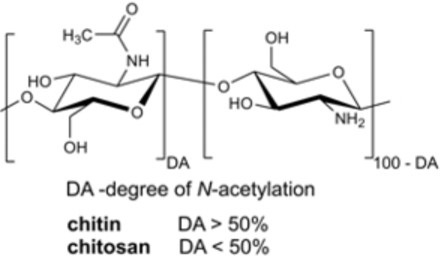 Fig.1 Schematic diagram of the structures of chitin and chitosan.1
FAQs
Q1: What physical property measurement services can you provide for chitosan?
A1: We provide comprehensive chitosan physical property measurement services, such as molecular weight, deacetylation degree, viscosity, thermal properties, moisture, content, crystallinity, and crystal structure. These physical property measurement services fully reveal the characteristics of chitosan and promote its application in the fields of medicine, biomedicine, the food industry, etc.
Q2: What should be noted when submitting chitosan samples for inspection?
A2: When submitting chitosan samples for inspection, please ensure that the samples are sealed and intact to avoid contamination and deliquescence. Provide sufficient sample volume (we will inform the specific sample requirements based on the required test items). In addition, please attach sample information, including source, batch, expected test items, etc., so that we can complete the test accurately and efficiently.
Q3: What applications are suitable for chitosan analysis services?
A3: The scope of chitosan analysis services is quite broad, encompassing various industries and fields. For example, in the pharmaceutical and biomedical fields, chitosan analysis helps develop new drug delivery systems, wound dressings, and tissue engineering scaffolds. In the food industry, the quality control and functional evaluation of chitosan are essential for the development of food additives. In the cosmetics industry, the property analysis of chitosan helps the research and development of skin care products and personal care products. Therefore, chitosan analysis services provide key technical data and quality assurance for various industries, promoting the development and application of chitosan in various fields.
Customer Review
Detailed Data Provided Reference for Clients
"Thank you very much for the chitosan analysis service provided by Creative Biolabs. Your test report was very detailed, and the data was comprehensive, which provided an important reference for our product development."
Efficient Testing Helped Clients Launch Their Products
"Creative Biolabs completed the chitosan content test quickly and efficiently. The analysis results you provided were accurate and reliable, helping us gain an advantage in the market competition. Thank you for your support. Your service efficiency deserved praise!"
Reference
-
Kumirska, Jolanta, et al. "Application of spectroscopic methods for structural analysis of chitin and chitosan." Marine Drugs 8.5 (2010): 1567-1636. Distributed under Open Access license CC BY 3.0, without modification.
Related Services
For Research Use Only.