Carotenoid Quantitative Analysis Service
Introduction to Carotenoid Quantitative Analysis
Are you currently facing challenges in accurately quantifying carotenoids, understanding their diverse profiles, or leveraging their full potential in your research or product development? Creative Biolabs' carotenoid quantitative analysis service helps you unlock precise insights into carotenoid composition and concentration, accelerating your research and product innovation through advanced chromatographic and spectroscopic techniques. Carotenoids are a vast group of naturally occurring pigments synthesized by plants, algae, and some fungi and bacteria, playing vital roles in photosynthesis, antioxidant defense, and as precursors to vitamin A. Their diverse structures lead to a wide range of biological activities and applications. Accurate quantitative analysis of these compounds is paramount for understanding their distribution, bioavailability, and functional properties in various matrices.
Mature Carotenoid Quantitative Analysis Service at Creative Biolabs
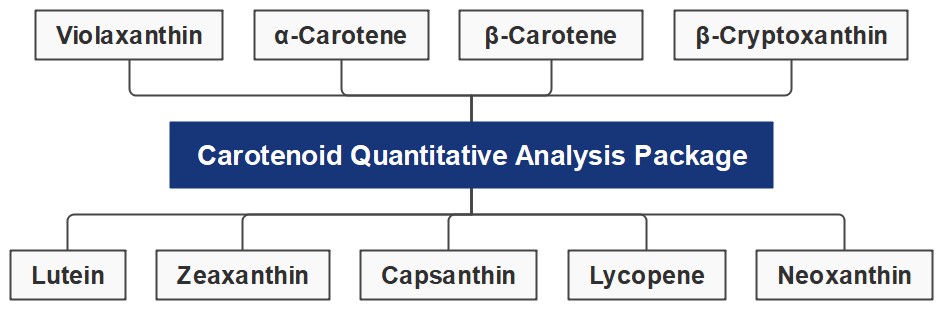
Our carotenoid quantitative analysis service provides unparalleled accuracy and detail, enabling you to precisely identify and quantify carotenoid profiles in complex biological and food matrices. This service is crucial for nutritional research, food science, cosmetic development, and pharmaceutical applications, offering the definitive data needed for informed decision-making and product enhancement. Creative Biolabs provides a versatile range of carotenoid quantitative analysis services tailored to specific research and industry needs:
-
Total carotenoid content analysis: Quantification of the overall carotenoid concentration in a sample.
-
Individual carotenoid profiling: Detailed identification and quantification of specific carotenoids (e.g., β-carotene, lutein, zeaxanthin, lycopene, cryptoxanthin, etc.).
-
Stereoisomer analysis: Separation and quantification of cis and trans isomers of carotenoids, crucial for understanding their stability and bioavailability.
-
Targeted carotenoid analysis: Focus on specific carotenoids of interest, often for quality control or regulatory compliance.
Our Streamlined Workflow
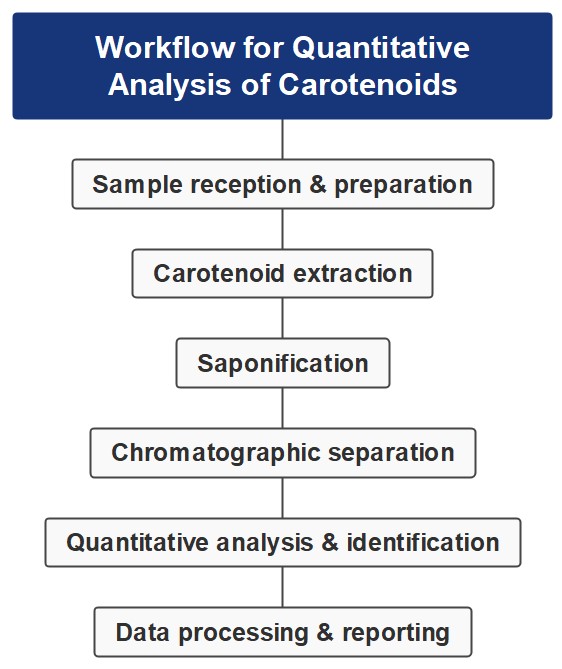
Our streamlined workflow is designed for efficiency and accuracy, providing a clear path from sample submission to comprehensive data delivery.
-
Sample reception & preparation
Upon receipt, samples undergo rigorous quality control and are meticulously prepared. This involves precise weighing, homogenization, and initial extraction steps tailored to the sample matrix to ensure optimal carotenoid recovery.
Carotenoids are extracted using optimized solvent systems (e.g., acetone, ethanol, hexane, or mixtures thereof) and techniques such as sonication, mechanical disruption, or accelerated solvent extraction (ASE). This step is critical for isolating carotenoids from other matrix components.
For samples containing significant amounts of carotenoid esters, saponification (alkaline hydrolysis) is performed to convert esters into their free alcohol forms. This ensures accurate quantification of total carotenoids and facilitates separation.
-
Chromatographic separation
The extracted carotenoids are then separated using high-performance liquid chromatography (HPLC) or ultra-performance liquid chromatography (UPLC) coupled with photodiode array (PDA) detection. This allows for the resolution of individual carotenoids based on their polarity and structure.
-
Quantitative analysis & identification
Individual carotenoids are quantified by comparing their peak areas or heights to those of known external standards. For ambiguous peaks or novel carotenoids, liquid chromatography-mass spectrometry (LC-MS/MS) can be employed for definitive identification and structural elucidation.
-
Data processing & reporting
Raw data is processed using specialized software, and comprehensive reports are generated. These reports include chromatographic profiles, quantitative results, and method parameters.
Creative Biolabs is your trusted partner for precise and insightful carotenoid quantitative analysis. We also provide quantitative analysis services for various compounds related to Metabolic Research, such as Organic Acid, Arachidonic Acid, Anthocyanin, Alkaloid, etc. Our commitment to scientific excellence and client success ensures that you receive the highest quality data to advance your projects. Please contact us for more information and to discuss your project.
Published Data
This study specifically delves into the carotenoid composition of Maclura tricuspidata (MT) fruits, revealing a novel finding: the majority of carotenoids present are ester mixtures of capsanthin and cryptocapsin. The researchers employed a combination of analysis techniques. Thin Layer Chromatography (TLC) was initially utilized to separate carotenoid fractions from unsaponified extracts, revealing distinct components. These fractions were then further purified using preparative TLC and silica gel column chromatography. For precise identification and quantification of individual carotenoids, HPLC was employed, with concentrations determined.
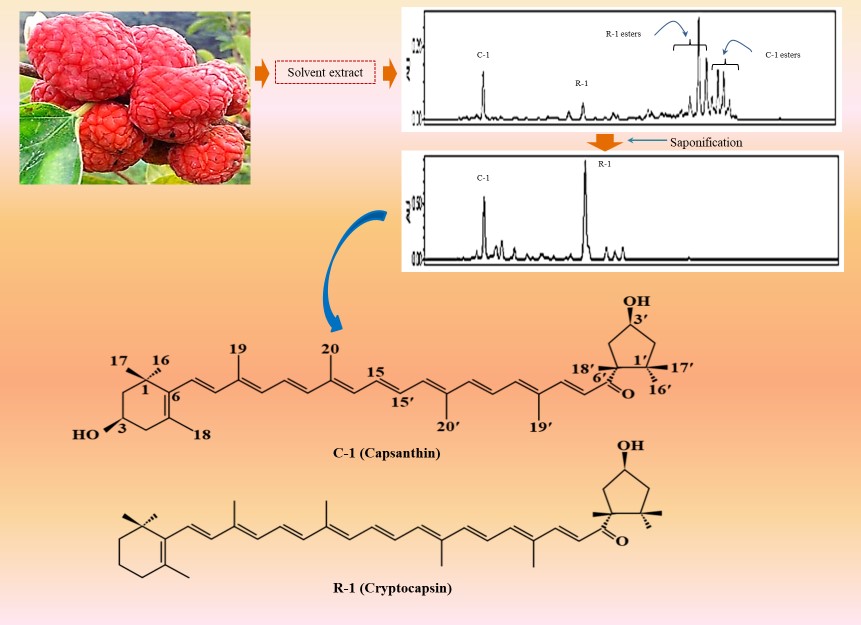 Fig.1 Determination of carotenoids in MT fruits.1
FAQs
Q1: What types of samples can Creative Biolabs analyze for carotenoids?
A1: We are equipped to analyze a broad spectrum of samples, including plant tissues, fruits, vegetables, algae, microbial cultures, food products, dietary supplements, etc. If you have a unique sample type, please reach out to discuss its suitability with our experts.
Q2: Can Creative Biolabs differentiate between various carotenoid isomers?
A2: Absolutely. Our advanced chromatographic methods are specifically designed to separate and quantify various carotenoid isomers, including cis and trans forms. This capability is vital for understanding the biological activity and stability of carotenoids, as different isomers can have distinct properties.
Q3: How accurate is Creative Biolabs' carotenoid quantitative analysis?
A3: Creative Biolabs employs state-of-the-art HPLC and UPLC systems with highly sensitive detectors, coupled with rigorous quality control measures and validated methods. This ensures exceptional accuracy and reproducibility in our quantitative results, providing you with reliable data for your critical applications.
Customer Review
Streamlined Workflow
"Creative Biolabs's service facilitated a rapid and efficient analysis of hundreds of plant samples for their carotenoid content. The clear data presentation and prompt communication allowed us to accelerate our breeding program, saving us months of in-house method development." - Ms. I. Rod***z
Unmatched Precision
"Using Creative Biolabs's carotenoid quantitative analysis service in our research has significantly improved our ability to accurately quantify specific carotenoid isomers in complex food matrices. Their detailed reports and robust methodology provided the confidence we needed for our high-impact publication." - Mr. J. Mar***z
Reference
-
Kim, Jong-Kuk, et al. "The Identification and Quantitative Analysis of Unusual Keto-Carotenoids in Ripe Fruits of Maclura tricuspidate and Its Potential as a Valuable Source of Cryptocapsin." Molecules 27.23 (2022): 8317. DOI: 10.3390/molecules27238317. Distributed under Open Access license CC BY 4.0, without modification.
Related Services
For Research Use Only.