Parallel Reaction Monitoring (PRM) based Targeted Proteomic Quantitative Analysis Service
Introduction of Parallel Reaction Monitoring (PRM)
PRM is a cutting-edge mass spectrometry-based technique for highly accurate and sensitive quantification of target proteins and peptides. Leveraging high-resolution and high-mass accuracy instruments, PRM offers unparalleled specificity by simultaneously monitoring all product ions of a selected precursor peptide. This approach overcomes limitations of traditional methods, providing robust and reproducible quantitative data essential for advancing biological research and drug development.
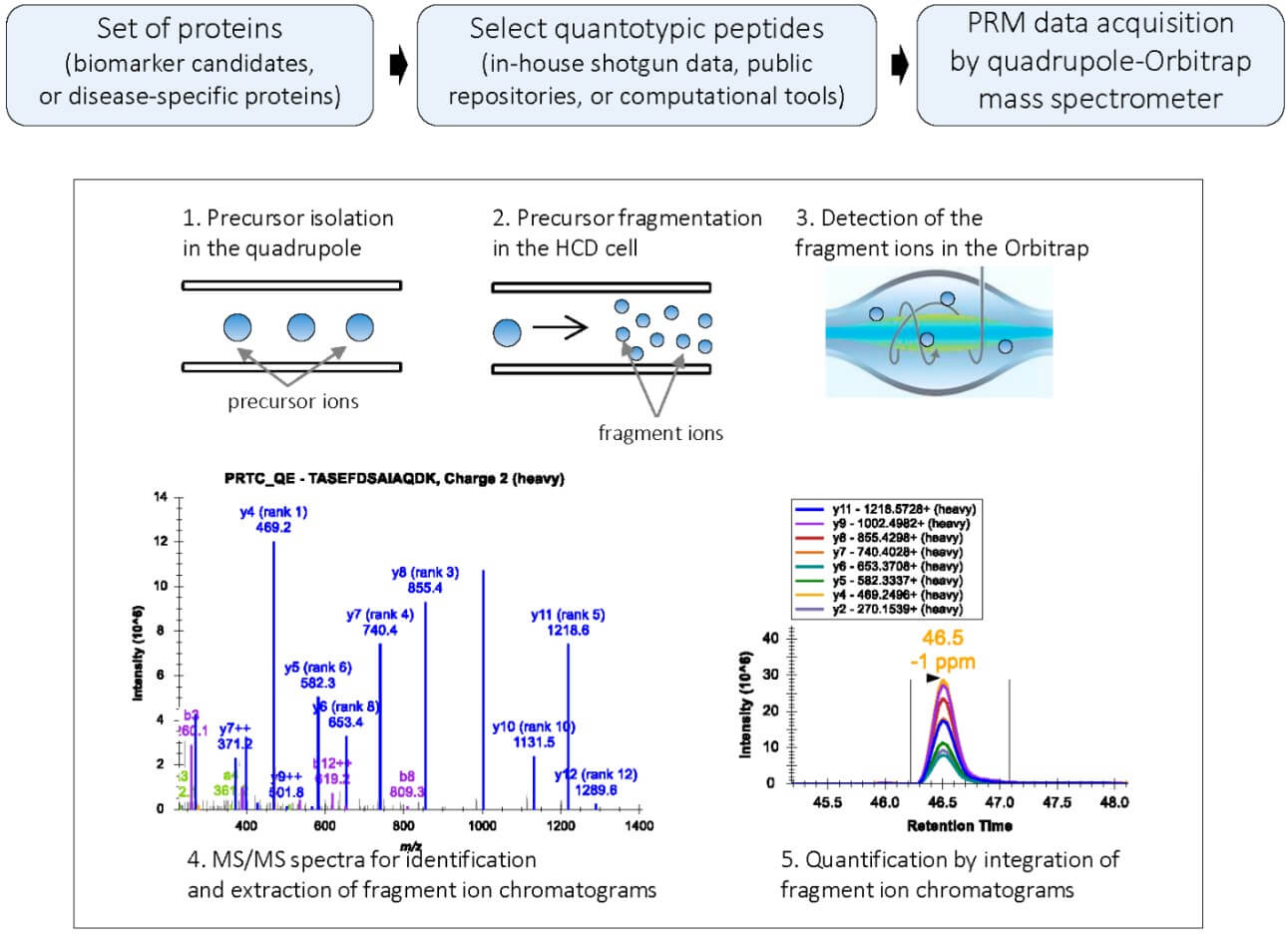 Fig.1 Analysis workflow of PRM.1,3
Creative Biolabs' PRM-based targeted proteomic quantitative analysis service helps you achieve highly accurate and reproducible protein quantification through advanced mass spectrometry technology. Accelerate your research with unparalleled specificity and sensitivity. The importance and broad application of our PRM service stem from its ability to provide high-quality, targeted Proteomic Quantitative Analysis across diverse research and development areas:
1
-
Biomarker discovery and validation: Precisely quantify candidate biomarkers identified from discovery studies in larger cohorts, moving them closer to clinical utility.
2
-
Drug target quantification and validation: Accurately measure the expression levels of potential drug targets, assess target engagement, and monitor on-target or off-target effects of therapeutic compounds.
3
-
Pharmacokinetic (PK) and pharmacodynamic (PD) studies: Track the fate and activity of therapeutic proteins (e.g., antibody drugs) in biological systems over time, providing critical data for drug development.
4
-
Understanding disease mechanisms: Uncover subtle but significant changes in protein expression in disease models, contributing to a deeper understanding of pathological processes.
5
-
Systems biology and pathway analysis: Quantify multiple proteins within specific signaling pathways or biological networks to gain a comprehensive, systems-level understanding of cellular responses and adaptations.
How Creative Biolabs' PRM Targeted Proteomic Quantitative Analysis Service Can Assist Your Project
At Creative Biolabs, our PRM service delivers precise, targeted, and highly sensitive protein quantification, empowering your research with actionable data. We provide a comprehensive PRM service by integrating state-of-the-art instrumentation, expert methodology, and rigorous data analysis, ensuring high-quality and reliable results for our clients.
-
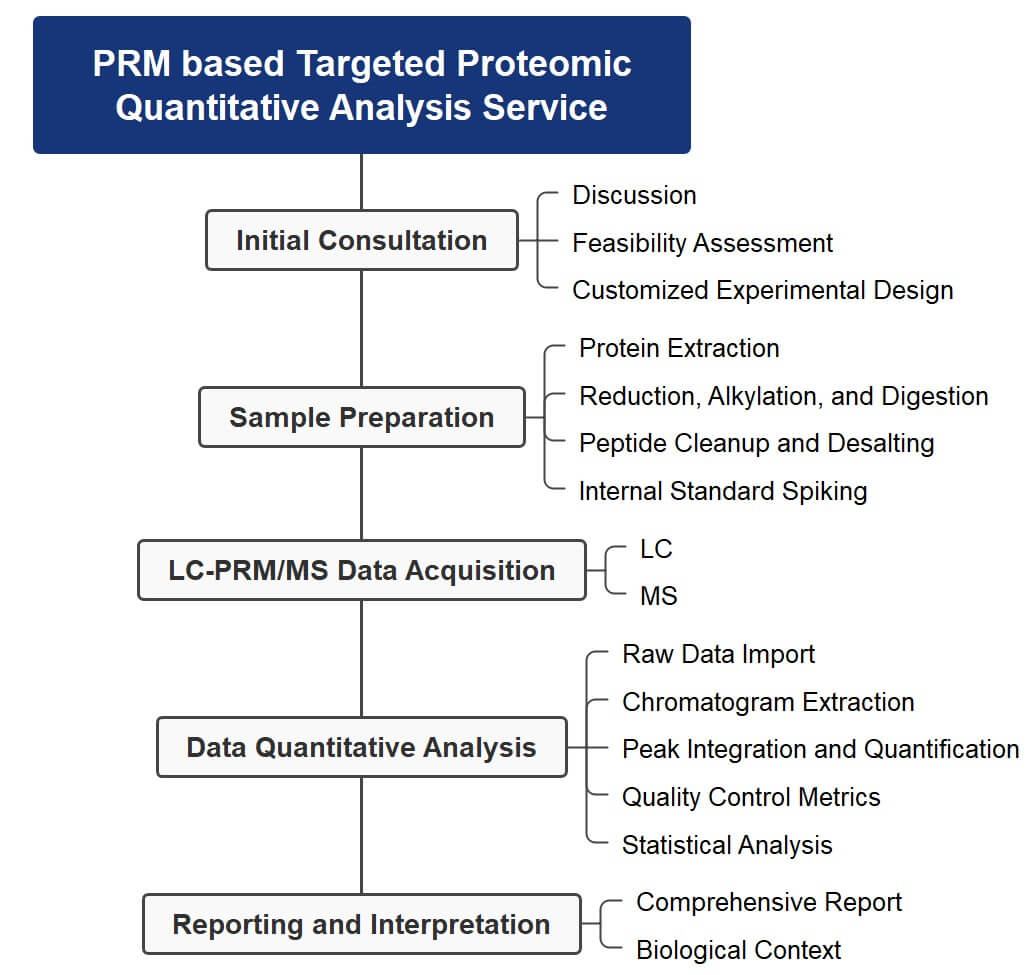
Discussion: Our scientific team engages with you to thoroughly understand your research goals, target proteins, sample types, and desired outcomes.
-
Feasibility Assessment: We evaluate the feasibility of your targets for PRM, considering factors like protein abundance and potential interferences.
-
Customized Experimental Design: A tailored experimental plan is developed, outlining sample preparation, target peptide selection, internal standard strategies, and data acquisition parameters.
-
Protein Extraction: Proteins are extracted from your provided biological samples using optimized protocols to ensure maximum yield and minimal degradation.
-
Reduction, Alkylation, and Digestion: Proteins are denatured, reduced, alkylated, and enzymatically digested (typically with trypsin or Lys-C/trypsin) into peptides.
-
Peptide Cleanup and Desalting: Peptides undergo purification and desalting steps to remove detergents, salts, and other interfering compounds, enhancing MS performance.
-
Internal Standard Spiking: Stable isotope-labeled synthetic peptides corresponding to your targets (or labeled reference peptides for normalization) are spiked into the samples at a known concentration. This is crucial for absolute quantification and to correct for matrix effects and analytical variations.
-
LC-PRM/MS Data Acquisition
-
Liquid Chromatography (LC): Peptides are separated using nano- or micro-flow liquid chromatography, typically on C18 reversed-phase columns, to achieve optimal chromatographic resolution and reduce sample complexity before mass spectrometry.
-
Mass Spectrometry (MS): The separated peptides are introduced into a high-resolution, accurate-mass quadrupole-Orbitrap mass spectrometer. The instrument performs a targeted PRM scan, where a specific precursor ion is isolated in the quadrupole, fragmented in the HCD cell, and all resulting product ions are simultaneously detected with high resolution and mass accuracy in the Orbitrap. This "parallel" detection of all fragments is a key differentiator from SRM.
-
Data Quantitative Analysis
-
Raw Data Import: Raw MS files are imported into specialized bioinformatics software.
-
Chromatogram Extraction: The software extracts highly specific ion chromatograms for the target peptides and their corresponding stable isotope-labeled internal standards, leveraging the high-resolution MS/MS data.
-
Peak Integration and Quantification: Peak areas for both light (endogenous) and heavy (internal standard) peptides are integrated. Ratios of light to heavy signals are calculated to determine the relative or absolute abundance of the target proteins.
-
Quality Control Metrics: Rigorous quality control checks are applied, including evaluation of chromatographic peak shape, retention time alignment, mass accuracy, and reproducibility across replicates.
-
Statistical Analysis: Appropriate statistical methods are applied to identify significant changes in protein expression between experimental groups.
-
Reporting and Interpretation
-
Comprehensive Report: A detailed report is provided, including raw data, processed data, quantitative results, statistical analysis, and a clear summary of findings.
-
Biological Context: Our scientists assist in interpreting the quantitative data within your specific biological context, helping you draw meaningful conclusions and plan next steps.
Creative Biolabs' PRM-based targeted proteomic quantitative analysis service is a powerful, precise, and highly reliable solution for your quantitative proteomics needs. We leverage the inherent advantages of PRM - its superior specificity, sensitivity, and ease of method development - to deliver accurate and reproducible quantification of your proteins of interest. Whether you are validating biomarkers, studying drug mechanisms, or developing diagnostic assays, our service provides the critical data required to accelerate your scientific discoveries and advance your projects with confidence.
Both PRM and DIA are powerful quantitative proteomics approaches, but they differ in their acquisition strategies and offer distinct advantages.
|
Feature
|
PRM
|
DIA
|
|
Acquisition Strategy
|
Targeted: Precursor ions are specifically selected (isolated) in the quadrupole, fragmented, and all resulting product ions are detected in a high-resolution mass analyzer.
|
Data independent: Wide m/z windows are sequentially isolated and fragmented. All precursor and fragment ions within each window are detected without prior selection.
|
|
Specificity
|
Very high: Achieved by precise precursor isolation and high-resolution, accurate-mass detection of all fragments.
|
High: Achieved by high-resolution MS/MS data and sophisticated software algorithms that deconvolve complex spectra.
|
|
Sensitivity
|
High: Excellent for low-abundance targets due to focused acquisition.
|
High: Can be very sensitive, especially for the discovery and quantification of many analytes.
|
|
Multiplexing
|
Moderate to high: Can quantify dozens to hundreds of targets per run with scheduled acquisition.
|
Very high: Can quantify thousands of proteins in a single run, often considered "quasi-untargeted."
|
|
Method Development
|
Minimal to moderate: Requires knowledge of target peptides and some optimization of acquisition parameters (e.g., collision energies, retention times). Easier than SRM.
|
Less upfront method development for targets: Once the DIA method is set up, it can be applied broadly. Library generation is key.
|
|
Data Analysis Complexity
|
Moderate: Relatively straightforward as it focuses on pre-defined targets.
|
High: Requires advanced computational tools and spectral libraries for deconvolution and quantification.
|
|
Quantitative Accuracy
|
Excellent: Highly accurate due to specific targeting and high-resolution fragment ion detection.
|
Excellent: High accuracy, comparable to PRM, especially with robust spectral libraries.
|
|
Interference Handling
|
Excellent: High resolution helps resolve isobaric interferences effectively.
|
Good: Software algorithms help to distinguish target signals from the background.
|
|
Advantages of PRM
|
-
Unparalleled specificity for known targets.
-
Easier method development compared to SRM.
-
Robust quantification in complex matrices.
-
High confidence in identification and quantification.
|
-
Discover and quantify thousands of proteins simultaneously.
-
Less upfront method development for new targets.
|
|
Disadvantages of PRM
|
-
Limited to pre-selected targets.
-
May require more instrument time per target compared to DIA for very large panels.
|
-
Data analysis is computationally intensive.
-
Requires high-quality spectral libraries for best results.
-
Potential for lower sensitivity for very low abundance targets compared to optimized PRM.
|
Related Services
To further support your research and development goals, Creative Biolabs offers a suite of proteomic services:
-
Discovery Proteomics: For unbiased, comprehensive identification and quantification of thousands of proteins in your samples, ideal for initial biomarker discovery or systems-level understanding.
-
Post-Translational Modification (PTM) Analysis: Specialized services for the identification and quantification of Phosphorylation, Acetylation, Ubiquitination, and other critical PTMs.
-
Bioanalytical Method Development & Validation: Custom development and validation of robust quantitative assays for specific proteins or peptides, tailored to your unique research needs.
-
Protein Expression & Purification: High-quality recombinant protein production for various research applications.
Creative Biolabs is your trusted partner for advanced proteomic solutions. Our parallel reaction monitoring (PRM) based targeted proteomic quantitative analysis service offers unparalleled precision and insight, driving your scientific discoveries forward. Ready to unlock the full potential of your proteomic research? Contact our team of experts today to discuss your project and discover how Creative Biolabs' PRM service can accelerate your breakthroughs.
Published Data
This research details a sophisticated methodology for precisely measuring the persistence of orally administered antibodies within the infant gastrointestinal system. The study utilized a recombinant human antibody, which was introduced into human milk and fed to infants. To accurately differentiate between antibody breakdown and dilution by digestive fluids, a unique tryptic peptide from the antibody was identified for quantification via highly sensitive mass spectrometry (PRM-MS), while polyethylene glycol 28 (PEG-28), a non-digestible marker, was co-administered to normalize for fluid volume changes. Samples were meticulously collected from the stomach, small intestine, and stool. The findings demonstrate a progressive reduction in intact antibody as it traverses the infant's digestive tract.
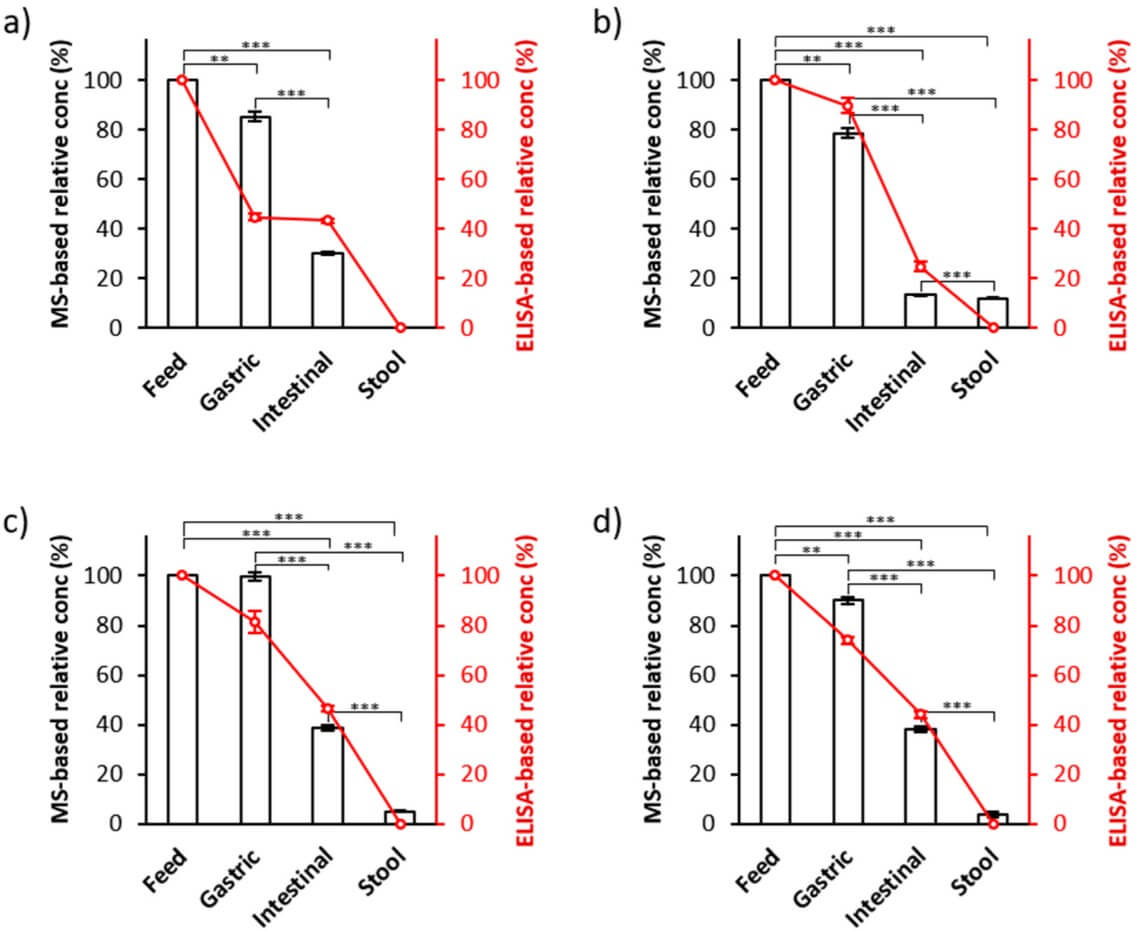 Fig.2 Quantification of antibodies in different samples by PRM-MS.2,3
FAQs
Q1: What types of samples are suitable for Creative Biolabs' PRM service?
A1: The PRM service is highly versatile and can accommodate a wide range of biological samples, including cell lysates, tissue homogenates, plasma, serum, urine, saliva, and even environmental samples such as wastewater. We'll work with you to ensure optimal sample preparation for your specific project.
Q2: How does PRM compare to traditional methods like Western Blot or ELISA for protein quantification?
A2: PRM offers superior specificity and multiplexing capabilities compared to traditional immunoassay methods. It provides single amino acid resolution, allowing for the precise quantification of specific protein isoforms and post-translational modifications, which is often not possible with antibody-based techniques. This means more accurate and detailed insights for your research.
Q3: What information do I need to provide to start a PRM project with Creative Biolabs?
A3: To get started, please provide details on your biological samples, the Uniprot IDs or amino acid sequences of your target proteins/peptides, and an overview of your experimental design and research questions. Our team will then guide you through the process and help refine your project plan.
Customer Review
Unparalleled Specificity
"Using Creative Biolabs' PRM service in our cancer biomarker discovery research has significantly improved our ability to distinguish true protein signals from complex biological backgrounds. The high-resolution data provided confidence that was unattainable with our previous methods." - Dr. G. Lew***s.
Accelerated Assay Development
"Creative Biolabs' team developed a multiplexed PRM assay for our panel of signaling proteins in record time. Their streamlined approach and expertise in method optimization drastically cut down our project timeline, allowing us to move forward with critical drug target validation much faster." - Mr. V. Wal***r.
References
-
Rauniyar, Navin. "Parallel reaction monitoring: a targeted experiment performed using high resolution and high mass accuracy mass spectrometry." International Journal of Molecular Sciences 16.12 (2015): 28566-28581. DOI: 10.3390/ijms161226120.
-
Kim, Bum Jin, et al. "Quantitative analysis of antibody survival across the infant digestive tract using mass spectrometry with parallel reaction monitoring." Foods 9.6 (2020): 759. DOI: 10.3390/foods9060759.
-
Distributed under an Open Access license CC BY 4.0, without modification.
Related Services
For Research Use Only.