Monosaccharide Composition Analysis Service for Polysaccharide
Necessity of Monosaccharide Composition Analysis in Polysaccharides
Polysaccharides are pretty important biological molecules that are everywhere in nature, doing all sorts of vital jobs for living organisms. What's interesting is that the actual mix of these monosaccharide building blocks in a polysaccharide can be quite different depending on where it comes from. For example, plant polysaccharides, animal ones, and the ones made by tiny microbes each tend to have their own sort of sugar fingerprint. Creative Biolabs has a good reputation in the field of Carbohydrate Analysis, which has been widely recognized by clients and the industry. We keep up with what's new and offer clients these pretty detailed monosaccharide analysis services to help with their research, making stuff, and other things.
Professional Monosaccharide Composition Analysis Process at Creative Biolabs
-
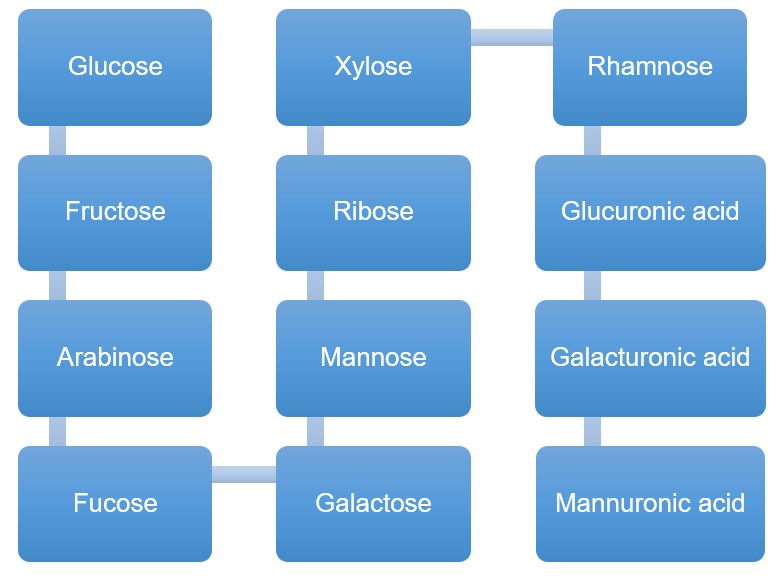
Diverse monosaccharide composition analysis
-
Professional Monosaccharide Composition Analysis Process
We perform pretreatments according to the nature of the client's sample to eliminate interference and improve the accuracy of the analysis. For example, we perform crushing and dissolution for solid samples, and purify samples to remove interfering substances.
We completely hydrolyze the sample by acid hydrolysis or enzyme hydrolysis, which breaks the glycosidic bonds of the polysaccharide and releases the monosaccharide.
-
Derivatization of monosaccharides
Most monosaccharides lack ultraviolet (UV) absorption or volatility, which are difficult to detect directly. We converted monosaccharides into derivatives with fluorescent or UV absorption characteristics to facilitate detection.
-
Separation and detection
-
High-performance liquid chromatography (HPLC): We inject the derivatized monosaccharides into HPLC and use the difference in the distribution coefficients of different monosaccharides between the stationary phase and the mobile phase to achieve the separation and quantitative analysis of monosaccharides.
-
Gas chromatography (GC): We convert monosaccharides into volatile derivatives (such as silylated derivatives) and then separate and detect them by GC.
-
Ion chromatography (IC): We directly detect neutral and acidic reducing monosaccharides through IC without derivatization.
-
Mass spectrometry (MS): We combine chromatography technology with MS to separate and quantify monosaccharides and also determine the type and connection mode of monosaccharides through the structural information provided by MS.
-
Analysis and Reporting
We professionally process the data obtained from the analysis and provide clients with detailed analysis reports, with relevant chromatograms or mass spectra attached, so that clients can verify and evaluate the results.
Technical Advantages
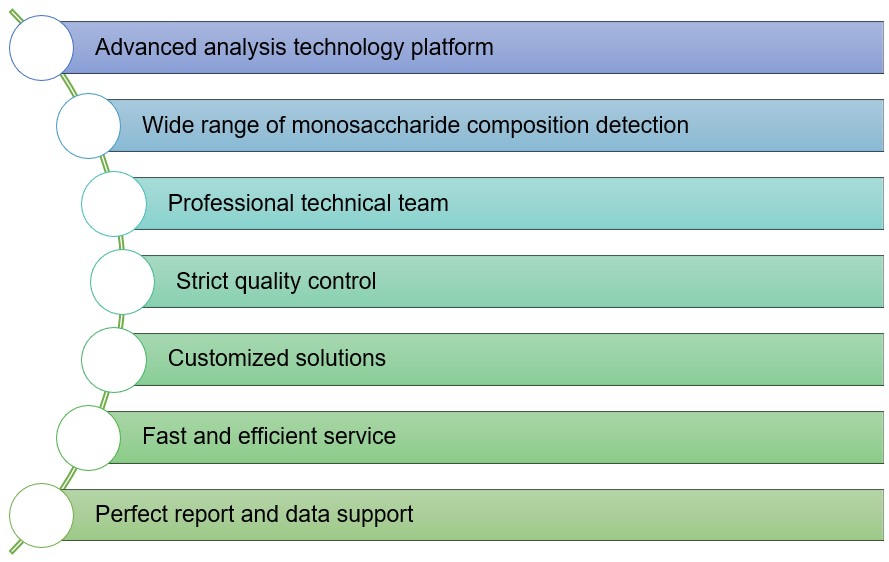
With the continuous deepening of polysaccharide research, the accuracy and sensitivity requirements for monosaccharide composition analysis for polysaccharides are also getting higher and higher. Creative Biolabs accurately reveals the monosaccharide composition of polysaccharides for clients through strict experimental procedures and advanced analysis techniques. We are committed to providing clients with high-quality analysis data and technical support to help them make breakthroughs in polysaccharide research and application. Please contact us if you want to obtain more analysis content.
Published Data
This article used Astragalus as the research object. The author introduced in detail the process of extracting, separating, and purifying polysaccharide components from Astragalus. The results showed that the author separated two polysaccharide components (APS-I and APS-II) from Astragalus. Subsequently, the author used HPLC coupled with gel permeation chromatography (HPLC-GPC) to determine the molecular weight and monosaccharide composition of these two polysaccharides. As shown in the figure below, APS-I was composed of arabinose and glucose, while APS-II contained arabinose, glucose, and rhamnose.
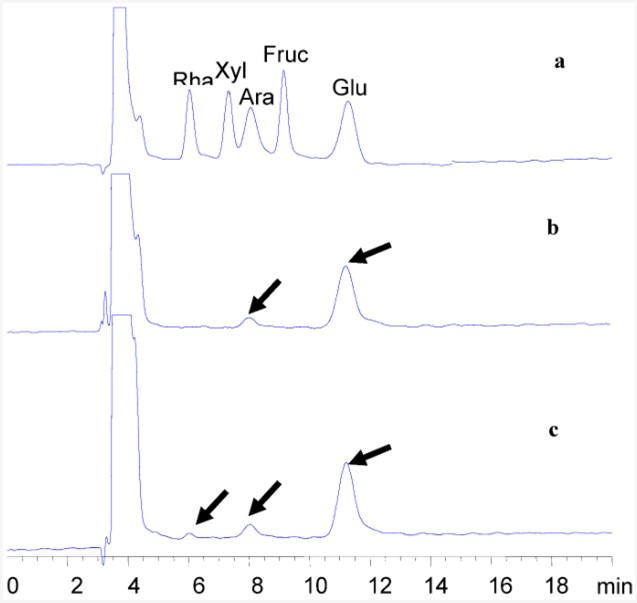 Fig.1 HPLC-RID analysis results of monosaccharide composition.1
FAQs
Q1: What kind of carbohydrate analysis services do you offer?
Q2: What types of samples can you analyze?
A2: We accept polysaccharide samples from various sources, such as plant, microbial, animal, and synthetic polysaccharides. You can send them as a dry powder, freeze-dried, or even as a liquid solution that's concentrated.
Q3: How sensitive and precise is your analysis?
A3: Our analysis methods are highly sensitive and precise. The detection limit can often get down to the nanomolar (nM) level. In addition, we use certified standards and internal standards for calibration to make sure our numbers are accurate.
Customer Review
Accuracy of the Analysis Results
"The report listed all the monosaccharide components in samples, and it also gave us a good explanation of the amounts of each sugar, which was helpful for us to understand how the polysaccharide's structure relates to what it does. It is very professional!"
Highly Recognized by the Client
"Compared to other places we've used before, the monosaccharide analysis report from Creative Biolabs was more professional and more complete, and they got it to us quickly. We were very satisfied. We're hoping to keep working with them for our future research and look forward to their continued help with things like structural analysis and understanding how things work."
Reference
-
Xu, Du-Juan, et al. "Molecular weight and monosaccharide composition of Astragalus polysaccharides." Molecules 13.10 (2008): 2408-2415. Distributed under Open Access license CC BY 3.0, without modification.
Related Services
For Research Use Only.