Soil Element & Heavy Metal Content Analysis Service
Introduction of Soil Elements and Heavy Metal Content Analysis
Soil quality is a cornerstone of environmental health, agricultural productivity, and safe land development. Heavy metals, often introduced through industrial activities or natural geological processes, can accumulate in soil, posing risks to ecosystems and human health. Concurrently, the precise balance of essential soil elements like nitrogen, phosphorus, and potassium is critical for sustainable plant growth and food security. Our soil elements and heavy metal content analysis service helps you gain unparalleled insights into soil health, mitigate environmental risks, and optimize nutrient management through a professional technical team and advanced analysis methods. Our Soil Analysis service provides the detailed analysis insights needed to understand and manage these complex soil characteristics, drawing on established methodologies and advancements in environmental monitoring and precision agriculture.
Elevating Environmental and Agricultural Precision with Creative Biolabs's Soil Analysis Service
Creative Biolabs's comprehensive soil elements and heavy metal content analysis service provides the critical data and insights necessary to make informed decisions for environmental protection, agricultural optimization, and infrastructure development. We deliver actionable solutions that range from identifying contamination hotspots and assessing soil fertility to guiding remediation strategies and enhancing crop yields. Our capabilities empower you to accurately understand soil composition, predict pollutant distribution, and implement sustainable land management practices. Creative Biolabs provides a comprehensive suite of soil analysis services tailored to meet diverse environmental and agricultural needs:
Heavy metal content analysis service
Includes the detection and quantification of toxic heavy metals such as Lead (Pb), Cadmium (Cd), Arsenic (As), Mercury (Hg), Chromium (Cr), Copper (Cu), Zinc (Zn), Nickel (Ni), and others, crucial for environmental risk assessments and regulatory compliance.
Soil nitrogen content analysis service
-
Soil total nitrogen: Measures all forms of nitrogen in the soil.
-
Soil available nitrogen: Quantifies the nitrogen readily usable by plants.
-
Soil nitrate-nitrogen: Focuses on the most common form of nitrogen absorbed by plants.
-
Soil nitrite-nitrogen: Detects an intermediate form of nitrogen.
Soil phosphorus content analysis service
-
Soil total phosphorus: Measures all phosphorus present in the soil.
-
Soil available phosphorus: Quantifies the phosphorus readily accessible to plants.
Soil potassium content analysis service
-
Soil total potassium: Measures all potassium present in the soil.
-
Soil available potassium: Quantifies the potassium readily accessible to plants.
Soil carbon content analysis service
-
Soil inert carbon: Measures stable, non-degradable carbon.
-
Soil organic carbon: Quantifies carbon from organic matter, vital for soil fertility.
Soil silicon analysis service
-
Soil total silicon: Measures all silicon in the soil.
-
Soil available silicon: Quantifies the silicon forms plant-available for uptake.
Soil boron analysis service
-
Soil total boron: Measures all boron in the soil.
-
Soil available boron: Quantifies boron forms plant-available for uptake.
Detailed Analysis Process: From Sample to Insight
The analysis process for these diverse soil elements and heavy metal content generally follows these rigorous steps:
Depending on the target analytes, samples undergo specific pre-treatment. For heavy metals, this typically involves acid digestion (e.g., using strong acids like nitric acid, hydrochloric acid, and hydrofluoric acid) to dissolve the metals into a solution. For nutrient analysis, different extraction methods are used to isolate available forms.
|
Heavy metals
|
The prepared solutions are analyzed using advanced instrumentation such as Inductively Coupled Plasma-Optical Emission Spectrometry (ICP-OES) or Inductively Coupled Plasma-Mass Spectrometry (ICP-MS). These techniques offer high sensitivity and multi-element detection capabilities, providing precise quantification of trace elements and heavy metals.
|
|
Nitrogen forms
|
Total nitrogen: Often determined using the Kjeldahl method or combustion methods (Dumas method), where nitrogen is converted to N2 and measured chromatographically.
|
|
Available nitrogen (nitrate, nitrite, ammonium): Typically extracted with specific salt solutions and then measured using colorimetric methods or ion-selective electrodes.
|
|
Phosphorus and potassium
|
Extracted available forms are often analyzed colorimetrically (for phosphorus) or using flame photometry/ICP-OES (for potassium).
|
|
Carbon
|
Organic carbon is often determined by combustion methods or wet oxidation methods. Inert carbon may require specific pretreatment.
|
|
Silicon and boron
|
They are analyzed via ICP-OES or other spectroscopic methods after appropriate digestion or extraction.
|
Throughout the analysis process, rigorous quality control measures are implemented. This includes the use of certified reference materials, method blanks, duplicates, and spiked samples to ensure the accuracy, precision, and reliability of the results.
-
Data validation and reporting
Raw data from the instruments is processed, validated against quality control criteria, and compiled into a comprehensive report. This report includes all analysis results, detection limits, and recommendations, especially when combined with geostatistical modeling.
Why Choose Us?
-
Cutting-edge technology: We invest in the latest analysis instrumentation, ensuring unparalleled accuracy and comprehensive insights into soil composition and contaminant distribution.
-
Expert team: Our specialists possess over 20 years of experience in environmental biology, analytical chemistry, and precision agriculture, providing expert consultation and interpretation of complex data.
-
Comprehensive analysis scope: From critical heavy metals to essential macro and micronutrients, our service covers a broad spectrum of soil parameters vital for diverse applications.
-
Comprehensive soil analysis solutions: We also provide a wide range of Soil Polysaccharide, Physical and Chemical Property, and Glycoproteinase Activity analysis services to provide clients with unique insights into soil health and environmental quality.
Creative Biolabs is your trusted partner. Our comprehensive soil elements and heavy metal content analysis service, backed by advanced analysis techniques and an expert team, provides the precision data you need for informed decision-making in environmental management, sustainable agriculture, and responsible development. Please contact us to discuss your specific project requirements, obtain a detailed quote, or learn more about how our advanced soil analysis solutions can benefit you.
Published Data
The article thoroughly examines the field of soil nitrogen detection, outlining both the hurdles and the advancements made. It highlights the critical importance of precisely measuring soil nitrogen levels for optimizing agricultural practices and safeguarding the environment. The paper presents an overview of diverse soil nitrogen detection methods, evaluating their respective benefits and drawbacks. It advocates for integrated research that combines detection technologies with modern innovations such as the Internet of Things (IoT) and big data analytics. Such integration is seen as vital for enabling real-time monitoring and control within agricultural systems.
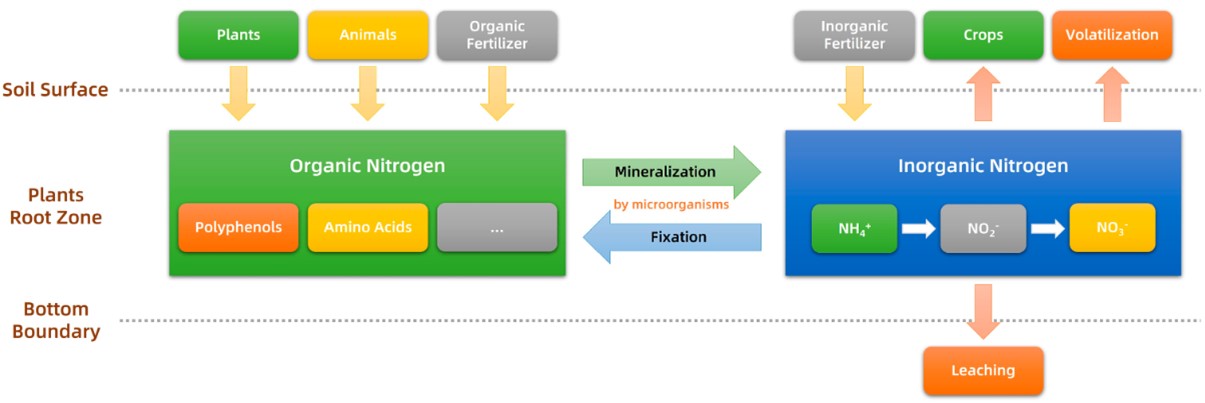 Fig.1 Sources and transformation forms of nitrogen in soil.1
FAQs
Q1: How accurate are Creative Biolabs' soil analysis results, especially for heavy metals?
A1: Our results are highly accurate and reliable, utilizing state-of-the-art analytical equipment like ICP-OES and ICP-MS, coupled with rigorous quality control protocols. This ensures precise quantification of even trace heavy metal concentrations, providing you with dependable data for critical environmental and agricultural decisions. We continuously validate our methods against international standards.
Q2: How does Creative Biolabs's approach compare to standard soil testing labs, especially for agricultural applications?
A2: While standard labs provide basic nutrient profiles, Creative Biolabs provides a more integrated and advanced solution. Our comprehensive suite includes specific forms of nitrogen (nitrate, ammonium) and detailed heavy metal analysis. This allows for a deeper understanding of soil dynamics, enabling more precise nutrient management and risk mitigation strategies than conventional bulk analysis alone.
Q3: Is your service suitable for both environmental compliance and agricultural optimization projects?
A3: Yes, our service is designed to cater to a broad range of applications. Whether you need to assess land for environmental contamination, ensure regulatory compliance for development projects, or optimize nutrient inputs for sustainable agriculture and increased crop yields, our detailed analyses and interpretive reports provide the essential insights you need. Don't hesitate to reach out to discuss your specific project needs.
Customer Review
Unmatched Accuracy
"Using Creative Biolabs's soil elements and heavy metal content analysis service in our environmental impact assessment has significantly improved the precision of our heavy metal distribution modeling. Their geostatistical mapping allowed us to pinpoint contamination zones with unprecedented accuracy, guiding our remediation efforts effectively compared to standard methods." - Ms. H. Wat***s
Enhanced Agricultural Productivity
"The detailed soil nitrogen content analysis from Creative Biolabs facilitated a targeted fertilization strategy for our vineyards, leading to visibly healthier vines and improved grape quality. Their service helped us avoid over-fertilization, a common precaution while ensuring optimal nutrient availability." - Dr. J. Morr***n
Reference
-
Liu, Jun, et al. "A review on soil nitrogen sensing technologies: challenges, progress and perspectives." Agriculture 13.4 (2023): 743. DOI: 10.3390/agriculture13040743. Distributed under an Open Access license CC BY 4.0, without modification.
Related Services
For Research Use Only.