TF, Tn & STn TACA Cancer Vaccine Development Services
Creative Biolabs provides comprehensive preclinical development services for TF, Tn, and STn carbohydrate-based cancer vaccines, covering antigen design and synthesis, carrier protein conjugation, adjuvant selection, in vitro immunogenicity profiling, in vivo efficacy evaluation, and IND-enabling support. These tumor-associated carbohydrate antigens (TACAs), arising from aberrant O-glycosylation on cancer mucins, are expressed in 50–80% of epithelial cancers—including breast, ovarian, colorectal, pancreatic, and gastric carcinomas—making them compelling targets for preclinical vaccine development. Our team offers customized workflows spanning monosaccharide/disaccharide antigen preparation, carrier coupling (KLH, CRM197, or alternative carriers), vaccine formulation, multi-level serological analysis, and integrated preclinical data packages tailored to your target indication and antigen format.
O-Glycan Truncation as a Targetable Vulnerability in Epithelial Cancers
Why Carbohydrate Antigens Offer Tumor Selectivity
Under normal conditions, O-linked glycans on mucin proteins undergo stepwise elongation beginning with a core GalNAc residue, generating complex branched structures. In cancer cells, disruptions in glycosyltransferase expression—particularly the silencing of COSMC, the chaperone required for T-synthase activity—lead to premature chain termination. The resulting truncated glycans—Tn (GalNAcα1-O-Ser/Thr), TF (Galβ1-3GalNAcα1-O-Ser/Thr), and STn (Neu5Acα2-6GalNAcα1-O-Ser/Thr)—are seldom exposed on healthy tissues yet densely displayed on tumor cell surfaces, often as clustered epitopes recognized by antibodies such as B72.3 (STn) and CC49 (TF/STn).
Clustered presentation of these antigens further enhances tumor specificity. While normal tissues may display occasional monomeric TACAs at ductal luminal surfaces—largely inaccessible to the immune system—cancer cells accumulate dense, multi-copy clusters of truncated glycans that form B-cell epitopes uniquely suited for vaccine-induced antibody targeting.
- Core Preclinical Challenges We Address:
- Overcoming the inherently low immunogenicity of monomeric Tn and TF antigens.
- Selecting optimal carrier proteins (KLH, CRM197) and conjugation chemistries.
- Designing clustered, multivalent antigen formats to boost B-cell receptor crosslinking.
- Quantifying antigen-specific IgG, IgM, and cross-reactive antibody titers in vivo.
Monomeric vs. Clustered Multivalent TACA Vaccine Design: A Feature Comparison
| Design Feature | Monomeric Single-Epitope Approach | Clustered Multivalent Antigen Display |
|---|---|---|
| Antibody Class Switching | Primarily IgM; weak IgG induction. | Robust IgG titers via enhanced BCR crosslinking. |
| Immune Tolerance Breaking | Limited; self-antigen recognition dampens response. | Multivalent spacing overrides natural tolerance mechanisms. |
| Glycosidase Stability | Vulnerable to enzymatic degradation in vivo. | Dense packing shields glycans from rapid hydrolase access. |
| Tumor Cell Binding | Moderate; low-avidity single-site interaction. | High-avidity binding mimics native tumor glycan clustering. |
Comprehensive TF, Tn & STn Vaccine Development Service Packages
Our preclinical service modules are designed to be flexible and fully customizable. Whether you need a single carbohydrate antigen synthesis or a complete vaccine construct with in vivo proof-of-concept data, every module can be tailored to your antigen structure, carrier preference, adjuvant strategy, and target cancer indication.
Antigen Structure Design & Strategy
Strategic antigen design to maximize immunogenicity and tumor selectivity for your lead candidate.
- Target Selection: Evaluation of TF, Tn, STn, and sTF as individual or combined targets.
- Epitope Clustering: Design of monomeric, dimeric, or clustered multivalent antigen formats.
- Linker Chemistry: Selection of aminooxy, thiol-maleimide, or squarate linkers for carrier conjugation.
- Structural Modification: N-acyl modification or unnatural linkage strategies to improve antigen stability.
Carbohydrate Antigen Synthesis & Characterization
Chemical and chemoenzymatic synthesis of high-purity TACA building blocks with analytical verification.
- Chemical Synthesis: Multi-step assembly of TF, Tn, STn monosaccharides and disaccharides.
- Chemoenzymatic Route: Glycosyltransferase-mediated elongation for complex glycan structures.
- Purity Analysis: HPLC, NMR, and mass spectrometry characterization for each batch.
- Glycan Quantification: Carbohydrate loading determination on carrier proteins.
Carrier Protein Conjugation & Formulation
Optimized conjugation of carbohydrate antigens to immunogenic carrier proteins with adjuvant screening.
- Carrier Selection: KLH, CRM197, BSA, TT, or nanoparticle-based carrier platforms.
- Conjugation Chemistry: Reductive amination, oxime ligation, or thiol-maleimide coupling.
- Adjuvant Screening: Evaluation of alum, QS-21 analogs, TLR agonists, or self-adjuvanting designs.
- Formulation Stability: Long-term storage condition assessment and aggregation monitoring.
In Vitro Immunogenicity Profiling
Comprehensive serological and cellular assays to characterize the vaccine-induced immune response.
- ELISA Titration: Quantitative IgG, IgM, and IgG subclass antibody titer measurement.
- Cross-Reactivity: Assessment of antibody binding to native cancer-associated glycoforms.
- FACS Binding: Flow cytometry evaluation of antisera binding to TACA-positive cancer cell lines.
- Functional Assays: Complement-dependent cytotoxicity (CDC) and ADCC reporter assays.
In Vivo Efficacy & Tumor Challenge Studies
Proof-of-concept efficacy evaluation using established preclinical tumor models.
- Prophylactic Models: Vaccination followed by syngeneic tumor cell challenge in mice.
- Therapeutic Models: Vaccine administration in tumor-bearing animals to assess growth inhibition.
- Metastasis Models: Lung metastasis quantification following intravenous tumor cell injection.
- Endpoint Analysis: Tumor volume tracking, survival curves, and TIL immunohistochemistry.
QC Documentation & IND-Enabling Data Packages
Comprehensive quality control and regulatory support for translational development.
- Analytical Characterization: SDS-PAGE, SEC-HPLC, and glycan loading quantification.
- Batch Records: Complete synthesis and conjugation documentation for reproducibility.
- Immunogenicity Reports: Compiled ELISA, FACS, CDC, and ELISpot data packages.
- Study Summaries: Integrated preclinical reports suitable for grant applications and IND filings.
Preclinical TF, Tn & STn Vaccine Development Workflow
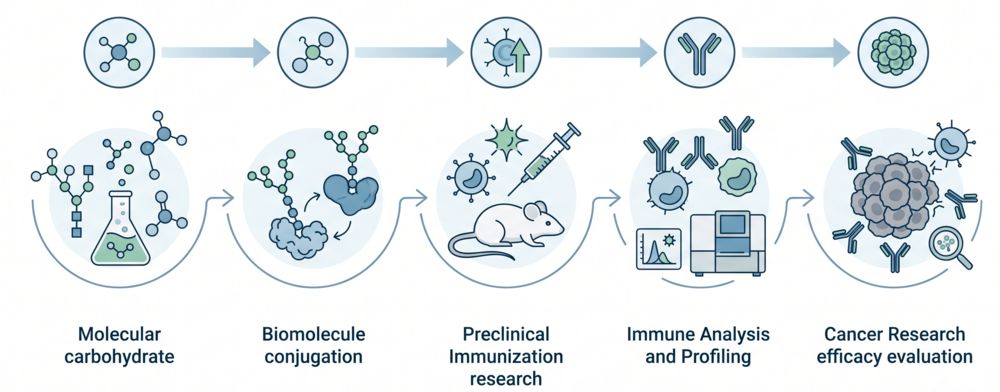
Phase 1 — Carbohydrate Antigen Design & Chemical Synthesis
We design and synthesize TF (Galβ1-3GalNAcα), Tn (GalNAcα), and STn (Neu5Acα2-6GalNAcα) building blocks using a combination of chemical synthesis and chemoenzymatic methods. Each batch is verified by NMR, HPLC, and mass spectrometry to ensure structural fidelity and purity.
Enabling Technology Platforms for Carbohydrate Vaccine Development
Why Choose Creative Biolabs for Carbohydrate Vaccine Development?
Our team brings years of focused experience in the synthesis, purification, and characterization of tumor-associated carbohydrate antigens, ensuring structurally accurate and immunologically relevant antigen preparations.
We offer KLH, CRM197, and alternative carrier platforms, allowing you to benchmark multiple conjugate formats in parallel to identify the most immunogenic construct for your target indication.
Every vaccine candidate undergoes multi-level serological analysis—ELISA IgG/IgM titers, FACS tumor cell binding, and functional CDC/ADCC assays—before advancing to in vivo efficacy studies.
From the choice of glycan structure (TF, Tn, STn, or combinations) to the preclinical tumor model and readout endpoints, every aspect of the project is configurable to your research objectives.
Research Insight: Enhancing Anti-TF Antibody Responses Through Bivalent Carbohydrate Conjugate Design
Key Findings from Preclinical Carbohydrate Vaccine Research
The Thomsen-Friedenreich (TF) antigen has long been recognized as a key TACA target, but its poor inherent immunogenicity has hindered vaccine development. Recent studies have shown that bivalent and multivalent conjugate designs can dramatically shift the antibody response from a primarily IgM-dominated profile to robust, class-switched IgG, enabling effective tumor cell recognition and complement-mediated killing.
-
Bivalent Strategy Overcomes IgM Limitation: A bivalent Tn-TF polysaccharide A1 conjugate generated high-titer IgG antibodies in C57BL/6 mice, whereas the monovalent TF conjugate produced exclusively IgM. The IgG antibodies recognized both MCF-7 breast cancer and OVCAR-5 ovarian cancer cell lines.
-
Pro-inflammatory Cytokine Shift: The bivalent construct increased IL-17 and IFN-γ production, suggesting engagement of Th17 and Th1 cellular arms in addition to humoral immunity—a profile linked to antitumor protection in preclinical models.
-
Tumor-Selective STn Expression Confirmed: Comprehensive STn profiling in pancreatic cancer tissues showed the antigen is absent from normal pancreas but highly prevalent in pancreatic ductal adenocarcinoma, with expression increasing from stage I to stage II—validating STn as a stage-relevant vaccine target.
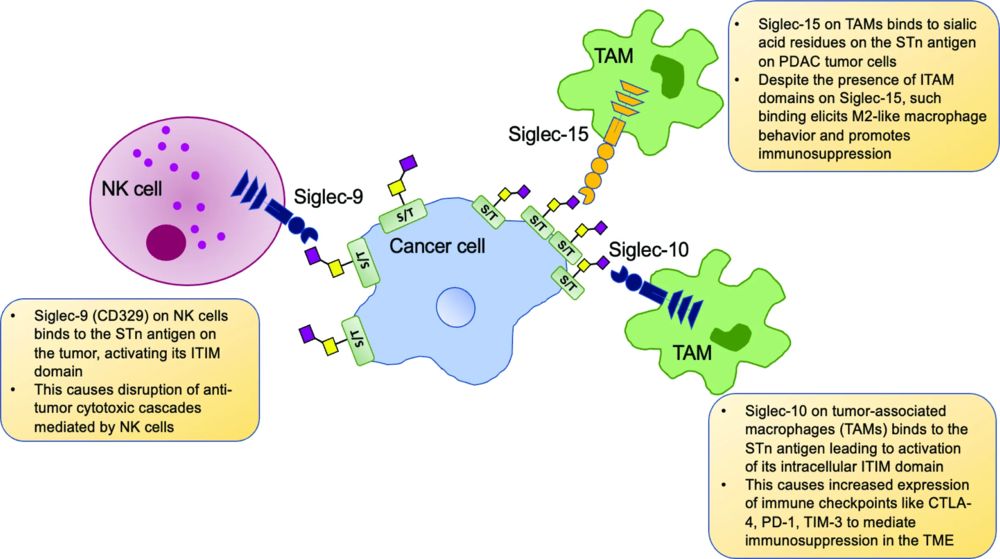
Fig.1 STn-specific interactions between tumor cells and immune cells.1,6