
Ley & Globo H Cancer Vaccine Preclinical Development Services
Creative Biolabs delivers comprehensive preclinical development services for carbohydrate-based cancer vaccines targeting two extensively validated tumor-associated carbohydrate antigens (TACAs) — Ley (Lewisy) and Globo H. Our platform covers full-service glycan antigen synthesis, carrier protein conjugation (KLH, CRM197), adjuvant optimization, and multi-tiered immunogenicity profiling, enabling researchers to advance Ley and Globo H vaccine candidates from design through preclinical proof-of-concept. We support the development of conjugate vaccines that convert inherently T-cell-independent carbohydrate epitopes into T-cell-dependent immunogens capable of eliciting antigen-specific IgM and IgG antibody responses, isotype switching, and complement-dependent cytotoxicity (CDC) against tumor cells expressing these glycan markers. Our scientists can tailor every module — from synthetic glycan chemistry and linker strategy to adjuvant selection and in vivo tumor challenge models — for your target cancer indication, including breast, ovarian, prostate, lung, colorectal, and gastric carcinomas.
Targeting Aberrant Glycosylation with Ley & Globo H Antigens
Carbohydrate Antigens as Selective Tumor Markers
Malignant transformation dramatically alters the glycosylation landscape on the cell surface. Tumor cells truncate complex glycans, overexpress unusual terminal sequences, and increase sialylation — generating a panel of TACAs that are minimally present on normal adult tissues. Ley (Fucα1→2Galβ1→4(Fucα1→3)GlcNAc) is a difucosylated type II blood group-related oligosaccharide overexpressed on the majority of epithelial carcinomas, while Globo H (Fucα1→2Galβ1→3GalNAcβ1→3Galα1→4Galβ1→4Glc) is a globo-series hexasaccharide glycosphingolipid identified on breast, ovarian, prostate, gastric, and non-small-cell lung carcinomas. Both antigens are largely restricted to the luminal border of normal secretory epithelia — a site inaccessible to circulating antibodies — making them selectively accessible immunological targets for active vaccination.
As pure carbohydrates, Ley and Globo H engage B-cell receptors but fail to recruit T-cell help, yielding weak, short-lived IgM responses without immunological memory. Covalent conjugation to immunogenic carrier proteins provides the peptide epitopes needed for MHC class II-restricted CD4+ T-cell activation, driving class switching to IgG and formation of long-lived plasma cells.
- Core Preclinical Challenges We Address:
- Achieving high-purity, scalable synthesis of Ley pentasaccharide and Globo H hexasaccharide.
- Overcoming weak carbohydrate immunogenicity through optimized carrier conjugation.
- Minimizing carrier-induced epitope suppression (CIES) through epitope ratio control.
- Quantifying both anti-carbohydrate IgM and IgG responses in vitro and in vivo.
Protein Carrier vs. Self-Adjuvanting Strategies for TACA Vaccines
| Key Comparison | Classical Protein Carrier (KLH/CRM197) | Self-Adjuvanting Carrier (MPLA/Lipid A) |
|---|---|---|
| Immunological Mechanism | Carrier-derived peptide epitopes activate CD4+ T cells, providing linked T-cell help. | TLR4-mediated innate activation triggers MyD88/TRIF signaling and co-stimulation. |
| Anti-Glycan vs. Anti-Carrier Response | Risk of dominant anti-carrier antibodies suppressing glycan-specific IgG (CIES). | No carrier competition; immune response focused on the glycan epitope. |
| Product Homogeneity | Heterogeneous hapten loading; batch-to-batch conjugate variability. | Defined 1:1 stoichiometry; routine characterization by HPLC and mass spectrometry. |
| Adjuvant Requirement | Requires co-formulation with external adjuvant (e.g., QS-21). | Single-component formulation with built-in TLR4 agonist; eliminates separate adjuvant step. |
End-to-End Ley & Globo H Vaccine Service Packages
Our preclinical services are structured into flexible, modular packages. We understand that each conjugate design is unique; therefore, all modules can be fully customized — from glycan synthesis route and linker chemistry to carrier selection and adjuvant formulation — to align with your target cancer indication and immunological goals.
Target Validation & Conjugate Design
Feasibility assessment and blueprint design for Ley or Globo H vaccine candidates.
- Glycotarget Profiling: Quantification of Ley/Globo H surface expression on client-specified tumor cell lines by flow cytometry.
- Antigen Accessibility Analysis: Confirmation of glycan epitope exposure within the tumor glycocalyx.
- Conjugate Architecture Design: Selection of linker length, spacer chemistry, and carrier attachment site.
- Feasibility Roadmap: Tailored preclinical timeline with defined go/no-go milestones.
Carbohydrate Antigen Synthesis
Chemical and chemoenzymatic production of high-purity Ley pentasaccharide and Globo H hexasaccharide.
- Glycal Assembly: Multi-step stereoselective glycal coupling for Ley/Gb5 oligosaccharide construction.
- Chemoenzymatic Fucosylation: Enzymatic α1,2-fucosylation for final glycan assembly with high regioselectivity.
- Linker Installation: Regioselective introduction of amine-reactive or thiol-reactive functional handles at the reducing end.
- Intermediate QC: NMR, HR-MS, and HPLC confirmation of each synthetic intermediate and final antigen.
Carrier Conjugation & Adjuvant Formulation
Site-selective bioconjugation of glycan antigens to carrier scaffolds with adjuvant screening.
- KLH Conjugation: Reductive amination or maleimide-thiol coupling to keyhole limpet hemocyanin.
- CRM197 Conjugation: Single-site conjugation to diphtheria toxoid CRM197 for defined hapten ratios.
- Self-Adjuvanting Conjugates: Direct conjugation of glycan to monophosphoryl lipid A (MPLA) derivatives.
- Adjuvant Screening: Head-to-head comparison of QS-21, 3D-MPL, and combination formulations.
In Vitro Immunogenicity Assessment
Rigorous serological and cellular profiling of vaccine-induced antibody responses.
- ELISA Titration: Quantification of antigen-specific IgM and IgG titers against Ley/Globo H ceramide.
- FACS Binding: Confirmation of antibody reactivity with antigen-positive tumor cell lines (e.g., MCF-7).
- CDC Assay: Complement-dependent cytotoxicity assessment against glycan-expressing target cells.
- Cross-Reactivity Screening: Specificity analysis against structurally related glycan antigens (SSEA-3, SSEA-4).
In Vivo Preclinical Efficacy Studies
Tumor challenge models to evaluate vaccine-induced tumor protection and immune memory.
- Immunization Schedule: Dose-ranging studies with defined prime-boost regimens in mouse models.
- Tumor Challenge: Prophylactic and therapeutic efficacy in syngeneic or xenograft tumor models.
- Immune Memory: Long-term monitoring of antibody persistence and recall responses.
- Combination Therapy: Evaluation of vaccine synergy with immune checkpoint inhibitors.
QC & Pre-IND Data Package
Comprehensive analytical characterization and documentation for translational development.
- Conjugate Characterization: Hapten loading determination via MALDI-TOF and SDS-PAGE analysis.
- Purity & Stability: SEC-HPLC purity assessment and accelerated stability studies.
- Serum Profiling: Detailed antibody isotype, subclass, and avidity measurements across multiple time points.
- Study Reports: Integrated preclinical data package with methodology, raw data, and statistical analysis.
Preclinical Ley & Globo H Vaccine Development Workflow
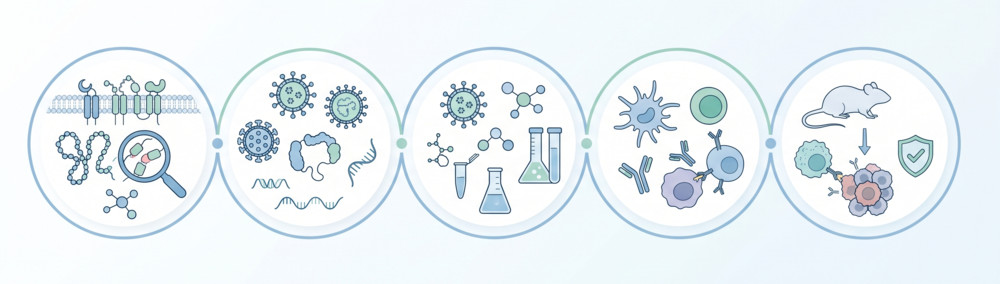
Phase 1 — Tumor Glycotarget Validation & Antigen Selection
We perform immunohistochemistry and flow cytometry profiling of Ley and/or Globo H expression on client-provided or reference tumor cell lines. This stage confirms the target glycan's surface density, epitope accessibility, and relevance to the specified cancer indication before committing to synthesis.
Enabling Chemistry Platforms for Carbohydrate Vaccine Construction
Why Partner with Creative Biolabs for Carbohydrate Vaccine Development?
Our scientists bring over a decade of synthetic carbohydrate chemistry experience, routinely assembling complex TACA structures including Ley pentasaccharide and Globo H hexasaccharide at milligram-to-gram scale.
We offer conjugation to KLH, CRM197, and self-adjuvanting lipid A scaffolds within a single workflow, enabling unbiased head-to-head immunogenicity comparison of multiple conjugate architectures.
Every conjugate is evaluated through a standardized cascade of ELISA, FACS binding, CDC, and cross-reactivity assays, ensuring data-driven selection of the lead candidate before in vivo studies.
From glycan clustering and linker chemistry to adjuvant combination screening, every module adapts to your specific antigen, cancer indication, and target immune response profile.
Research Insight: Next-Generation Globo H Vaccine Architectures
From KLH Conjugates to Self-Adjuvanting and VLP-Based Designs
Globo H has progressed further than any other TACA in clinical translation, with Globo H-KLH (adagloxad simolenin) having completed Phase II/III trials in breast cancer. Preclinical research continues to drive innovations in carrier design and adjuvant technology.
-
Self-Adjuvanting MPLA Conjugates: A fully synthetic Globo H-MPLA construct was shown to elicit robust IgG1 antibody responses and T cell-dependent immunity without external adjuvant, inducing significantly faster and stronger immune responses than the corresponding KLH conjugate.
-
Dual Adjuvant Synergy: Globo H-CRM197 formulated with the combination of QS-21 and synthetic 3D-MPL elicited robust IgG2a/IgG3 antibody responses and Th1-biased cellular immunity, with antibodies demonstrating superior CDC and antibody-dependent cellular phagocytosis against MCF-7 breast cancer cells.
-
Ley Epitope Clustering: Preclinical studies demonstrated that a clustered Ley construct bearing three contiguous Ley-serine epitopes conjugated to KLH plus QS-21 adjuvant generated both IgG and IgM antibodies reacting with tumor cells, establishing clustered presentation as a viable strategy for carbohydrate vaccine optimization.
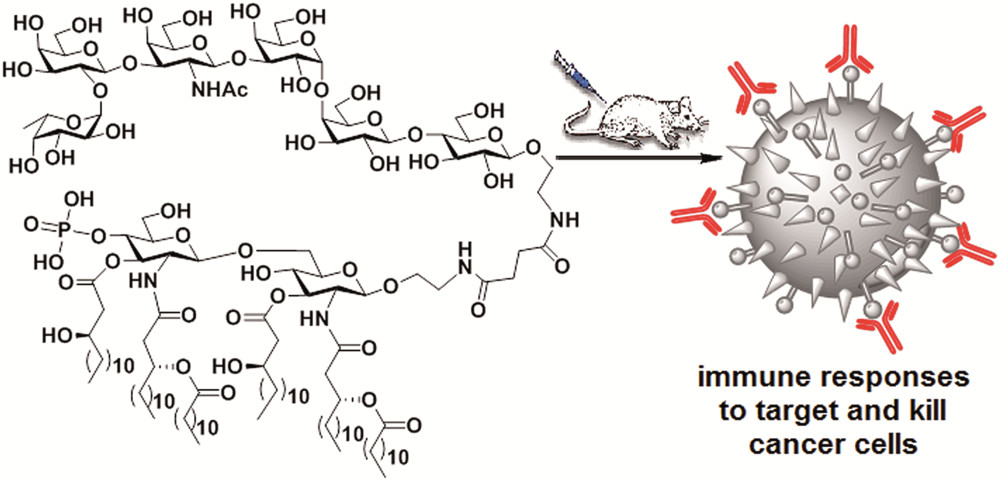
Fig.1 Self-adjuvanting MPLA–Globo H conjugate induces T cell-mediated antitumor immunity.1,3