
IDO1-Targeting Cancer Vaccine & TME Reprogramming Development
Creative Biolabs provides comprehensive preclinical development services for IDO-targeting therapeutic vaccines designed to overcome tumor-induced immune tolerance. Indoleamine 2,3-dioxygenase (IDO) is a heme-containing enzyme that catalyzes the rate-limiting step in tryptophan catabolism along the kynurenine pathway, creating an immunosuppressive tumor microenvironment (TME) through tryptophan depletion and kynurenine accumulation. Our services span IDO epitope identification, peptide vaccine design, in vitro T-cell response validation, in vivo efficacy evaluation in syngeneic tumor models, and combination strategy assessment with checkpoint inhibitors or chemotherapy. Whether you are targeting IDO-expressing tumor cells directly or seeking to reprogram immunosuppressive myeloid compartments, our team delivers customized workflows backed by deep expertise in tumor immunology and metabolic immune regulation.
Targeting IDO to Reverse Tumor Immune Evasion
The Metabolic Gatekeeper of Immune Tolerance
IDO is an evolutionarily ancient immunoregulatory enzyme that degrades the essential amino acid tryptophan into kynurenine and downstream metabolites. Under physiological conditions, IDO maintains peripheral tolerance and controls excessive inflammation. However, tumors co-opt this pathway aberrantly: IDO overexpression in the TME and tumor-draining lymph nodes depletes local tryptophan, activating the GCN2 stress-response kinase in effector T cells and driving cell cycle arrest, while accumulating kynurenine engages the aryl hydrocarbon receptor (AhR), promoting regulatory T cell (Treg) differentiation and suppressing effector T-cell function. This dual mechanism creates an immune-privileged niche that facilitates tumor escape.
Unlike small-molecule IDO inhibitors that only block enzymatic activity, IDO-targeting vaccines induce IDO-specific T cells that directly kill IDO-expressing immunosuppressive cells—including tumor cells, tolerogenic dendritic cells, and MDSCs—regardless of whether the tumor itself expresses IDO or has low HLA expression. This broadens the therapeutic applicability beyond what traditional tumor-antigen-specific vaccines can achieve.
- Core Preclinical Challenges We Address:
- Identifying immunogenic IDO-derived epitopes that elicit robust T-cell responses.
- Designing vaccine constructs that overcome self-tolerance to IDO as a non-mutated antigen.
- Evaluating combinatorial efficacy with checkpoint blockade in in vivo models.
- Monitoring TME remodeling: Treg reduction, CD8+ T-cell infiltration, cytokine profiling.
IDO Vaccines vs. Conventional IDO Inhibitors
| Key Comparison | Small-Molecule IDO Inhibitors | IDO-Targeting Therapeutic Vaccines |
|---|---|---|
| Mechanism of Action | Blocks enzymatic activity only; tryptophan depletion and kynurenine signaling may persist via TDO2/IDO2 compensation. | Induces IDO-specific T cells that directly eliminate IDO+ immunosuppressive cells. |
| Tumor HLA Dependence | Indirect; relies on restoring endogenous anti-tumor immunity without antigen-specific targeting. | Effective even in tumors with low HLA expression or no IDO expression on tumor cells. |
| Immune Reprogramming | Passive metabolic normalization; does not actively recruit pro-inflammatory T cells. | Actively recruits pro-inflammatory T cells to the TME; releases cytokines that reprogram the immune landscape. |
| Durability & Combination Potential | Continuous drug dosing required; ECHO-301 Phase III failed to show synergy with anti-PD-1 in melanoma. | Induces immunological memory; synergizes with checkpoint blockade in preclinical models. |
End-to-End IDO Vaccine Development Service Packages
Our preclinical services are organized into modular packages covering every stage from epitope discovery to in vivo efficacy. Each module can be customized to match your specific tumor indication, antigen format, and combination strategy. Whether you need a single service or an integrated end-to-end program, we adapt to your research goals.
IDO Epitope Identification & Validation
Systematic screening of IDO1-derived peptide epitopes to identify immunogenic candidates that overcome self-tolerance.
- In Silico Prediction: HLA binding affinity and immunogenicity scoring across MHC class I and II alleles.
- Peptide Library Design: Overlapping peptide pools spanning the full IDO1 protein sequence.
- T-Cell Screening: In vitro IFN-γ ELISpot using healthy donor PBMCs to confirm epitope immunogenicity.
- Epitope Ranking: Prioritization based on T-cell response magnitude and cross-reactivity safety profile.
Vaccine Construct Engineering
Design and synthesis of vaccine formulations optimized for immunogenicity and TME-specific targeting.
- Peptide Vaccine Format: Long-peptide constructs with helper T-cell epitopes and linker optimization.
- Adjuvant Screening: Evaluation of TLR agonists and emulsion-based adjuvants for Th1 polarization.
- DNA/mRNA Constructs: Codon-optimized IDO1-encoding vectors for intracellular antigen expression.
- Formulation Development: Liposomal or nanoparticle delivery systems to enhance lymph node targeting.
In Vitro T-Cell Response Evaluation
Comprehensive immunological assessment of vaccine-induced IDO-specific T-cell activation.
- ELISpot Assays: IFN-γ and Granzyme B secretion quantification after peptide stimulation.
- Intracellular Cytokine Staining: Multi-parameter flow cytometry for CD4+/CD8+ T-cell profiling.
- Cytotoxicity Assays: killing of IDO-expressing target cells (tumor cells, DCs) by vaccine-primed T cells.
- Treg Suppression Assay: Evaluation of IDO-specific T cells on Treg suppressive function in vitro.
In Vivo Efficacy & TME Profiling
Tumor-bearing mouse model studies to evaluate therapeutic efficacy and immune microenvironment remodeling.
- Syngeneic Tumor Models: B16F10 melanoma, CT26 colon carcinoma, and syngeneic colorectal carcinoma platforms.
- Tumor Growth Monitoring: Volume tracking, survival analysis, and body weight recording.
- Immune Infiltrate Analysis: Flow cytometry profiling of TILs, Tregs, MDSCs, and DCs post-vaccination.
- TME Cytokine Profiling: Multiplex quantification of pro- and anti-inflammatory cytokines in tumor lysates.
Combination Strategy Assessment
Preclinical evaluation of IDO vaccines combined with checkpoint inhibitors, chemotherapy, or other immunotherapies.
- Checkpoint Combination: IDO vaccine + anti-PD-1/PD-L1 dosing schedule optimization and synergy assessment.
- Chemo-Immunotherapy: Evaluation of chemotherapy-induced immunogenic cell death synergizing with IDO vaccination.
- Dual-Target Vaccines: Co-formulation with PD-L1-targeting peptides for combinatorial immunosuppression blockade.
- Biomarker Discovery: IDO1 expression, Kyn/Trp ratio, and immune infiltration as predictive biomarkers.
Quality Control & Data Package
Comprehensive quality assurance and integrated data reporting for translational research support.
- Peptide QC: Purity verification by HPLC and identity confirmation by mass spectrometry.
- Immunogenicity Certificate: Standardized ELISpot and flow cytometry data with batch controls.
- Study Reports: Full in vivo study protocols, raw data, statistical analysis, and interpretation.
- Translational Support: Biomarker strategy consultation and IND-enabling data package preparation.
Preclinical IDO Vaccine Development Workflow
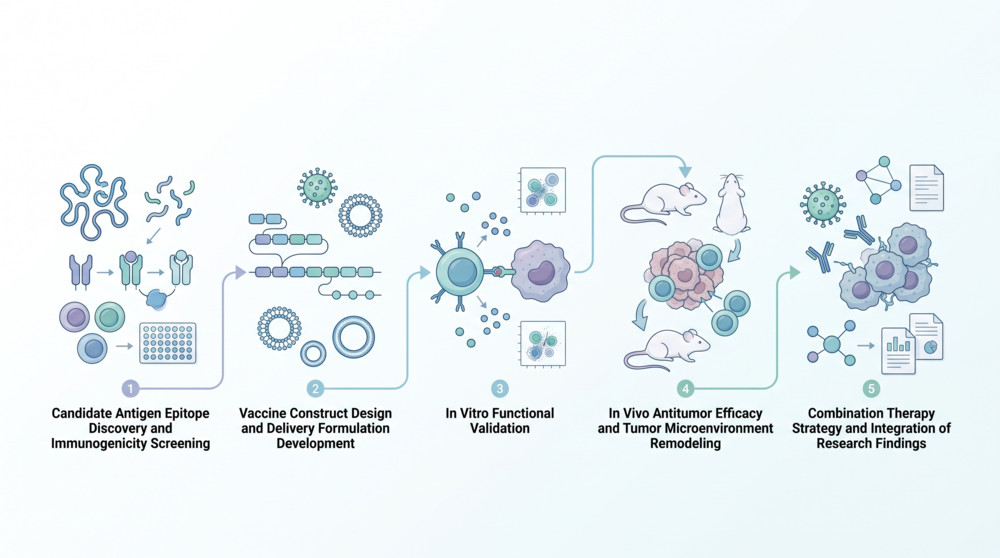
Phase 1 — IDO Epitope Discovery & Immunogenicity Screening
We perform computational prediction of HLA-binding IDO1-derived peptides across multiple alleles, followed by overlapping peptide library synthesis. Each candidate is screened in vitro using IFN-γ ELISpot with healthy donor PBMCs to identify epitopes that elicit robust T-cell responses despite IDO being a self-antigen.
Enabling Technologies for IDO Vaccine Development
Why Choose Creative Biolabs?
Our scientists possess extensive knowledge of tryptophan-catabolism pathways, IDO1/IDO2/TDO2 biology, and the metabolic-immune interface in the tumor microenvironment.
We combine T-cell functional assays with tryptophan-kynurenine metabolomics to provide dual pharmacodynamic evidence of IDO pathway disruption.
From dual-target IDO/PD-L1 vaccines to chemo-immunotherapy schedules, we design and execute combination studies tailored to your therapeutic hypothesis.
From peptide synthesis and in vitro screening to in vivo efficacy and IND-enabling data packages, we deliver a streamlined workflow under one roof.
Research Insight: IDO Vaccines Reprogram the Tumor Microenvironment
Key Preclinical Findings on IDO-Targeting Vaccines
Preclinical studies of IDO-specific peptide vaccines have demonstrated remarkable efficacy in both IDO-secreting and non-IDO-secreting tumor models, confirming the broad applicability of this approach beyond direct tumor targeting.
-
Efficacy Independent of Tumor IDO Expression: IDO peptide vaccines significantly inhibited tumor progression and prolonged survival in B16F10 melanoma (IDO-expressing) and TC-1 (non-IDO-expressing) models, confirming that IDO-specific T cells target IDO+ host immunosuppressive cells in the TME rather than tumor cells alone.
-
Dual Mechanism of Action: IDO-specific T cells modulate the TME by releasing pro-inflammatory cytokines that recruit and activate additional immune effector cells, while simultaneously directly killing immunosuppressive IDO+ target cells including tolerogenic DCs and MDSCs.
-
Synergy with Checkpoint Blockade: In preclinical tumor models, combining IDO1 and PD-L1 peptide vaccines cooperatively reduced tumor growth through distinct molecular pathways—the IDO1 vaccine predominantly reduced myeloid-derived immune suppression, while the PD-L1 vaccine enhanced T-effector function, supporting a dual-antigen approach.
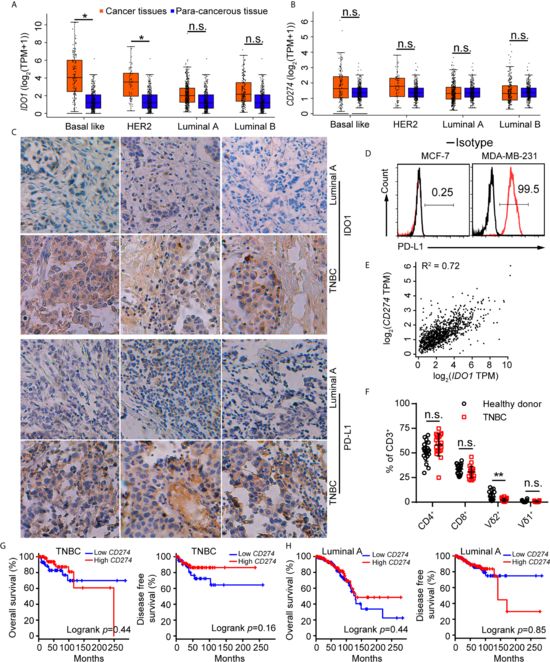
Fig.1 Co-expression of IDO1 and PD-L1 in triple-negative breast cancer.1,4