N-Acyl-Modified Polysialic Acid Cancer Vaccine Development
Creative Biolabs provides end-to-end preclinical development services for polysialic acid (PSA)-based cancer vaccines, covering antigen identification and characterization, chemical modification of sialic acid precursors, glycoconjugate synthesis, carrier protein conjugation, adjuvant screening, immunogenicity evaluation, and in vivo efficacy studies. This solution is suitable for researchers targeting oncofetal carbohydrate antigens expressed on tumors such as small cell lung cancer, neuroblastoma, Wilms' tumor, and rhabdomyosarcoma. Our scientists can provide customized study strategies, assay development, quality control, data interpretation, and integrated preclinical packages tailored to your tumor indication, antigen format, and translational goals.
Targeting Polysialic Acid to Disrupt Tumor Metastasis
The Oncofactal Antigen Driving Tumor Invasion
Polysialic acid (PSA) is a linear homopolymer of α2,8-linked sialic acid residues attached to the neural cell adhesion molecule (NCAM). During embryonic development, PSA is abundantly expressed, but in adults its presence is largely restricted to a few discrete neural tissues. However, PSA reappears on the surface of multiple tumor types—including small cell lung cancer (SCLC), neuroblastoma, Wilms' tumor, and rhabdomyosarcoma—where it attenuates NCAM-mediated cell adhesion and promotes tumor cell detachment, migration, and metastasis. This oncofetal expression pattern makes PSA a compelling target for cancer vaccine development.
Because PSA is a self-carbohydrate expressed during embryogenesis, the human immune system exhibits limited reactivity against it. Creative Biolabs addresses this through N-acyl modification strategies—particularly N-propanoylation—which generate a non-self antigen (NPr-PSA) capable of eliciting robust antibody responses while retaining cross-reactivity with native tumor-expressed PSA.
- Core Preclinical Challenges We Address:
- Overcoming immune tolerance to self-carbohydrate antigens.
- Optimizing N-acyl modification to maximize immunogenicity.
- Selecting carrier proteins and adjuvants for T-cell-dependent responses.
- Quantifying anti-PSA antibody titers and tumor cell reactivity in vitro and in vivo.
Why N-Acyl-Modified PSA Outperforms Native Polysialic Acid Vaccines?
| Key Comparison | Native PSA Conjugate Vaccines | N-Acyl-Modified PSA Vaccines |
|---|---|---|
| Immune Tolerance Breakthrough | Recognized as self; weak IgM response only. | N-acyl groups create non-self epitopes that break tolerance. |
| Antibody Response Quality | Inconsistent IgM; minimal IgG class switching. | Consistent high-titer IgM and IgG with cross-reactivity to native PSA. |
| Tumor Cell Reactivity | Limited binding to PSA-expressing tumor lines. | Post-immunization sera bind SCLC and neuroblastoma cells. |
| Metabolic Engineering Potential | Cannot be biosynthetically incorporated. | Modified sialic acid precursors enable selective tumor surface display. |
End-to-End Polysialic Acid Vaccine Service Packages
Our preclinical services are structured into flexible, modular packages. We understand that every project is unique; therefore, all modules can be fully customized—from N-acyl modification chemistries to carrier protein selection and adjuvant pairing—to align with your therapeutic targets and tumor indications.
PSA Target Discovery & Expression Profiling
Comprehensive identification and characterization of PSA expression across tumor types and patient-derived samples.
- Tumor Screening: Immunohistochemical profiling of PSA-NCAM in SCLC, neuroblastoma, Wilms' tumor, and rhabdomyosarcoma.
- Expression Quantification: Flow cytometry and Western blot analysis of PSA chain length and density on tumor cell lines.
- NCAM Isoform Mapping: Identification of embryonic vs. adult NCAM isoforms carrying polysialylation.
- Metastasis Correlation: Assessment of PSA expression levels relative to invasion and metastatic potential.
Chemical Modification & Glycoconjugate Synthesis
Rational design and synthesis of N-acyl-modified PSA antigens to overcome self-tolerance and enhance immunogenicity.
- N-Propanoylation: Conversion of N-acetyl to N-propanoyl groups on sialic acid residues to generate non-self epitopes.
- Polymer Length Control: Tuning degree of polymerization (DP 8–90+) to match tumor-associated PSA chain lengths.
- Alternative N-Acyl Groups: Exploration of N-butanoyl and other acyl modifications for enhanced immune recognition.
- Purity Characterization: Anion-exchange chromatography and NMR confirmation of modification efficiency.
Carrier Protein Conjugation & Formulation
Strategic conjugation of modified PSA to immunogenic carrier proteins to convert T-independent antigens into T-dependent responses.
- Carrier Selection: Evaluation of keyhole limpet hemocyanin, tetanus toxoid, and CRM197 as carrier proteins.
- Linker Chemistry: Optimization of spacer molecules and conjugation sites for antigen density and stability.
- Adjuvant Pairing: Screening of immunological adjuvants to enhance IgG class switching and memory B-cell formation.
- Formulation Stability: Physicochemical stability testing of final conjugate vaccine formulations.
Metabolic Glycoengineering Strategy
Biochemical engineering of tumor cell surface PSA to enable selective immune targeting through modified sialic acid precursors.
- Precursor Design: Synthesis of N-propanoyl-D-mannosamine (NPrMan) and related sialic acid precursors.
- Metabolic Incorporation: In vitro validation of precursor uptake and biosynthetic incorporation into cell surface glycans.
- Selectivity Assessment: Differential display analysis comparing NPr-PSA on tumor vs. normal cells.
- Immunotargeting Validation: Antibody-mediated recognition of metabolically engineered NPr-PSA on tumor surfaces.
Comprehensive Immunogenicity Evaluation
Multi-level assessment of vaccine-induced humoral and cellular immune responses against PSA-expressing tumors.
- Antibody Profiling: ELISA-based quantification of IgM and IgG titers against NPr-PSA and native PSA.
- Tumor Cell Binding: Flow cytometry confirmation of antibody reactivity with SCLC and neuroblastoma cell lines.
- Complement Activation: Complement-dependent cytotoxicity (CDC) assays to evaluate tumor cell killing.
- Cross-Reactivity Analysis: Assessment of antibody cross-reactivity between modified and native PSA epitopes.
In Vivo Efficacy & IND-Enabling Services
Translational efficacy studies and comprehensive data packages to support preclinical advancement of PSA vaccine candidates.
- Tumor Model Selection: Syngeneic and xenograft models for PSA-expressing tumors (SCLC, neuroblastoma).
- Efficacy Studies: In vivo assessment of tumor growth inhibition, metastasis reduction, and survival benefit.
- Immune Monitoring: Serial bleeding for antibody titer kinetics and tumor-infiltrating immune cell analysis.
- Safety Profiling: Local reactogenicity, systemic toxicity, and neuropathology evaluation for IND support.
Optimized Preclinical Polysialic Acid Vaccine Development Workflow
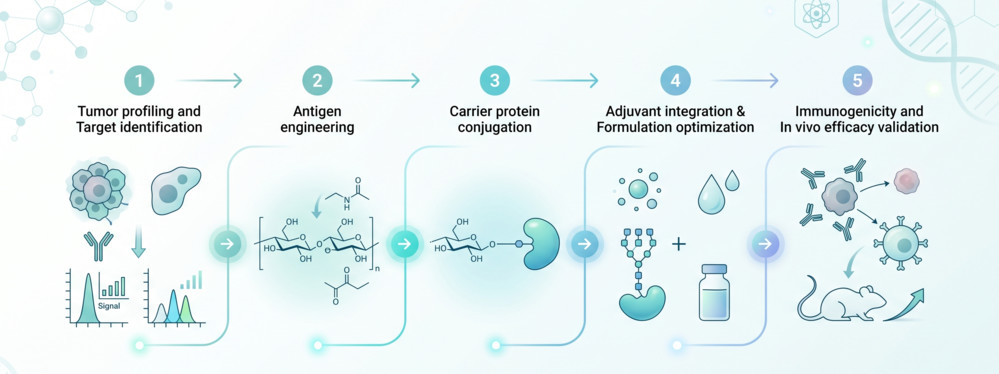
Phase 1 — PSA Expression Identification & Tumor Profiling
We begin by screening tumor cell lines and patient-derived samples for PSA-NCAM expression using monoclonal antibody-based immunohistochemistry and flow cytometry. This stage confirms target relevance and establishes baseline expression data across tumor types including SCLC, neuroblastoma, and rhabdomyosarcoma.
Enabling Technologies for High-Potency PSA Vaccines
Why Choose Creative Biolabs?
Our scientists possess deep experience in glycoconjugate vaccine design, from carbohydrate antigen synthesis to carrier protein conjugation chemistry and adjuvant selection.
Our platform combines chromatographic separation, mass spectrometry, and immunological assays to ensure batch-to-batch consistency and structural confirmation of modified PSA antigens.
From N-propanoylation to alternative N-acyl modifications, we offer fully flexible chemical engineering approaches tailored to your immune tolerance-breaking strategy.
We provide complete documentation and rigorous QC for every step, from antigen synthesis to in vivo efficacy, offering a streamlined path to preclinical data packages.
Research Insight: N-Propionylated PSA Vaccines for Small Cell Lung Cancer
Key Findings from Preclinical & Translational Studies
PSA is extensively expressed on the surface of small cell lung cancer (SCLC) cells, and its inhibitory effect on cell adhesion is closely linked to the aggressive metastatic behavior of this malignancy. Research on N-propionylated PSA (NPr-PSA) conjugate vaccines has demonstrated promising strategies for breaking immune tolerance and generating anti-tumor antibody responses.
-
Breaking Self-Tolerance: Vaccination with NPr-PSA conjugated to carrier proteins elicited consistent high-titer IgM antibodies in all evaluated subjects, while unmodified PSA failed to generate reliable immune responses.
-
Cross-Reactivity with Tumor Cells: Post-vaccination sera demonstrated strong reactivity with human SCLC cell lines by flow cytometry, confirming that antibodies raised against NPr-PSA cross-react with native PSA on tumor surfaces.
-
Metabolic Engineering Approach: Biochemical engineering of surface PSA using modified sialic acid precursors achieved selective immunotargeting—NPr-PSA was displayed on tumor cells while remaining distinguishable from native PSA on normal tissues.
-
Polysialyltransferase as Therapeutic Target: ST8SiaII and ST8SiaIV, the enzymes responsible for PSA biosynthesis, have been validated as promising targets for anti-metastatic strategies, complementing vaccine-based approaches.
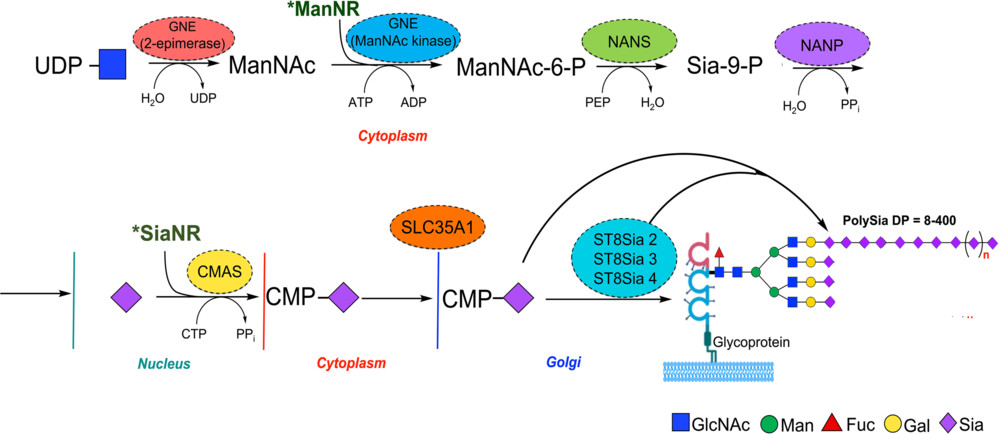
Fig.1 Schematic overview of mammalian polysialic acid (polySia) biosynthesis.1,4