
ARG1-Targeting Cancer Vaccine & Myeloid TME Reprogramming
Creative Biolabs provides comprehensive preclinical development services for arginase-targeting cancer vaccines designed to eliminate arginase-expressing immunosuppressive myeloid cells within the tumor microenvironment. Arginase, particularly arginase-1 (ARG1), is a binuclear manganese metalloenzyme that hydrolyzes L-arginine to L-ornithine and urea. In tumors, ARG1-expressing myeloid-derived suppressor cells (MDSCs) and tumor-associated macrophages (TAMs) deplete extracellular L-arginine, causing downregulation of the CD3ζ chain, T cell cycle arrest, and impaired effector function. Our arginase vaccine approach activates arginase-specific T cells that selectively kill ARG1-expressing suppressor cells, restoring L-arginine availability and inducing Th1 inflammation at tumor sites. This solution covers epitope discovery, vaccine construct design, in vitro T cell response evaluation, in vivo efficacy testing, combination strategy assessment, and quality control for researchers developing immune-modulatory vaccines against myeloid-driven immunosuppression.
Targeting Arginase to Reverse Myeloid-Driven Immunosuppression
The L-Arginine–Arginase Immunosuppressive Axis
Two isoforms of arginase exist in mammals: ARG1, a cytosolic enzyme predominantly expressed in the liver, and ARG2, a mitochondrial enzyme found in kidney, brain, small intestine, and macrophages. In the tumor microenvironment (TME), ARG1 is highly expressed by MDSCs, TAMs, and neutrophils recruited or educated by tumor-derived factors. These cells consume extracellular L-arginine at high rates, depriving T cells of an amino acid essential for proliferation, survival, and cytokine production. The resulting L-arginine depletion causes downregulation of CD3ζ, blockade of T cell cycle progression at G0–G1, and reduced IFN-γ and granzyme B secretion—collectively defining the "excluded" tumor phenotype where CD8+ T cells are prevented from entering the tumor parenchyma.
Unlike small-molecule arginase inhibitors that reversibly block enzymatic activity, an arginase-specific vaccine actively recruits the immune system to eliminate ARG1-expressing suppressor cells. This approach not only restores local L-arginine levels but also induces durable Th1 inflammation and immunological memory that persists beyond the treatment period.
- Core Preclinical Challenges We Address:
- Identifying immunodominant arginase epitopes across diverse HLA types.
- Breaking immune tolerance to the self-antigen arginase.
- Achieving selective T cell killing of ARG1+ MDSCs without systemic toxicity.
- Evaluating TME remodeling and Th1 inflammation shift after vaccination in vivo.
Arginase Vaccine vs. Small-Molecule Arginase Inhibitors
| Key Comparison | Small-Molecule Arginase Inhibitors | Arginase-Targeting Vaccine |
|---|---|---|
| Mechanism of Action | Reversible enzymatic activity blockade; suppressor cells remain intact. | Active immune-mediated elimination of ARG1-expressing suppressor cells. |
| Target Cell Elimination | No direct killing; ARG1+ MDSCs and TAMs persist and may rebound after dosing. | CD8+ and CD4+ T cells directly kill ARG1+ MDSCs and TAMs. |
| Immune Memory | No adaptive memory; efficacy ceases upon drug withdrawal. | Long-lived T cell memory provides sustained immunosurveillance. |
| TME Remodeling | Limited; immunosuppressive architecture largely unchanged. | Shifts M1/M2 macrophage ratio and drives Th1 inflammation at tumor site. |
End-to-End Arginase Vaccine Service Packages
Our preclinical services are structured into flexible, modular packages. We understand that every project is unique; therefore, all modules can be fully customized—from epitope selection to vaccine format and combination partners—to align with your therapeutic goals and tumor indications.
Epitope Discovery & Immunogenicity Mapping
Identification of arginase-derived T cell epitopes that activate both CD4+ and CD8+ T cell responses against ARG1-expressing suppressor cells.
- Hot-Spot Mapping: Identification of immunological hot-spot regions in ARG1 sequence recognized by T cells.
- HLA Binding Prediction: In silico ranking of candidate peptides across multiple HLA alleles.
- Immunopeptidomics: Mass spectrometry-based validation of naturally presented ARG1-derived MHC ligands.
- T cell Recognition Assays: Screening of donor PBMCs for spontaneous arginase-specific T cell responses.
Vaccine Construct Design & Production
Multi-format vaccine assembly to maximize immunogenicity and target the specific biology of arginase-expressing myeloid cells.
- Peptide Vaccine: Long-peptide formulation (20-mer) from ARG1 hot-spot regions with adjuvant pairing.
- Nucleic Acid Vaccines: mRNA and DNA constructs encoding ARG1 epitopes for endogenous processing.
- Adjuvant Optimization: Screening of emulsion-based and TLR agonist adjuvants for Th1 polarization.
- Multivalent Constructs: Design of combined ARG1/IDO epitope vaccines for synergistic TME modulation.
In Vitro T Cell Response Evaluation
Functional assessment of vaccine-induced arginase-specific T cells to confirm specific recognition and killing of ARG1+ suppressor cells.
- ELISpot Assays: IFN-γ and TNF-α secretion profiling against ARG1 peptide pools.
- Intracellular Cytokine Staining: Flow cytometric quantification of CD4+ and CD8+ arginase-specific T cells.
- Cytotoxicity Assays: Co-culture of vaccine-primed T cells with ARG1-expressing MDSCs or TAMs.
- Suppression Reversal: Measurement of T cell proliferation restoration after ARG1+ cell elimination.
In Vivo Efficacy & TME Analysis
Syngeneic tumor model evaluation of anti-tumor immunity, immune cell infiltration, and microenvironment remodeling following vaccination.
- Tumor Growth Inhibition: Vaccination in multiple syngeneic mouse tumor models with survival tracking.
- Immune Cell Profiling: Flow cytometry quantification of TILs, MDSCs, and TAM M1/M2 ratio post-vaccination.
- Arginase Expression Monitoring: IHC and qPCR tracking of ARG1 expression in tumor-infiltrating myeloid cells.
- L-Arginine Quantification: Metabolomic measurement of intratumoral L-arginine levels after treatment.
Combination Strategy Assessment
Preclinical evaluation of arginase vaccine combinations with checkpoint inhibitors, IDO vaccines, or arginase inhibitors for synergistic activity.
- Checkpoint Inhibitor Synergy: Combination with anti-PD-1/PD-L1 in in vivo models.
- IDO Vaccine Combination: Dual-targeting of ARG1 and IDO epitopes to exploit Th1-driven IDO induction.
- Enzyme Inhibitor Plus Vaccine: Assessment of concurrent arginase inhibition and vaccination.
- Dose-Schedule Optimization: Rational sequencing and dosing for maximal TME remodeling.
Quality Control & Translational Data Package
Comprehensive characterization and documentation to support translational advancement of arginase vaccine candidates.
- Peptide Quality: Purity, identity, and stability testing for peptide vaccine lots.
- Immunopotency Assays: Standardized T cell activation readouts for batch-to-batch consistency.
- Safety Profiling: In vitro and in vivo toxicity assessment including systemic cytokine monitoring.
- Translational Documentation: Integrated data packages with mechanism-of-action and efficacy summaries.
Preclinical Arginase Vaccine Development Workflow
Phase 1 — Arginase Epitope Identification & Validation
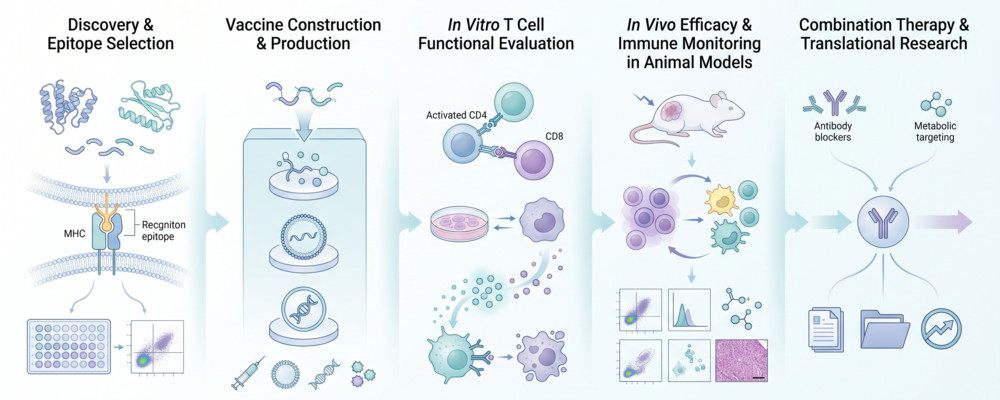
We identify immunological hot-spot regions within the ARG1 protein sequence that are spontaneously recognized by T cells. Candidate peptides are ranked in silico for HLA binding affinity and validated through immunopeptidomics to confirm natural MHC presentation. Donor PBMC screening identifies peptides that elicit arginase-specific T cell responses.
Enabling Technologies for Arginase Vaccine Development
Why Choose Creative Biolabs?
Our team has extensive experience developing vaccines that target immunosuppressive enzymes including arginase, IDO, and TDO, with deep understanding of T cell-mediated elimination of suppressor cells.
Specialized capabilities in MDSC and TAM characterization, isolation, and functional assays ensure accurate evaluation of vaccine-induced myeloid cell elimination and TME remodeling.
Proven expertise in designing dual-targeting vaccine constructs (e.g., ARG1/IDO) and combination regimens with checkpoint inhibitors for enhanced therapeutic outcomes.
From epitope discovery through in vivo efficacy and translational data packaging, our streamlined workflow ensures continuity, traceability, and rigorous quality control at every step.
Research Insight: Arginase-Targeting Vaccines Reprogram the Tumor Microenvironment
Key Findings from Preclinical and Early-Phase Studies
Arginase-targeting therapeutic vaccines represent a novel class of immune-modulatory cancer therapy that leverages endogenous T cell immunity to eliminate ARG1-expressing immunosuppressive myeloid cells. Research has demonstrated both the biological rationale and translational potential of this approach.
-
Robust T Cell Induction: In a phase I trial of ARG1 peptide vaccination in metastatic solid tumors, 90% of patients developed measurable peptide-specific T cell responses, with both CD4+ and CD8+ arginase-specific T cells detected in peripheral blood.
-
TME Remodeling: Preclinical syngeneic models demonstrated that ARG1-targeting vaccines increased T cell infiltration, decreased ARG1 expression, reduced suppressive function of tumor-educated myeloid cells, and shifted the M1/M2 macrophage ratio toward a proinflammatory phenotype.
-
Synergy with Checkpoint Blockade: Combination of ARG1 vaccines with anti-PD-1 resulted in enhanced tumor control compared to either monotherapy, supporting the rationale for dual immunotherapy regimens targeting complementary suppressive mechanisms.
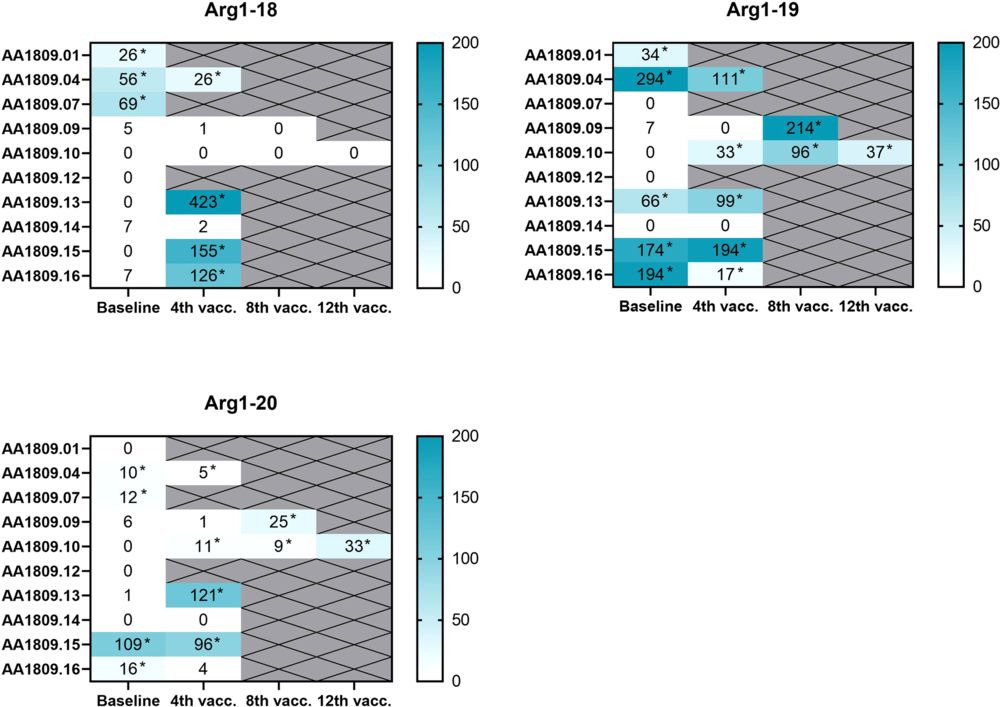
Fig.1 Heatmaps of ARG1-specific PBMC responses at baseline and during treatment measured by IFN-γ ELISPOT.1,4