MUC1 Cancer Vaccine Development & Multi-Platform Solutions
Creative Biolabs provides end-to-end preclinical development services for MUC1-targeted cancer vaccines, covering antigen design and epitope mapping, glycopeptide synthesis, dendritic cell loading, nucleic acid and viral vector construction, adjuvant screening, formulation optimization, in vitro immunogenicity testing, and in vivo efficacy evaluation. This solution is suitable for researchers developing therapeutic or prophylactic vaccines against MUC1-expressing adenocarcinomas, validating tumor-associated glycopeptide epitopes, optimizing carrier and adjuvant combinations, assessing MUC1-specific humoral and cellular responses, or evaluating combination strategies with immune checkpoint inhibitors. Our scientists can provide customized workflows, assay development, quality control, and integrated preclinical study packages tailored to your tumor indication, antigen format, and translational goals.
MUC1: A High-Priority Tumor-Associated Antigen for Vaccine Development
The Biology Behind MUC1 Immunogenicity
MUC1 is a transmembrane glycoprotein whose extracellular domain contains a variable number tandem repeat (VNTR) region composed of 20-amino-acid sequences (HGVTSAPDTRPAPGSTAPPA) that can be repeated 20 to 120 times. In healthy epithelial tissues, MUC1 is expressed at low levels on the apical surface of ductal epithelial cells, where heavy O-glycosylation shields the peptide core from immune recognition. On tumor cells, however, MUC1 becomes overexpressed, hypo-glycosylated, and redistributed across the entire cell surface, exposing the immunogenic VNTR peptide backbone and tumor-associated carbohydrate antigens such as Tn, T, and sialyl-Tn. This aberrant glycosylation generates novel glycopeptide epitopes that can be processed by antigen-presenting cells and presented via both MHC class I and II pathways, making MUC1 a target for approximately 80% of all adenocarcinoma cases.
Beyond serving as a tumor antigen, MUC1 actively contributes to drug resistance, apoptosis evasion, proliferation, angiogenesis, and metastasis. Immune-mediated reduction of MUC1 expression would therefore impair the tumor cell's ability to replicate, invade, and spread—making it a dual-function vaccine target.
- Core Preclinical Challenges We Address:
- Overcoming immune tolerance to this self-antigen in transgenic models.
- Selecting protective glycopeptide epitopes over immunodominant non-protective ones.
- Designing self-adjuvanting constructs that elicit both humoral and cellular immunity.
- Generating antibodies that distinguish tumor-associated from normal MUC1.
Native MUC1 vs. Tumor-Associated MUC1: Key Differences for Vaccine Design
| Feature | Native MUC1 (Healthy Cells) | Tumor-Associated MUC1 |
|---|---|---|
| Glycosylation | Heavily O-glycosylated; peptide core shielded. | Hypo-glycosylated; VNTR peptide core exposed. |
| Expression Level | Low, restricted to apical surface of ductal epithelia. | Overexpressed (>100-fold) across entire cell surface. |
| Carbohydrate Antigens | Complex oligosaccharides; Tn/T antigens masked. | Truncated Tn, T, and sialyl-Tn antigens exposed. |
| Immune Recognition | Peptide core hidden; low immunogenicity. | Novel glycopeptide epitopes elicit B- and T-cell responses. |
End-to-End MUC1 Vaccine Service Packages
Our preclinical services are structured into flexible, modular packages. We understand that every project is unique; therefore, all modules can be fully customized—from specific glycopeptide epitopes to unique delivery platforms—to align with your therapeutic goals and tumor indications.
Antigen Design & Epitope Mapping
Strategic identification of protective MUC1 epitopes to maximize tumor-specific immune recognition.
- VNTR Peptide Selection: Identification of immunodominant and protective epitopes within the tandem repeat region.
- Glycopeptide Design: Incorporation of tumor-associated carbohydrate antigens (Tn, T, sialyl-Tn) at key glycosylation sites.
- Epitope Screening: Peptide array profiling to distinguish protective from non-protective epitopes.
- Customized Path: Tailored antigen configurations for peptide, glycopeptide, or nucleic acid formats.
Peptide & Glycopeptide Synthesis
High-purity production of synthetic long peptides and glycopeptides using solid-phase chemistry.
- SLP Production: Multi-epitope synthetic long peptide pools spanning VNTR sequences.
- Glycopeptide Assembly: Chemoenzymatic synthesis with site-specific Tn/T antigen installation.
- Carrier Conjugation: Conjugation to protein carriers (KLH, CRM197) or nanoparticle scaffolds.
- Purity Validation: HPLC and mass spectrometry confirmation of product integrity.
Dendritic Cell-Based MUC1 Vaccines
Preparation of MUC1-loaded dendritic cells for potent antigen presentation and T-cell priming.
- DC Generation: Isolation and maturation of monocyte-derived DCs with optimized cytokine cocktails.
- Antigen Loading: Peptide pulsing, mRNA electroporation, or lentiviral transduction with MUC1 sequences.
- Phenotype QC: Flow cytometry verification of CD11c, CD80, CD83, CD86, and HLA-DR expression.
- Exosome Conjugation: DC-derived exosome conjugate preparation for alternative delivery.
Nucleic Acid Vaccine Construction
Design and assembly of DNA and mRNA vaccine constructs encoding MUC1 tandem repeat sequences.
- DNA Plasmids: Codon-optimized MUC1 VNTR constructs with leader sequences for enhanced expression.
- mRNA Synthesis: In vitro transcription with modified nucleosides for improved stability.
- Formulation: Lipid nanoparticle or lipoplex encapsulation for efficient delivery.
- Expression Validation: Western blot and immunofluorescence confirmation of MUC1 production.
Viral Vector Vaccine Development
Recombinant viral vectors carrying MUC1 sequences for sustained antigen expression and immune activation.
- Poxvirus Vectors: Construction of vaccinia and fowlpox vectors encoding MUC1 and co-stimulatory molecules.
- MVA-Based Constructs: Modified vaccinia Ankara strains delivering MUC1 with immunostimulatory cytokines.
- Adenoviral Platforms: Replication-deficient adenoviral vectors with MUC1 VNTR inserts.
- Titer & Potency: Viral titer quantification and in vitro expression confirmation.
Preclinical Efficacy Evaluation
Comprehensive assessment of vaccine-induced immune responses and antitumor activity.
- Humoral Assays: ELISA for anti-MUC1 IgG titers, antibody isotyping, and tumor cell binding by flow cytometry.
- Cellular Assays: ELISpot (IFN-γ), intracellular cytokine staining, and CTL killing assays.
- In Vivo POC: Tumor challenge and survival studies in MUC1 transgenic or syngeneic mouse models.
- Immune Profiling: TIL analysis, TCR repertoire sequencing, and cytokine multiplexing.
Streamlined MUC1 Vaccine Development Workflow
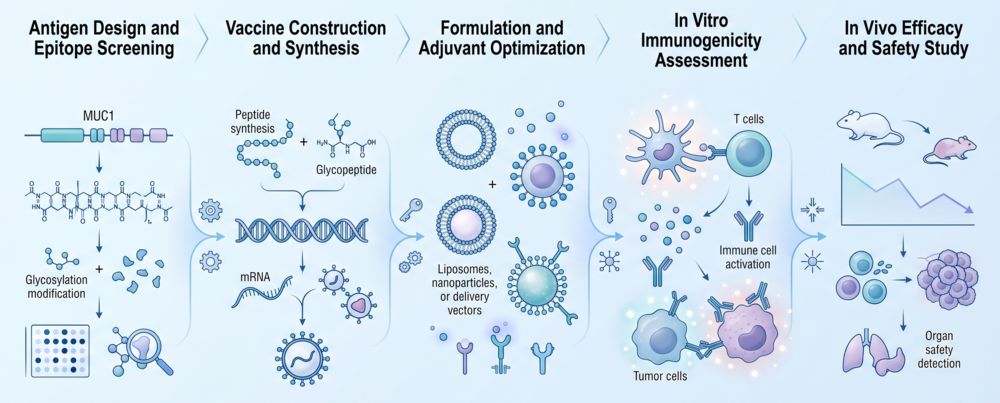
Phase 1 — Antigen Design & Epitope Selection
We begin by analyzing the MUC1 VNTR sequence to identify peptide and glycopeptide epitopes that preferentially target tumor-associated glycoforms. Peptide array profiling helps distinguish protective epitopes from immunodominant but non-protective sequences, ensuring the vaccine elicits antibodies capable of binding and killing tumor cells.
Enabling Technologies for MUC1 Vaccine Development
Why Choose Creative Biolabs?
Our scientists possess extensive knowledge of MUC1 glycosylation patterns, epitope immunogenicity, and tumor microenvironment interactions, enabling rational vaccine design grounded in molecular insight.
From glycopeptide conjugates to DC-based and viral vector platforms, we offer the full spectrum of MUC1 vaccine modalities, allowing platform selection tailored to your indication and mechanism of action.
Our peptide array screening and structure-guided design capabilities identify the most protective epitopes, avoiding immunodominant non-protective responses that can divert immunity.
From antigen design through in vivo efficacy, we provide end-to-end project management with rigorous quality control and transparent data reporting at every stage.
Research Insight: Multi-Platform MUC1 Vaccine Strategies in Preclinical Models
Key Findings from Recent Preclinical Studies
Recent studies highlight how combining MUC1 antigen with advanced delivery systems and immunostimulatory adjuvants can overcome the historical challenge of weak immunogenicity and immune tolerance associated with this self-antigen.
-
DNA Plus DC Combination: Co-administration of MUC1 DNA with bone marrow-derived dendritic cells significantly reduced colon tumor incidence, number, and size in MUC1 transgenic mice, whereas either component alone was ineffective—demonstrating the synergy of combined antigen delivery and professional APC activation.
-
Liposomal Adjuvant Enhancement: Cationic liposomes containing DDA and MPLA (TLR4 agonist) induced robust Th1-biased anti-MUC1 antibody responses. Antibodies from vaccinated mice efficiently recognized and killed MUC1-positive tumor cells through complement-mediated cytotoxicity.
-
TLR Co-Delivery in Tolerant Hosts: Co-encapsulation of MUC1 antigen with three TLR agonists (TLR4, TLR7/8, TLR9) in complement-binding liposomes significantly enhanced both antibody and T-cell responses in MUC1 transgenic mice, overcoming immune tolerance and eliminating sex-based response differences.
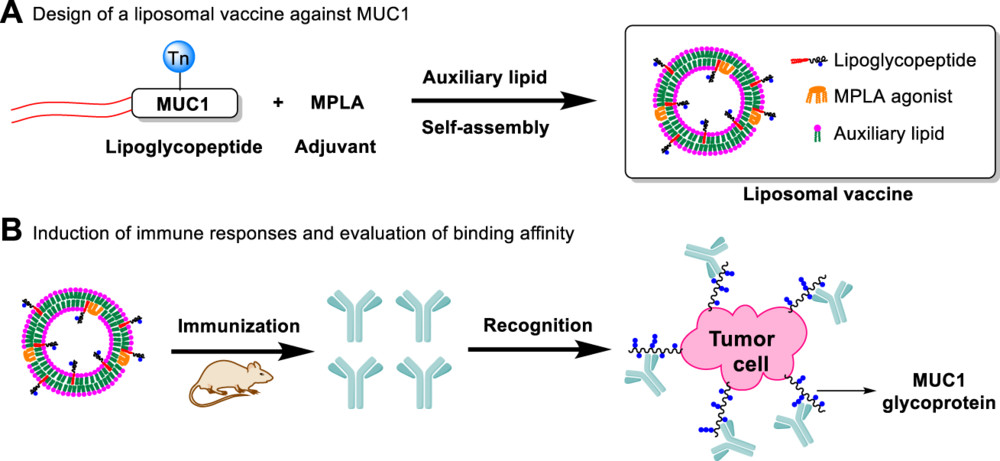
Fig.1 Design of a liposomal vaccine containing MUC1 lipoglycopeptides and MPLA adjuvant.2, 4