Preclinical Whole Inactivated Yeast-Based Vaccine Platform
Creative Biolabs delivers a specialized, end-to-end preclinical platform for the development of whole inactivated yeast-based T cell vaccines. Built on the unique biological properties of Saccharomyces cerevisiae as a particulate antigen delivery vehicle, our platform combines recombinant protein engineering with controlled heat-inactivation to produce intact, antigen-loaded yeast particles that are avidly phagocytosed by professional antigen-presenting cells (APCs). This particulate nature triggers efficient phagosomal processing and cross-presentation, funneling tumor-associated antigens into both MHC class I and class II pathways for robust CD8+ and CD4+ T cell priming. By integrating rational attenuation design, standardized quality assessments, and rigorous immunogenicity testing, our services are purpose-built to accelerate preclinical proof-of-concept for researchers developing T-cell-focused cancer immunotherapies.
The Particulate Yeast Advantage for T Cell Priming
Particulate Carrier-Driven Antigen Processing
Whole inactivated yeast particles (~3–5 µm diameter) are optimally sized for phagocytic uptake by dendritic cells and macrophages. Unlike soluble antigens that rely on fluid-phase pinocytosis, yeast particles engage multiple pattern-recognition receptors—including Dectin-1, TLR2, and TLR4—simultaneously delivering the antigen payload and a built-in maturation signal to APCs. The yeast cell wall β-glucan component engages Dectin-1/Syk signaling, driving phagosome maturation, ROS production, and efficient antigen cross-presentation through the vacuolar pathway. This dual function—antigen carrier plus innate adjuvant—makes heat-inactivated yeast a uniquely self-contained T cell vaccine platform requiring no exogenous adjuvants.
Particulate uptake through phagocytosis channels antigen into specialized cross-presentation compartments, achieving up to 10,000-fold greater efficiency in MHC class I presentation compared to pinocytosed soluble protein. This is the mechanistic basis for yeast's exceptional capacity to prime tumor-specific CD8+ cytotoxic T lymphocytes (CTLs).
- Core Preclinical Challenges We Address:
- Selecting the optimal yeast strain background and gene dosage for stable heterologous antigen expression.
- Establishing heat-inactivation parameters (temperature, duration) that preserve particulate integrity and antigen epitopes.
- Quantifying the efficiency of APC-mediated cross-presentation of yeast-delivered antigens in vitro.
- Evaluating functional CTL activity and memory T cell generation in vivo after yeast-based vaccination.
Why Whole Inactivated Yeast Outperforms Soluble Antigen Vaccines?
| Key Comparison | Soluble Antigen Vaccines | Whole Inactivated Yeast Vaccines |
|---|---|---|
| Antigen Uptake Mechanism | Fluid-phase pinocytosis; low efficiency and surface display. | Receptor-mediated phagocytosis; optimal particle size (~3–5 µm). |
| Cross-Presentation Efficiency | Minimal MHC-I loading; predominantly MHC-II restricted. | ~10,000-fold enhanced cross-presentation via vacuolar pathway. |
| Built-in Adjuvant Activity | Requires co-formulation with exogenous adjuvant. | β-glucan/Dectin-1/Syk drives intrinsic APC maturation signal. |
| Manufacturing Scalability | Complex purification; often cold-chain dependent. | High-density fermentation; lyophilizable for ambient storage. |
End-to-End Whole Inactivated Yeast T Cell Vaccine Services
Our preclinical services follow a modular structure built around the unique biological properties of particulate yeast carriers. Each module addresses a critical checkpoint in the development pipeline—from antigen cassette design through inactivation and T cell readout—and all modules can be independently selected or combined to match the scope and stage of your project.
Antigen Selection & Cassette Engineering
Strategic selection of tumor antigens and vector design optimized for yeast intracellular expression and downstream T cell presentation.
- Antigen Prioritization: Evaluation of tumor-associated antigens (CEA, MUC1, HPV-E7) or patient-specific neoantigens for yeast compatibility.
- Plasmid Architecture: Custom episomal or integrative vectors with constitutive (GPD, TEF1) or inducible (GAL1) promoters.
- Codon Optimization: Codon adaptation for S. cerevisiae translational machinery to maximize antigen yield per cell.
- Fusion Strategy: Evaluation of antigen fusions (ubiquitin, LAMP-1) to direct proteasomal processing and cross-presentation.
Recombinant Yeast Strain Construction
Generation of stable haploid S. cerevisiae clones expressing heterologous tumor antigens at high and reproducible levels.
- Strain Selection: Evaluation of laboratory (S288C, W303) and industrial yeast strains for vaccine-grade performance.
- Transformation & Selection: High-efficiency chemical or electroporation transformation with auxotrophic or antibiotic-resistance markers.
- Clonal Screening: Multi-round screening of antigen expression level, growth rate, and genetic stability.
- Copy Number Control: Chromosomal integration strategies (rDNA locus, δ-sequences) for tunable, stable antigen gene dosage.
Fermentation & Heat-Inactivation Process
Scalable high-density fermentation with controlled heat-inactivation that preserves particle structure and antigen epitopes.
- High-Density Culture: Fed-batch fermentation in defined synthetic medium for reproducible biomass yields and consistent antigen content.
- Harvest & Wash: Multi-step centrifugation and buffer exchange to remove medium components and metabolic byproducts.
- Heat-Inactivation: Controlled treatment at 56 °C in phosphate-buffered saline for precisely 1 hour to eliminate replicative capacity.
- Quality Gate: Confirmation of complete inactivation via colony-forming unit (CFU) assay on rich agar plates.
Biophysical & Functional Characterization
Comprehensive characterization of inactivated yeast particles for particle integrity, antigen content, and APC activation potency.
- Particle Analysis: Flow cytometry and microscopy for size distribution, aggregation state, and morphological integrity.
- Antigen Quantification: Immunoblotting and ELISA for heterologous antigen content per particle and per dose.
- Wall Integrity: Calcofluor white staining for chitin, aniline blue for β-glucan accessibility, and zymolyase sensitivity assays.
- Batch Consistency: Multi-parameter quality metrics establishing lot-to-lot reproducibility.
APC Activation & T Cell Priming Assays
Functional assessment of yeast particle uptake, APC maturation, and antigen-specific T cell priming in controlled in vitro systems.
- Phagocytosis Assay: Fluorescently labeled yeast particle uptake kinetics in bone marrow-derived dendritic cells (BMDCs).
- DC Maturation Panel: Flow cytometry for MHC-II, CD80, CD86, and CD40 upregulation after yeast feeding.
- Cross-Presentation: B3Z T cell hybridoma assay or OT-I/OT-II transgenic readout for MHC-I/MHC-II antigen presentation.
- Cytokine Profiling: Multiplex ELISA for IL-12p70, TNF-α, IL-6, and IL-10 secretion by yeast-stimulated APCs.
In Vivo Immunogenicity & Efficacy Studies
Comprehensive preclinical evaluation of yeast vaccine-induced T cell responses and antitumor activity in relevant animal models.
- Immunogenicity: ELISpot (IFN-γ), intracellular cytokine staining, and tetramer staining for antigen-specific CTL quantification.
- Tumor Challenge: Prophylactic and therapeutic vaccination in syngeneic models (B16-OVA, CT26, TC-1).
- Treg Monitoring: FoxP3+ Treg enumeration and functional suppression assays to assess vaccine-induced Treg modulation.
- Memory Response: Longitudinal CD44/CD62L phenotyping and recall challenge to evaluate T cell memory durability.
Preclinical Yeast T Cell Vaccine Development Workflow
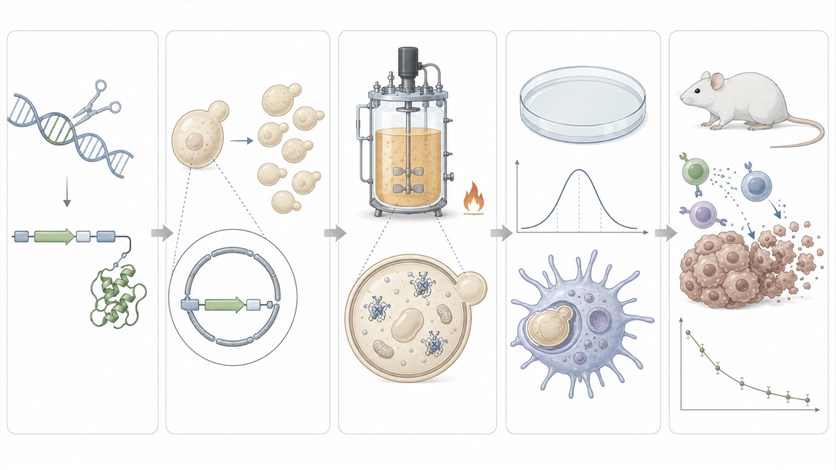
Phase 1 — Antigen Cassette Design & Codon Optimization
We begin by selecting target tumor antigens and designing expression cassettes optimized for S. cerevisiae. Codon usage is adapted to yeast translational preferences, and antigen fusions—such as ubiquitin targeting—are evaluated to channel the translated polypeptide into the proteasomal degradation pathway, enhancing the pool of MHC-I-compatible peptides available for cross-presentation after heat-inactivation and phagocytic uptake.
Enabling Technologies for Whole Inactivated Yeast Vaccines
Why Choose Creative Biolabs?
Our team brings extensive knowledge of the Dectin-1/TLR crosstalk, phagosome biology, and cross-presentation pathways that underpin yeast-based T cell priming.
We customize codon optimization, fusion strategy, and chromosomal integration for each tumor antigen to maximize processing and presentation.
Our validated 56 °C/1-hour heat-inactivation protocol is supported by rigorous biophysical and functional release testing for batch consistency.
We provide integrated in vitro to in vivo T cell analysis, from phagocytosis and cross-presentation through tumor challenge and memory profiling.
Research Insight: Yeast Particulate Carriers Drive Potent T Cell Immunity
Key Preclinical Findings on Yeast-Based T Cell Vaccination
Accumulating evidence positions whole inactivated yeast as a uniquely effective particulate carrier for driving tumor-specific T cell responses. The combination of optimal phagocytic size, intrinsic β-glucan/Dectin-1 adjuvant signaling, and the capacity for stable heterologous antigen expression creates a self-contained vaccine particle that efficiently primes both CD4+ and CD8+ T cells.
-
Particulate Cross-Presentation Advantage: Standardization studies of whole yeast vaccines have documented that optimized heat-inactivation parameters preserve antigen integrity while the particulate nature channels antigen into cross-presentation pathways with substantially higher MHC-I loading efficiency than soluble controls.1
-
Yeast-Derived Nanoparticle TME Remodeling: Yeast cell wall-derived nanoparticles engage Dectin-1/Syk signaling in intratumoral myeloid cells, reprogramming the immunosuppressive tumor microenvironment and achieving synergistic tumor control when combined with immune checkpoint blockade.2
-
Broad Platform Applicability: Recombinant yeast technology supports expression of diverse heterologous antigens—from infectious disease targets to cancer neoantigens—and the modular engineering workflow is readily adaptable to different antigen classes and tumor indications.3
-
β-Glucan Trained Immunity in Myeloid Cells: Yeast-derived β-glucan particles trigger metabolic reprogramming in macrophages and dendritic cells, inducing a trained immunity phenotype characterized by enhanced pro-inflammatory cytokine production and improved antitumor NK cell activity.4
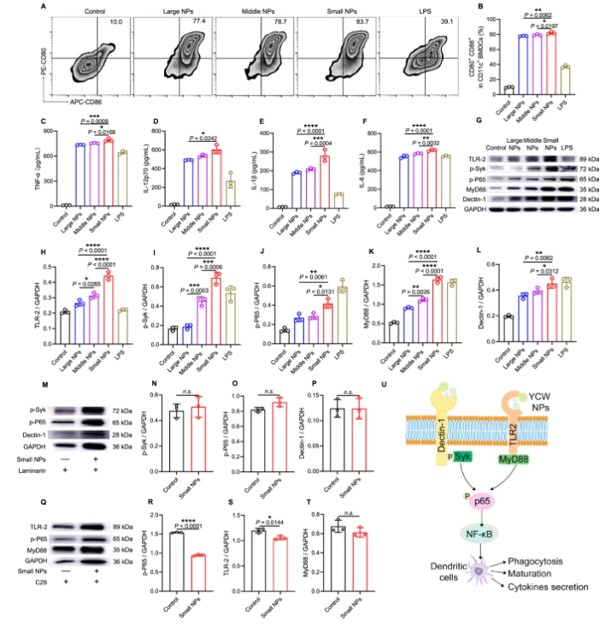
Fig.1 YCW NP-induced dendritic cell activation and underlying mechanisms.2,4